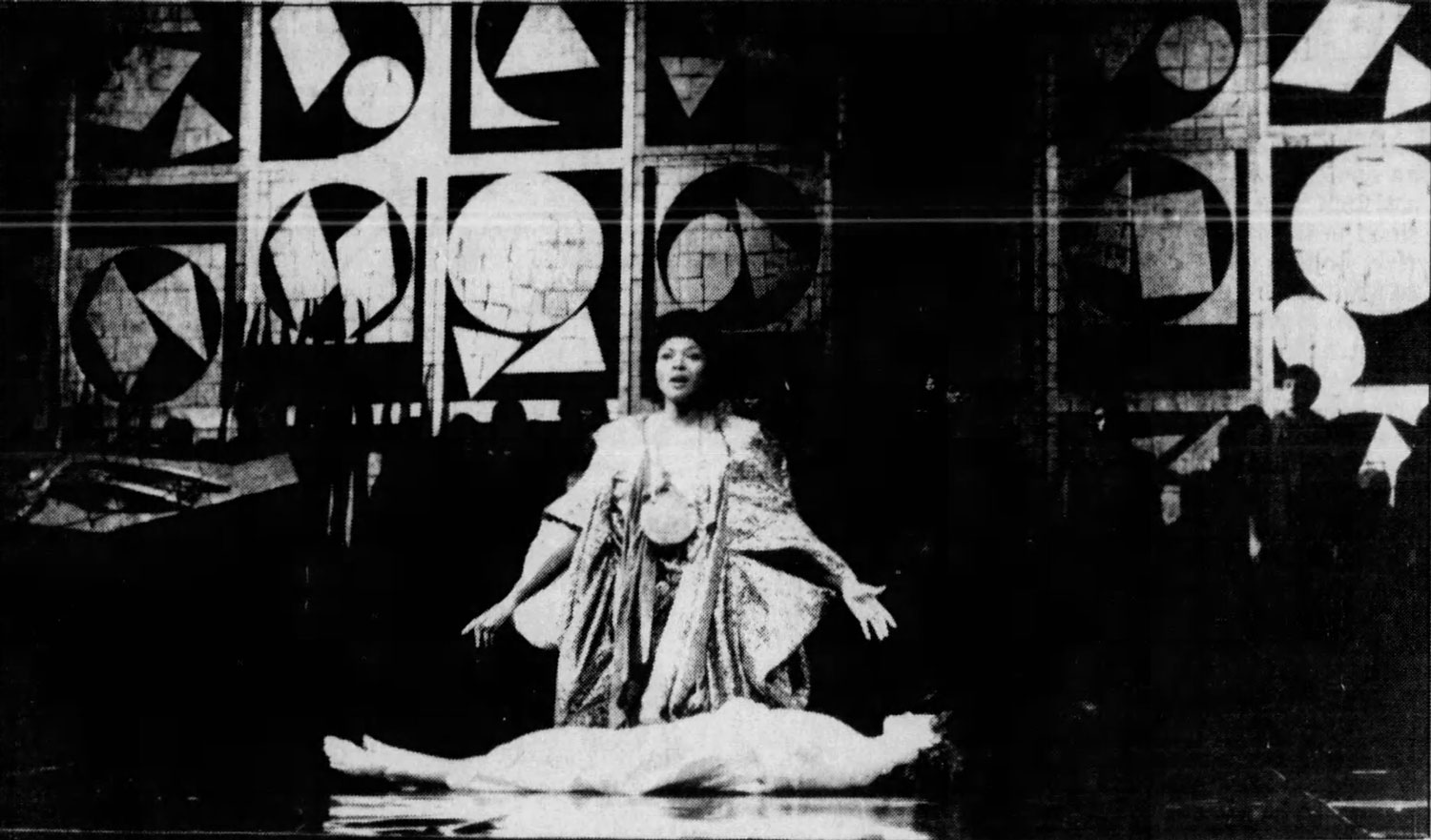
Alteouise Devaughn as Orfeo, with beautiful sets and costumes by Louise Nevelson, from an Opera Theater St. Louis production that took place in early June, 1984. This photo ran in the Post-Dispatch originally, and I apologize to whoever holds the copyright and will take it down if need be (although I hope not, because I didn’t take photos and do not have a time machine).
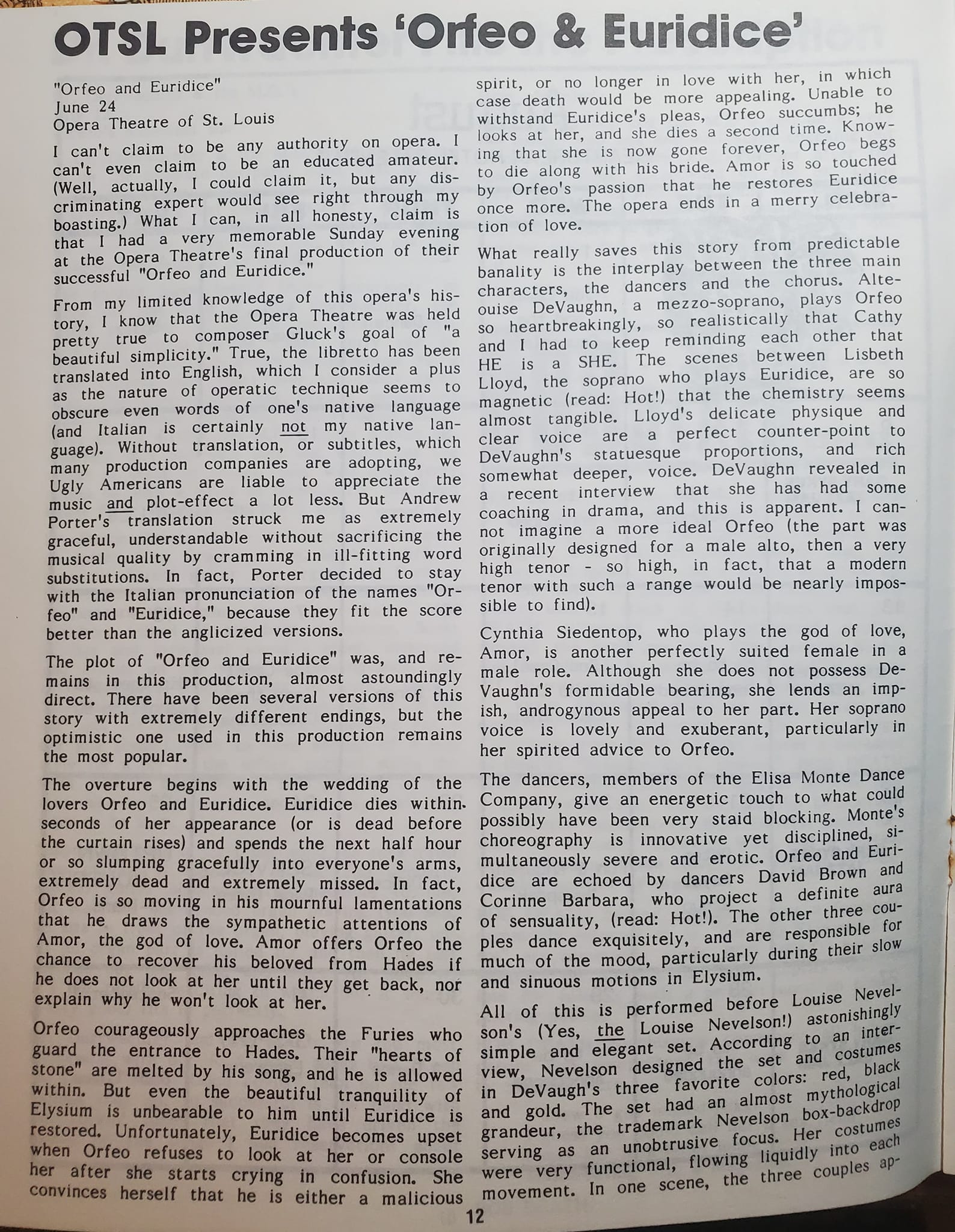
My friend Greg Kessler, who runs and holds the copyright to the invaluable blog St. Louis Punk Archive and its associated Facebook page, was kind enough to scan what I believe is my first foray into writing about what is loosely called classical music (in this case, though, Baroque opera). I won’t lie: rereading this piece after many years–written by a (very) recent high school graduate–it does make me cringe in a few places. I could probably do a lot better now–I hope so, anyway!–but mostly I am just moved by the knowledge that the punk rock fanzine Jet Lag, to which most of my closest friends regularly contributed, scored comp tickets to this fancy-ass Gluck opera–with set and costume designs by Louise Nevelson (!!!), a BFD that even my callow teenage self recognized as such, well, that is just a delightful snapshot of what St. Louis arts culture was like in the mid-80s: “Hey, we have some extra tickets to this opera; maybe we should offer them to the punk rock fanzine people, why not?” And then my editors probably thought, “oh, why not let the girl who last wrote about The Time and Black Flag cover it?” (I’m kidding. We were all good friends by that point, so they knew I had “facets.”)
I also think it’s cool that I went with my friend Cat Pick, whose name then was Cathy Renner. She has her own Substack now, as does her husband and our Jet Lag editor, the first person to recruit me to write for publication, Steve Pick. I urge you to check out both Substacks. If I could remember how to edit or augment my website’s blogroll, I would, but that’s a project for another day.
Another fun local fact that might make me seem hyperprovincial (or more so, that is): my friend Patty Kofron, whom I quoted most recently in my Verdi Requiem notes, was singing in the chorus for that production I saw. I didn’t know her at the time, and it never occurred to me to think in my first exposure to Gluck’s Orfeo ed Euridice that 40 years later I’d be friends with someone who was singing that night. Time, the mindfuck revelator!
I suppose I’ll tag this as juvenilia. I’ll add for benefit of younger readers, who don’t remember how regular people published stuff before the Internet, the convention was to underline or capitalize type that would get italicized today. Sometimes we would go in and draw diacritical marks. That’s why I never got too fussy about the acute accent over the second e in my first name. For years I simply didn’t have the option (on my birth certificate, I think someone typed in an apostrophe or something). And the reason this byline has the surname Spencer instead of Saller is that I had not yet married. Although in a strange coincidence that also suggests hyperprovinciality, I did meet my husband a few months later, in a poetry class at Webster University. We did not start dating until the mid-90s, however.
I wrote about Giuseppe Verdi’s monumental Requiem for the Dallas Symphony Orchestra back in November, and it seems that I never posted my notes for this stunning performance. Either that or the WordPress searchbots are lying to me, and I’m experiencing short-term memory loss, both possibilities I would prefer not to contemplate.
At any rate, here are the notes I wrote, which can also be found on the DSO website, if you click around and expand some menus and so forth. Or you could just read them here.
Verdi’s Requiem
by René Spencer Saller
Giuseppe Verdi (1813–1901): Messa da Requiem
I asked a friend, Patty Kofron, a versatile mezzo-soprano who has sung Giuseppe Verdi’s Requiem several times, to describe the experience from the performer’s perspective. “I don’t know if I can express how much more it is than the complexity of the double choruses, or the beauty and terror of the music,” she said. “When I sing the ‘Libera me,’ I feel like I am personally begging God to spare me from eternal damnation… and I’m not even religious. It’s the most powerful thing I’ve ever sung or will ever sing. As much as I love the Brahms, Fauré, Mozart, and other requiems, the Verdi puts my own mortality and my maker right in my face.”
You don’t need to be singing to feel a similar rush. You don’t even need to believe in God. Despite its obvious Judeo-Christian framework, its churchy fugues, and its incense-steeped Latin trappings, this Requiem deals more with the secular than the sacred. For long, delectable stretches, if you tune out the Latin text and simply let the melodies wash over you unmediated, you might convince yourself that you’re listening to a love duet or an arietta, perhaps a quartet backed by large chorus or some showstopper from one of his recent operas. Indeed, Verdi finished Aida, a commission to honor the Suez Canal, in 1871, a few years before the first performance of the Requiem; the two scores share a similar intensity, a dark grandeur bleeding into raw emotion.
No wonder the Requiem appeals to the nonreligious: Verdi himself was often accused of agnosticism. His second wife, Giuseppina Strepponi, described the composer’s spiritual outlook as a matter of temperament: “Everyone agrees that …he’s the soul of honesty, he understands and feels every noble and delicate sentiment; yet for all that, [he] allows himself to be, I won’t say an atheist, but certainly not much of a believer, and all with a calm obstinance that makes you want to thrash him.”
Everyone who loves Verdi’s Requiem has a favorite part. The concluding “Libera me” gets most of the attention, and deservedly so, but highlights abound. Sometimes it’s the glittering majesty of the “Sanctus” that satiates my brain’s pleasure centers; sometimes it’s the intimate, chamber-music bliss of the “Lux aeterna.” But the Requiem is more than the sum of its parts, and most of its power is cumulative. When the unstoppable “Dies irae” theme returns, it hits us like a sucker punch: we can’t escape our certain deaths. All we can do, awaiting judgment, is express our all too human selves.
Verdi does more than resurrect the Requiem form: he re-humanizes it, bringing the drama back to individual sinners with enormous needs: for grace, for redemption, for eternal peace, or at least an escape from hellish torment. The singers are relatable in the same way that opera heroes and heroines are relatable: larger than life but fatally flawed.
Late-Life Superachiever
Over a six-decade career, Verdi wrote 28 operas, easily half of them masterpieces. He produced many of his greatest works when he was in his 70s, at a time when 60 was considered old. He was still at the peak of his powers when he died, on January 27, 1901, a few days after suffering a massive stroke. To this day his funeral ranks as the largest public assembly ever recorded in Italy.
Beyond his genius for indelible melodies, Verdi was a master dramatist. A devotee of Shakespeare, Schiller, Byron, and Voltaire, he read widely and deeply, always on the hunt for the next opera plot. He worked closely with his librettists to ensure minimal flab and maximal feeling. In the world according to Verdi, rage and terror rule, desire redeems and destroys, and the tenor loves bravely forever.
He was born in Le Roncole (now known as Roncole Verdi), in a rural area then under the control of France. Although he liked to call himself a peasant, his parents were innkeepers, with enough disposable income to pay for his private organ lessons at age four. During his adolescence he lived in Busseto with a patron’s family, growing close to the patron’s daughter, his music pupil. After he failed the entrance examination for the Milan Conservatory, his wealthy future father-in-law paid for three years of private composition lessons.
In 1836, two months after Verdi was appointed director of Busseto’s Philharmonic Society, he married Margherita Barezzi, his patron’s daughter. They had two children, both of whom died as babies. In 1840, a year after the successful premiere of his first opera, Oberto, Verdi’s 26-year-old wife suddenly died, probably from encephalitis. His next effort, a comedy, was a flop, and he considered giving up. But in 1842, Nabucco, his third opera, became the first in a long series of overlapping hits, launching the 29-year-old composer’s international career and securing his fame.
It was during rehearsals for Nabucco that Verdi met his second wife: the soprano Giuseppina Strepponi, who stepped into the role of Abigaille at the last minute and saved the production. Verdi and Strepponi invited scandal by living together “in sin” (technically, in Paris, Busseto, and finally an estate in Sant’Agata, in his ancestral Parmesan countryside). They married in secret in 1859, and the union lasted until her death, in 1897; Verdi died a few years later.
At his funeral, thousands of mourners lined the streets while Arturo Toscanini conducted a 900-voice choir in the “Va, pensiero” chorus from Nabucco. Although Verdi was first buried in the Cimitero Monumentale, in Milan, his remains were relocated to the crypt of the Casa di Riposo per Musicisti, a retirement home for musicians that Verdi had founded.
Roots of the Requiem
In 1868, soon after the death of Gioachino Rossini, whom he revered, Verdi pitched a kind of compilation Requiem in honor of the late composer to his publisher, Tito Ricordi, with the various parts supplied by himself and a dozen of Italy’s other leading composers. Verdi composed the final “Libera me.” The memorial mass was not performed in 1869, as originally scheduled, the first anniversary of Rossini’s death. The complete compilation version of the work wasn’t debuted until 1988.
In 1873, at Verdi’s request, Ricordi returned the “Libera me” score, around the same time that the Italian novelist and poet Allesandro Manzoni died. Verdi’s grief over the loss of Manzoni, a hero of the Risorgimento (the 19th-century Italian unification movement), likely compounded the grief he felt for Rossini. Whatever the source of these strong emotions, Verdi sought expression in the elegiac: he decided to complete the remaining movements of the Requiem—everything save “Libera me,” which he revised significantly. He spent the summer of 1873 composing, or reverse-engineering, a complete Requiem. He believed in the project so strongly that he spent his own money printing the sheet music for the first performance, which he conducted, at the Church of San Marco, in Milan, on May 22, 1874.
Verdi’s Requiem translates the ancient Latin mass for the dead into the vernacular of Italian opera. Ferocious and crude as a gut punch, tender and transcendent as a kiss, Verdi’s Requiem revels in the dramatic, or at least doesn’t refute the charge lobbed by the conductor Hans von Bülow, who dismissed Verdi’s Requiem as “his latest opera, in ecclesiastical vestments.”
Johannes Brahms, Bülow’s close ally and associate, disagreed. “Bülow has made an almighty fool of himself,” Brahms said after taking in Verdi’s Requiem. “Only a genius could have written such a work.”
Verdi, for his part, tried to distinguish his Requiem from his previous works for the stage. “One mustn’t sing this Mass in the way one sings an opera,” he explained, “and therefore phrasing and dynamics that may be fine in the theater won’t satisfy me at all, not at all.”
Theatricality aside, Verdi taps into the divine by way of the carnal. All the best evangelists understand the link between the loins and the great hereafter. As for theological matters, he was an agnostic and loath to get too preachy. Maybe that’s why his lead quartet often sounds like pairs of lovers singing to other lovers. He understood divine mercy through his art, those melodies that sear our souls like sudden truths.
In Memory of Two Great Men
Verdi’s “Libera me” was originally written to honor Gioachino Rossini (1792–1868), the composer Verdi once called “a glory of Italy.” Verdi called Manzoni’s 1827 novel I promessi sposi (The Betrothed) “not only the greatest book of our epoch, but one of the greatest ever to emerge from a human brain.” He called Manzoni himself a “saint.”
Later, when Manzoni died at age 88—coincidentally, the same age at which Verdi himself would die almost 30 years later—he remembered his contribution to the compilation Requiem and realized that he could build upon this promising foundation.
On June 3, 1873, Verdi wrote to Ricordi of his plans: “I too would like to demonstrate what affection and veneration I bore and bear to that Great Man who is no more, and whom Milan has so worthily honored. I would like to set to music a Mass for the Dead to be performed next year on the anniversary of his death. The Mass would have rather vast dimensions, and besides a large orchestra and a large chorus, it would also require… four or five principal singers…. I would have the copying of the music done at my expense, and I myself would conduct the performance both at the rehearsals and in church.”
Verdi asked Ricordi to obtain permission from the mayor of Milan. After the project was approved, Verdi got to work. By using the music that he had written for the earlier compilation Requiem, he would need only about an hour’s worth of additional music to frame and complete it. He composed the settings for a multipart “Dies irae” and other sacred texts, and finished it on April 10, 1874. He printed the score at his own expense, as promised, and conducted the first performance in Milan on May 22, one year after Manzoni’s death. Verdi’s original title: “Requiem Mass for the anniversary of the death of Manzoni, 22 May 1874.”
Varieties of Requiem
Technically speaking, a Requiem refers to a musical setting of the Latin Mass for the Dead. Sometime after 1450 and possibly as late as 1470, the Franco-Flemish composer-turned-priest Johannes Ockeghem wrote an early, incomplete polyphonic rendition, minus the Sanctus, Agnus Dei, and Communion. Many significant Requiem settings followed, from the 15th century onward, including Mozart’s iconic unfinished composition from the months, indeed hours, leading up to his death in 1791. Closer to Verdi’s time, Luigi Cherubini composed a stellar pair (1816 and 1836), and Hector Berlioz contributed another even more famous one, sometimes called the Grande Messe des morts (Great Mass of the Dead; 1837). Verdi would have been familiar with all those composers’ works, although his own Requiem was less rooted in the liturgical.
Verdi responded to the Latin text by locating its emotional core, the dramatic significance of each singer’s moral confession. He offers no comforting lies, no confident speculation. Let other composers traffic in the theological; Verdi’s heart is with the human: the soprano, pleading in terror for her salvation, sinful but shining, shining. The tenor, the mezzo, the bass-baritone: all kissed by the holy, implicated and yet innocent.
A Closer Listen
I. In the opening movement, an appeal on the behalf of the recently departed for a peaceful rest, the chorus sings from the perspective of the mourners. Prefaced by austere low strings, the singers begin with the standard lines “Requiem aeternam dona eis, Domine” (Grant them eternal rest, O Lord), which the chorus and orchestra intone with a hushed gravitas. Verdi translates the Lord’s promise of endless light into the luminous language of late Romanticism, turning a grief-laden hymn into an operatic anthem. The four solo singers join the chorus and orchestra for a jubilant “Kyrie eleison” (Lord have mercy).
II. The doomy and demonic second movement, the nine-part “Dies irae” (Day of Wrath), slashes and burns through a terrifying series of scenarios wherein the sinners individually confront their wretched souls. What awaits us after death? Eternal perdition or a joy so perfect that the most celestial fugue can only approximate it? The singers roar, wail, whisper, shriek, and hiss; the orchestra invests each scene with the appropriate mood and color.
The “Dies irae” is based on a poem about Judgment Day commonly attributed to Thomas of Celano, a 13th-century Franciscan monk. In his setting of the ancient text, Verdi squires us through all the stages of grief. Against punishing bass drum and shrieking piccolo, and preceded by apocalyptic brass fanfares, the choristers describe the day that fire consumes the world. Verdi’s melodies do 90 percent of the persuasion, and his Technicolor scoring does the rest. Only a robot could resist the “Recordare,” in which the soprano and the mezzo-soprano sing a lustrous Mozartian rhapsody. Other highlights include the godlike trumpet fanfare of the chorus-driven “Tuba mirum”; the sensuous grip of “Liber scriptus”; the delicate, wind-driven pastorale of “Quid sum miser”; and the pathos-drenched “Lacrymoso,” for solo quartet and chorus, the sinner’s tearful plea for salvation.
III. The solo quartet sings the “Offertorium,” a light-rinsed, lullaby-like testament to the creator’s tender mercies. Here the four singers describe the holy radiance that God promises to bestow on Abraham and his descendants.
IV. The “Sanctus,” a resplendent double fugue for two choruses, is sung from the angelic perspective: divinity casting a fond downward glance at the suffering humans. The angels’ joy seems almost explosive, in contrast to the anguish of the human characters: “Holy, holy, holy, Lord of Hosts! Heaven and earth are filled with your glory!”
V. Against spare orchestral accompaniment, the chorus, the soprano, and then the mezzo-soprano sing the “Agnus Dei”: “Lamb of God, who takes away the sins of the world, grant them rest.”
VI. Sometimes a cappella and sometimes accompanied by shimmering strings and delicate winds, the mezzo-soprano, tenor, and bass deliver the luminous prayer “Lux aeterna” (Light eternal). The violins are divided into six parts to enhance the celestial effect.
VII. The soprano returns, with chorus, for the transcendent “Libera me,” which redirects our attention to the singular terrified sinner. On one level, you can appreciate the final movement as an aria, a gracefully emotive outpouring of bel canto splendor. At its climactic midpoint, the soprano’s high C rips through the chorus to remind us of her individual suffering. The chorus responds, a soothing balm made of light. A wild fugue develops, jagged with accidentals, propelled past terror into panic. Is the sinner consoled or even redeemed by this onslaught of beauty, or simply distracted from the potential terrors of the afterlife? Did she do enough—will we have done enough?—to atone?
Verdi respects us too much to speak for a God he wasn’t entirely sure even existed. He puts his faith in our collective capacity to figure it out for ourselves. The Requiem ends with the soprano and chorus crooning so softly that they might as well be whispering, “Libera me”: Deliver me.
Gustav Mahler was born on July 7, 1860 (happy belated birthday, G!), which made me think I might as well post some notes I wrote a few years back for the Dallas Symphony and Das Lied von der Erde, in chamber reduction. (I have written about the full orchestral version, too, I’m pretty sure, but I think both versions of the work are fascinating and urge you to listen to both, if you haven’t already.) I’m pretty sure I have never posted them before, but if I’m repeating myself, please take it up with the subscriptions department, which will reimburse you in full.
If you’d like to listen to a lovely performance that’s readily available on YouTube, I recommend this performance by Cantata Profana, from 2018:
In 1907, about a year before he started writing Das Lied von der Erde (The Song of the Earth), Gustav Mahler (1860–1911) endured three brutal losses. First, through no fault of his own, he was forced out of his longtime position as conductor of the Vienna Court Opera. Next, his cherished four-year-old daughter died from scarlet fever. Then his physician told him that he had a fatal heart condition. Frightened and grieving, Mahler confronted his mortality crisis by working harder than ever. Despite being warned by his doctor to get more rest, he wouldn’t—or couldn’t—slow down.
In July of 1908, he wrote to Bruno Walter, who would conduct the posthumous premiere in Munich, not quite six months after the composer’s death:
“If I am to find my way back to myself, I have got to accept the horrors of loneliness, since you do not know what has gone on and is going on within me. It is, assuredly, no hypochondriac fear of death, as you suppose. I have long known that I have got to die…. Without trying to explain or describe something for which there probably are no words, I simply say that with a single fell stroke I have lost any calm and peace of mind I ever achieved. I stand vis-à-vis de rien [face-to-face with nothingness], and now, at the end of my life, have to begin to learn to walk and stand.”
Two months later, he wrote another, less morbid letter to the conductor. “I have been hard at work,” he reported. “I do not know what the whole thing should be called. I have been granted a time that was good, and I think it is the most personal thing that I have done so far.”
Unsure how to classify Das Lied von der Erde, Mahler finally settled on “a symphony for tenor and alto (or baritone) and orchestra.” Nominally a song cycle, with alternating movements for two singers—usually, but not always, male and female—the composition was originally scored for a large orchestra, although Mahler’s many small instrumental groupings often suggest the intimacy and expressive clarity of chamber music. He indicated that a tenor should sing movements 1, 3, and 5, and assigned the remaining three, including the sprawling sixth, to either a contralto or a baritone. (In most cases, a contralto is chosen.)
Schoenberg/Riehn Arrangement
Thanks to Mahler’s gossamer textures, the score for Das Lied von der Erde lends itself to a chamber-music reduction. In 1921 the largely self-taught Austrian composer Arnold Schoenberg (1874–1951) began an arrangement for a small (14-instrument) ensemble. Schoenberg never meant for the arrangement to be published or performed publicly. He created it mostly for educational purposes, under the auspices of The Society for Private Musical Performance, which he and his musical disciples Alban Berg and Anton Webern had co-founded in Vienna in 1919.
The goal of the Society—which denied entry to music critics and forbade applause during or after performances—was to promote new and underperformed music by contemporary composers such as Stravinsky, Debussy, and Bartók. Over its roughly three-year existence, the Society staged more than 100 performances. Each piece on the program was performed twice in a single evening to help subscribers absorb and appreciate what were likely to be totally unfamiliar works. Owing to financial constraints and other practical considerations, many scores (such as Mahler’s) were stripped down to more economical arrangements for piano or chamber ensemble.
Schoenberg arranged Das Lied von der Erde for string quintet (standard quartet, plus double bass), wind quintet, bassoon, horn, piano, harmonium, and percussion (glockenspiel, cymbals, tam-tam, tambourine, small and large drum). By the time the Society folded in 1922, he had abandoned the project, after orchestrating only the first song. For the remaining songs, he left extensive notes, which, in 1983, decades after his death in 1951, the German composer, conductor, and musicologist Rainer Riehn (1941–2015) used to finish the score. Making a slight adjustment to Schoenberg’s instrumentation, Riehn added a part for celesta in “Der Abschied.”
Instead of the lustrous orchestration of Mahler’s original, the Schoenberg/Riehn arrangement calls for solo instrumentalists to accompany the singer, with a single violin or cello standing in for Mahler’s massed strings. Comparing Mahler’s original orchestral score to a painting, Riehn called the chamber arrangement a woodcut rendition.
Song by Song
The lyrics are based on texts from Die chinescische Flöte (The Chinese Flute), a collection of ancient Chinese poems translated into German by Hans Bethge. Mahler chose poems by Li Tai-Po, Mong Kao-Yen, Wang Wei, and Tchan Tsi, but adapted the lines as needed, sometimes augmenting them with his own words. All six songs touch on the brevity of life and the certainty of death.
The first song, “Das Trinklied von Jammer der Erde” (The Drinking Song of the Earth’s Sorrow), seems at first like a jovial tribute to the analgesic properties of alcohol, but each of the three stanzas ends with the same ominous refrain: “Dark is life, and so is death.” Mahler raises the pitch of this line with every repetition, ramping up the emotional tension.
Next, in the delicately scored “Der Einsame in Herbst” (The Solitary One in Autumn), a seamstress laments her loneliness over a long, sleepless night: “Sun of love, will you never shine again/To dry my bitter tears?” A spectral oboe and spare, shuddering strings intensify the autumnal flavor.
The third and briefest song, “Von der Jugend” (Of Youth), describes a gaggle of pretty young things under a porcelain pavilion. Pentatonic patterns and Asian-inspired percussion set the scene while darting woodwinds mimic the partygoers’ passing remarks.
In “Von der Schönheit” (Beauty), the singer depicts a group of maidens gathering lotus blossoms by a riverbank. The loveliest one gazes longingly at a young man, who doesn’t notice her. Despite the sad lyrics, the music is sprightly, buoyed by frisky winds, pizzicato strings, and dotted rhythms.
In the fifth song, “Der Trunkene im Frühling” (The Drunkard in Spring), the booze-fueled male protagonist tries in vain to obliterate his thoughts while birds twitter mindlessly in the background: “What does spring matter to me?” he concludes. “Let me be drunk!”
A sinuous, sorrowful solo oboe glides over swaying strings and pulsing rhythms in the half-hour-long finale, “Der Abschied” (The Farewell). “I shall no longer seek the far horizon,” the singer declares. “My heart is still….” Mahler combined two poems by different authors, punctuated by a magnificent orchestral death march. He marked the end Gäzlich esterbend (completely dying away), and added his own words as conclusion: “Everywhere and forever the luminous blue of the horizon… Forever… forever…” That last word, ewig, summoned from the depths of the contralto’s register, is repeated nine times as the music melts into radiant silence.
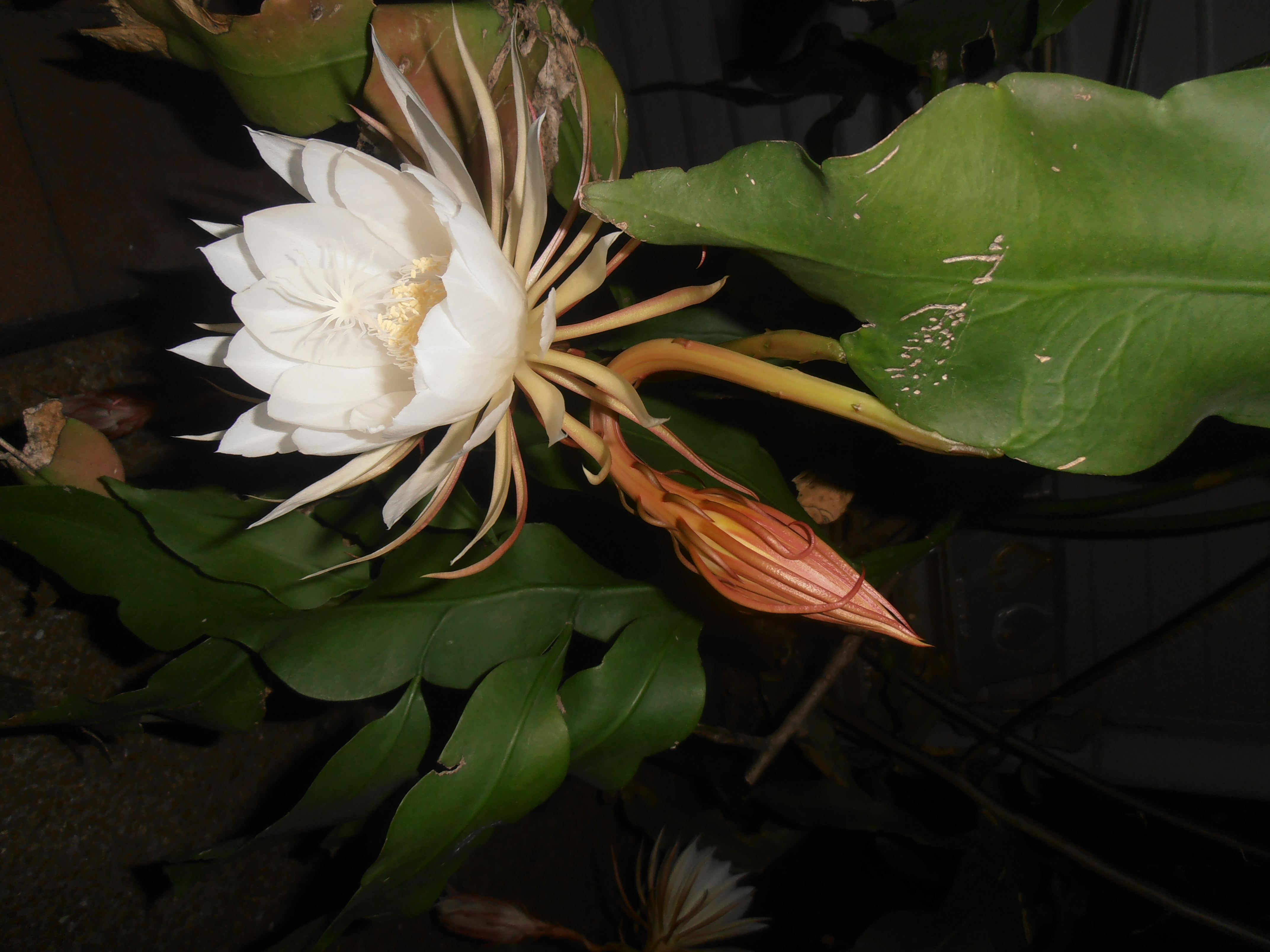
One of four blossoms that opened tonight on our night-blooming cereus plant, along with one of the beautiful Cronenbergian buds that will probably open tomorrow night.
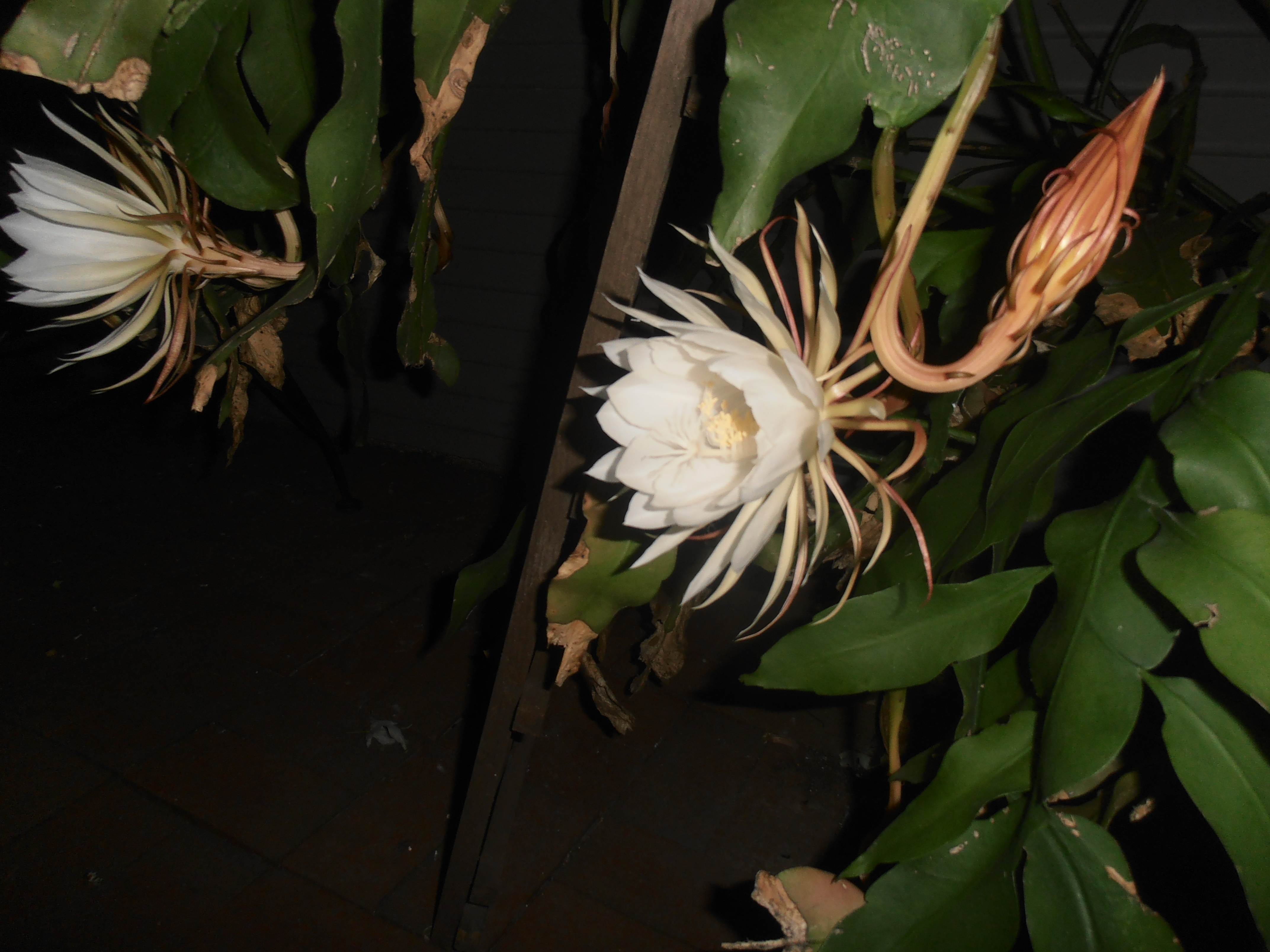
Instead of updating the blog with some of my program notes, of which I have a huge backlog, I feel like celebrating the fact that (a) we have electricity for the third night in a row, which is still heavenly after three nights without it and (b) we had four blooms open tonight on the night-blooming cereus. We had a few more last week, and I don’t want to get jaded. They really are the most extraordinary flowers. I hope they draw all sorts of exotic moths, bats, and nightbirds to our patio, even if I never see them with my own myopic old night-blind eyeballs. Do your thing, furtive nocturnal pollinators, and know that I love you!
Before I hit you with the night-blooming cereus shots, though, I’m going to throw in a funny one I took of the passionflower vine, which is doing quite well on our back decks. It’s a native (Passiflora incarnata), and I hope it comes back abundantly, even though the fragrance is disappointingly salami-like. The important thing is that it attracts and feeds a variety of interesting moths, so I suppose it smells the way it needs to smell to perpetuate itself. (As for me, I’ll stick to Chanel Misia for now.) I’d probably grow the Passiflora incarnata even if it smelled totally rancid, like a corpseflower, which it does not, thank goodness. I like the way it looks. It reminds me of Phyllis Diller. This lil maypop doesn’t take itself too seriously!
Passiflora incarnata at night
This and all the other photos are night-blooming cereus blossoms and buds, along with the strangely veiny succulent leaves. The buds form from the same veins that cause new little leaves. Weird.OLYMPUS DIGITAL CAMERA
Author of SAINT OF THE NARROWS STREET, SHOOT THE MOONLIGHT OUT, CITY OF MARGINS, A FRIEND IS A GIFT YOU GIVE YOURSELF, THE LONELY WITNESS, EVERYTHING IS BROKEN, DEATH DON'T HAVE NO MERCY, and GRAVESEND






 René Spencer Saller