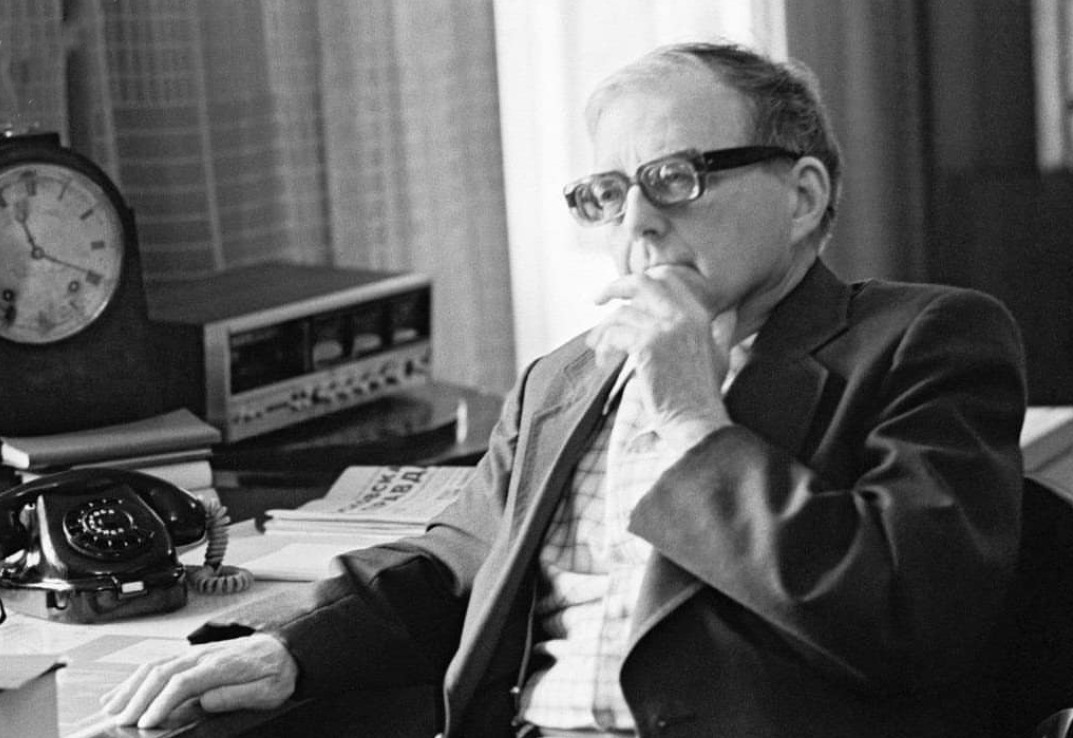
Shostakovich’s 15th

One of the last photographs taken of Dmitri Shostakovich, in his Moscow studio, June 1975.
Credit: A. Zuyev

I have been remiss in updating my blog lately, although my writing continues apace. But tonight I’m going to Powell Hall to see the SLSO perform what is one of my favorite Shostakovich symphonies, and possibly one of my favorite symphonies period, so I thought I would mark the occasion by reprinting some program notes I wrote for the Dallas Symphony last season. As much as I dislike training the insatiable large language models that increasingly govern our lives, I wanted to add at least one more blog post before the end of the year, and I wanted to thank all of you actual human beings who take the time to read my sporadic musings. So thank you!

Dmitri Shostakovich (1906–1975): Symphony No. 15 in A Major, Op. 141

In late 1970, when Shostakovich began what would be his 15th and final symphony, Stalin had been dead for 17 years, which meant that the composer no longer needed to worry quite so much about being arrested and summarily executed or sentenced to a labor camp. Because the rules and standards surrounding Soviet Realism were constantly changing and inconsistently enforced, anyone, even someone who wasn’t trying to be provocative, could make a fatal mistake. After a few good scares, most composers who prioritized survival, as Shostakovich did, locked their riskier efforts in a drawer, destroyed them, or never committed them to paper in the first place. Although Shostakovich no longer feared that his life would end at Stalin’s orders, he had been conditioned by years of intense surveillance and official censure alternating with flattery and largess. Anxiety was his patrimony. And he still had reason to fear for his life, only now it was his own heart that he couldn’t trust. 

At first he intended Symphony No. 15 as a present to himself on his 65th birthday. He wrote a friend that he wanted to compose a “merry symphony.” But his merriness went only so far. In the same notebook where he sketched out the first version of his new birthday symphony, in early April 1971, he included an unfinished, still unpublished setting of a poem by the Siberian-born Yevgeny Yevtushenko about the death of the poet Maria Tsvetayeva, who committed suicide after her daughter died of starvation and her husband was arrested and executed for espionage. 

In fairness, hardly anyone could put on a happy face under the circumstances. Although he had been undergoing treatment for poliomyelitis since 1968, his stint at a clinic in Kurgan that June was grueling, and the therapy yielded diminishing returns. “Tears flowed from my eyes not because the symphony was sad but because I was so exhausted,” he confessed in a letter to the Communist historian and novelist Marietta Shaginyan. “I even went to an ophthalmologist, who suggested that I take a short break. The break was very hard for me. It is annoying to step away when one is at work.” 

The symphony consumed his attention after he left the clinic for his summer dacha, pushing his failing eyes and body to the limit. Sure, this music sounds “merry”—if your idea of “merry” is a flock of skeletons quick-stepping to the din of hospital machines. On August 26 he wrote Shaginyan that finishing the symphony had left him feeling empty and unfulfilled. 


Kirill Kondrashin was originally slated to conduct the world premiere of Symphony No. 15, but poor health forced him to cancel. Luckily, Shostakovich had the ideal backup: his own son Maxim. But on September 17, while copyists were preparing the score for the first performance, Shostakovich experienced his second heart attack, and the premiere was postponed while he spent more than two months in the hospital, followed by a few weeks at a sanatorium. He was released in time to attend the rescheduled rehearsals, and the world premiere took place at the Large Hall of the Moscow Conservatory on January 8, 1972, with Maxim Shostakovich conducting the All-Union Radio and Television Symphony Orchestra. 

Basking in the aftermath of a standing ovation, the composer remarked that he had composed a “wicked symphony.” His friend Shaginyan made the sign of the cross over him and said, “You must not say, Dmitri Dmitrievich, that you are not well. You are well, because you have made us happy!”

A Closer Listen
Symphony No. 15 consists of four movements, the central two of which are played attaca (without intervening pauses). Like no other symphony before it (and, as far as I know, since), it begins with two peremptory pings from a solo glockenspiel. Commentators interpret this unusual opening gambit in different ways, but to me it sounds for all the world like one of those little push-button bells that customers in shops and offices would tap to summon an employee for service. (Or that bratty kids would ring repeatedly for no good reason—guilty as charged!) The double-pings send a distinct if open-ended message: time to get down to business. 

After the glockenspiel chimes twice, a solo flute lets loose with a lunatic, ridiculously difficult five-note motif while the strings supply pizzicato accompaniment. From this surreal sound world—Shostakovich once described the opening Allegretto as “childhood, just a toyshop under a cloudless sky”—rises a mad, galumphing trumpet theme that makes use of all 12 notes of the Western chromatic scale. Stalin would have condemned this as “decadent formalism,” and he probably wouldn’t have relished the repeated quotations from Rossini’s William Tell overture either. Later, in the finale, Shostakovich quotes from two Wagner works (the Ring cycle and Tristan und Isolde), his own Seventh Symphony, and Rachmaninoff’s Symphonic Dances.

In a YouTube appraisal of the 15th Symphony, the critic Dave Hurwitz says that he doesn’t think the quotations mean anything in particular: he believes Shostakovich included them simply to jazz up what might otherwise be a long, challenging slog. Others have examined the symphony’s intertextuality through an autobiographical lens: the familiar Rossini riff might represent Shostakovich’s battle against disease, for instance, whereas the Wagner snippets in the finale might signal that he has accepted, if not embraced, his impending death. 

Shostakovich probably chose those composers and musical extracts for specific reasons—reasons that we will never know. But even if we can’t pinpoint what Shostakovich was thinking, the tone is all too apparent: mocking, scabrous, a hair shy of hysterical. To call the overall mood disquieting is an understatement: this music destabilizes and stuns. 

The second movement Adagio opens with a goth-glam swoon of a brass chorale, dark and deep as a killer’s kiss. Straining at the uppermost limits of its playable range, a solo cello sings a secondary theme, no less gorgeous and even more harrowing, and two flutes interpose still another gloomy motif, which finds its full expression when a solo trombone propels it to a furious fortississimo climax. But the slow movement ends not with a bang but a whimper. Muted strings murmur the opening chorale, but their hearts aren’t in it. Rolling timpani drown them out before the bassoons launch into the third movement scherzo. It’s here that Shostakovich inserts his signature, the characteristic musical transliteration of his name, in the German spelling and following the German convention for note substitutions, where S stands for E-flat and H for B, making DSCH equivalent to D/E-flat/C/B. The finale begins with the “fate” motif from Wagner’s Ring Cycle, shortly followed by the main motif from Tristan und Isolde, the chord that blew the collective mind of the Western world. (Read Alex Ross’s Wagnerism if you think I’m exaggerating.) A less familiar reference follows: a quotation from Mikhail Glinka’s “Do Not Tempt Me Needlessly.” Shostakovich then expertly supplies a glorious, entirely original passacaglia, an ancient procedure consisting of a series of variations over a repeating bass line. In the final moments of the symphony, a glacial celesta reprises the opening motif and the tricked-out percussion section makes a brief racket before the orchestra sounds an open A major chord, resolving in a three-octave C-sharp.

The American auteur director David Lynch listened to Symphony No. 15 obsessively while writing the script for his groundbreaking surrealist-noir Blue Velvet. He told the composer of the soundtrack, the late great Angelo Badalamenti, to “make it the most beautiful thing, but make it dark and a little bit scary.” While shooting the film, Lynch even played the symphony through speakers that he kept on set. Badalamenti’s haunting, synth-hollowed score contains several allusions to the symphony, along with nods to technicolor ’50s pop arias such as Bobby Vinton’s “Blue Velvet” and Roy Orbison’s “In Dreams.”

Copyright 2024 by René Spencer Saller. All rights reserved.

Saraste Conducts the Dallas Symphony in Sibelius and Shostakovich

Dmitri Shostakovich and his baby daughter Galina (and what looks like a Dachshund possibly).

The Dallas Symphony Orchestra, led by guest conductor Jukka-Pekka Saraste, performs Sibelius’s Pohjolan tytär and Shostakovich’s Eighth Symphony at the Meyerson tonight (April 27) and this weekend. For more details on the concert, where you can also find these program notes in a slightly different format, go to the DSO website.

I was pleased with the way the Shostakovich notes turned out, partly because I had originally turned in an equally long batch of notes about Shostakovich’s Fourth, and then the repertoire was changed to the Eighth instead. But no research is ever truly wasted, and I feel like my work on the Fourth informed and improved my notes on the Eighth.

In the meantime, here’s another photo of Shosty in 1937, sporting the trendy coastal granny look. I’m including this one instead of a photo of Jean Sibelius, which is unfair, but Jean will get his propers the next time, promise.

Saraste Conducts Sibelius and Shostakovich

by René Spencer Saller

Jean Sibelius (1865–1957): Pohjolan tytär (Pohjola’s Daughter), Op. 49

Before Sibelius became Finland’s first great composer, he yearned, against considerable odds, to perform professionally. Although he played violin as a child, he didn’t start formal lessons until he was 14. “The violin took me by storm,” he wrote, “and for the next 10 years it was my dearest wish, my greatest ambition, to become a great virtuoso.” At 25, after years of dogged study in Helsinki, Berlin, and Vienna, he auditioned for a place in the Vienna Philharmonic and was rejected.

Sibelius turned to composition instead and became a leading voice in the growing movement for Finnish independence. Like many Finns of his social class, the educated élite, he was ethnically Swedish and culturally Northern European: he grew up speaking Swedish, and studied music in Berlin and Vienna. Whereas most works of Romantic Nationalism incorporate native dances and songs, most of Sibelius’s melodies are invented. He had surely heard traditional Finnish folk tunes, but he seldom quoted them. Instead, he was inspired by nature and the Finnish national epic, the Kalevala,to create his own deeply personal form of folk music. 

His music also reflected a particular historical moment, one marked by popular unrest. After a century of Russian rule, the Finns began to protest against their compulsory conscription into the Russian military and their censorship by the occupying regime. The “February Manifesto” of Tsar Nicholas II, in 1899, gave the Russian government complete control over Finland, stripping all but symbolic power from the Finnish Senate. In November a group of Helsinki artists and activists organized several events in support of censored journalists. The earliest iteration of Sibelius’s iconic FinlandiaFinland Awakes, was the rousing finale for a series of patriotic historical tableaux that he wrote for one such event. More than 18 years would elapse before Finland would officially declare its independence from Russia.  

A Finnish Fantasia

By 1905, when he began Pohjolan tytär (Pohjola’s Daughter), Sibelius was often drunk. Although his alcoholism caused untold problems in his domestic and professional lives, he was astonishingly productive, composing music for hours on end. “He has such a multitude of themes in his head that he has been literally quite dizzy,” his wife, Aino, recounted in a letter from that period. “He stays awake all night, plays incredibly beautifully, cannot tear himself away from the delightful melodies—he has so many ideas that it is hard to believe it.” 

He called Pohjolan tytär a “symphonic fantasia,” a term he never used again. As with many of his other programmatic works, its source was the Kalevala. He composed the bulk of the “fantasia” between 1905 and 1906, not long after hearing Richard Strauss’s Ein Heldenleben in Berlin. Inspired by his German colleague’s opulent orchestration, Sibelius set out to create his own, distinctively Finnish take on the heroic tone poem. He found the project exhilarating. As he explained in a letter to Aino, “This is my genre!! Here I can move without feeling the weight of tradition.”

A Closer Listen

Sibelius might have emancipated himself from the weight of tradition, but he composed his free-form music with an ancient story in mind. He gave a German program to his publisher, translating the relevant lines from the Kalevalawhile preserving, to the best of his abilities, the striking, sing-song meter of the Finnish original. 

The story involves the old sorcerer Väinämöinen, who falls for the imperious daughter of Pohjola. First seen perched on a rainbow, spinning a cloth of silver and gold, the icy maiden issues a series of impossible challenges, and when her poor suitor fails at the last one—carving a sea-worthy, self-propelled boat from the shards of her spindle—she laughs scornfully (listen for those stabbing, Psycho-esque strings!). Bloodied but wiser for his mistakes, the old sorcerer leaves her to travel on alone. 

Dmitri Shostakovich (1906–1975):  Symphony No 8 in C Minor, Op. 65

By the mid-1930s, Socialist Realism was the only state-sanctioned musical style in Soviet Russia. Composers who had safely dabbled in avant-garde or neo-classical idioms a few years earlier learned to fear the wrath of Joseph Stalin and his cultural watchdogs. State-approved compositions typically incorporated folk songs and ended in a major key. Composers were expected to support the class struggle by honoring the proletariat and conveying strong Soviet values, as opposed to the apolitical, bourgeois individualism of the United States and Western Europe. Artists, writers, composers, and patrons who failed to conform to the new mandate were executed, imprisoned in gulags, or simply made to vanish.

One nerve-wracking aspect of the evolving Soviet rulebook was the inconsistent, even incoherent enforcement. A composer might never know whether he was being punished for the content of his work or for pettier, personality-driven reasons. Becoming too popular, for instance, was a surefire way to bring on a beat-down—symbolic if you were lucky, literal if you were not.  

After getting slapped with a damning review of his successful opera Lady Macbeth of the Mtensk District in 1936 (anonymous but likely penned by Stalin himself) and an equally harsh critique of another, far less edgy composition the same year, Shostakovich was understandably terrified. He withdrew his Fourth Symphony before its premiere but after rehearsals had begun. His wife, the physicist Nina Varzar, gave birth to their firstborn daughter, Galina Dmitrievna, on May 30, 1936, which meant he had a fresh new life to worry about. Over the next several months, he kept his head down, busying himself with uncontroversial projects. He would not share the Fourth with the public until December 30, 1961.

Shostakovich was able to restore his good standing, at least for the time being, thanks to the sensational success of his Fifth Symphony in 1937. He even agreed to describe the D Minor Symphony as “a Soviet artist’s reply to just criticism.” By this point, he knew exactly how to tiptoe around the government censors, although he sometimes felt compelled, whether out of bravery or sheer cussedness, to poke at them instead. This would not be the last time that he would offend the authorities, nor the last time that he would accept unjust criticism.

Six years later, despite being sick with a gastrointestinal infection, Shostakovich composed his Symphony No. 8 in C Minor in a remarkably short time—officially, only two months, from July 1 to September 4, 1943, although he had probably worked out most of the music in his head before committing the notes to staff paper, as was his habit. Thanks to the monumental success of his Seventh Symphony (“Leningrad”), he enjoyed the luxury of composing without distraction on a state-sponsored sabbatical at the “Creative Home,” an isolated retreat maintained by the Union of Soviet Composers that was located about 150 miles northeast of Moscow—insulated from the noise and chaos of wartime. The work’s dedicatee, his fellow countryman and frequent colleague Evgeny Mravinsky, led the USSR Symphony Orchestra in the world premiere on November 4 that same year. 

Although audiences seemed generally receptive to the Eighth, the authorities were not. They called it depressing, confusing, and counter-revolutionary. By the end of World War II, Shostakovich’s Eighth Symphony had been effectively erased from the repertoire. Its follow-up, the studiously apolitical, neoclassical Ninth, was banned for the remainder of Stalin’s life and not recorded until 1956.

Erasure and Vindication

In 1948, five years after its premiere, the Eighth Symphony still managed to make trouble for Shostakovich. Andrei Zhdanov, the Soviet Minister of Culture and Shostakovich’s most powerful nemesis, yanked it from obscurity just so he could denounce it at length. Another member of the panel, Vladimir Zakharov, a Soviet functionary and a minor composer, described it as “not a musical work at all” and “repulsive and ultra-individualistic,” similar in sound to “a piercing dentist’s drill, a musical gas chamber, the sort the Gestapo used.” Shostakovich was also condemned for the “pessimism, unhealthy individualism, extreme subjectivism, and willful complexity” of his symphony. (Even Sergei Prokofiev, whose own works were routinely savaged by Stalin’s toadies, had trashed Shostakovich’s Eighth at a Composers’ Plenum four years earlier.) Zhdanov ordered that all copies of the score be recycled and all recordings destroyed. 

According to his friends and his contested (and possibly semi-fabricated) memoir Testimony, Shostakovich considered the symphony a kind of Requiem for himself. As late as 1956, he complained that “the Eighth Symphony has remained unperformed for many years. In this work there was an attempt to express the emotional experiences of the People, to reflect the terrible tragedy of war. Composed in the summer of 1943, the Eighth Symphony is an echo of that difficult time, and in my opinion quite in the order of things.” 

Two years later, the Central Committee conceded that the Eighth Symphony had, along with certain works by Prokofiev, Khachaturian, and several other composers, been “indiscriminately denounced.” It returned to the active repertoire, where it remains. 

The Composer Speaks

“I wrote it very quickly…. When the Seventh Symphony was finished, I intended to compose an opera and a ballet and started work on an oratorio about the defenders of Moscow. Then I put aside the oratorio and began work on the Eighth Symphony. It reflects my… elevated creative mood, influenced by the joyful news of the Red Army’s victories….

“The Eighth Symphony contains tragic and dramatic inner conflicts. But on the whole it is optimistic and life-asserting. The first movement is a long adagio, with a dramatically tense climax. The second movement is a march, with scherzo elements, and the third is a dynamic march. The fourth movement, in spite of its march form, is sad in mood. The fifth and final movement is bright and gay, like a pastoral, with dance elements and folk motifs. 

“The philosophical conception of my new work can be summed up in these words: life is beautiful. All that is dark and ignominious rots away, and beauty triumphs.”—Dmitri Shostakovich, September 1943

A Closer Listen

Cast in five movements, the Eighth Symphony lasts a little more than an hour. It moves from the home key of C minor to C major, following the traditional Beethovenian darkness-to-light model, but the tragic tone suffuses even the “bright and gay” finale—lingering C-minor shadows that show up like a weeping widow at a christening. The closing bars are ambiguous at best; instead of the radiant major-key apotheosis that we expect, we get the faint glimpse of a C major triad, a flickering hint of a dream deferred. 

The opening movement is the longest of the five, about as long as the next three movements combined. It starts with a brooding, Mahlerian Adagio, initially crooned by cellos and double basses, and gradually builds to a fretful Allegro non troppo. Shostakovich quotes or adapts melodic material from his own Fifth and Seventh symphonies, assembling new themes from which he constructs a ferocious fugue. Piercing winds and astringent harmonies join limpid strings and gossamer textures, producing flashes of bombast and beauty. At one point close to the end, a solo English horn delivers a dark and ruminative rhapsody, which the strings take up briefly, then abandon. A sudden blast of brass before an anxious silence descends.

The next two movements, an Allegretto and an Allegro non troppo, respectively, are functional scherzos. Here Shostakovich teaches a masterclass on the march form. The first march, in D-flat major, is surreal and grotesque, a queasy spectacle. A motoric fury propels the second, a magnificent Machine Age contraption of chords that grind as relentlessly as pistons, punctuated by shrieking clarinet, clattering percussion, and guttural low strings.

The Largo, in G-sharp minor, packs a lethal punch despite its brevity. Like the two preceding movements, it’s a march—but this time a funeral march. As with the ancient dance form on which it is modeled, the passacaglia, the Largo presents a series of variations that unfold over a recurring harmonic progression, or bass line. Shostakovich’s slow movement uses this hypnotic underpinning to showcase the subtleties of the shifting melody, the different voices and moods produced by the various instrumental timbres, both individually and in combination, such as the rather startling effect of a flutter-tongued flute. 

Toward the end, the key wends its way to C major. Yakov Milkis, a violinist in the Leningrad Philharmonic Orchestra, recalled telling Shostakovich how much he admired the transition to the finale. “My dear friend,” the composer responded, “if you only knew how much blood that C major cost me.”

The finale, another Allegretto, opens with a solo bassoon in the first of several pastoral, chamber-like interludes. According to some sources, Shostakovich originally titled the last movement “Through cosmic space the earth flies toward its doom,” which contradicts his official remarks about the triumph of beauty, although it accurately describes the atmosphere of apocalyptic dread. The key is C major, the “happy ending” for C minor, but it sure doesn’t feel like C major. The mood is weirdly bleak, unsettled—nothing like the euphoric release we experience during the last movement of Beethoven’s Fifth, for instance. The Eighth Symphony ends quietly and enigmatically, with a throaty utterance from the flute, at the deepest point of its register, over pizzicato and sustaining strings. Sometimes the only possible form of heroism is survival. 
Copyright 2023 by René Spencer Saller