

I had the great honor of contributing some notes for a recent–and newly revised–orchestral composition by the singular composer Reena Esmail for the San Francisco Symphony program book. The concert runs this weekend, so by all means snag some tickets if you plan to be in San Francisco then.
I wasn’t able to make the performance last night, but my friend and colleague Ben Pesetsky, the Associate Director of Editorial at the SF Symphony and a fine composer in his own right, was kind enough to take a photo of my byline in the paper version of the book and email it to me. (I will include the notes in a more legible format below the photo.)
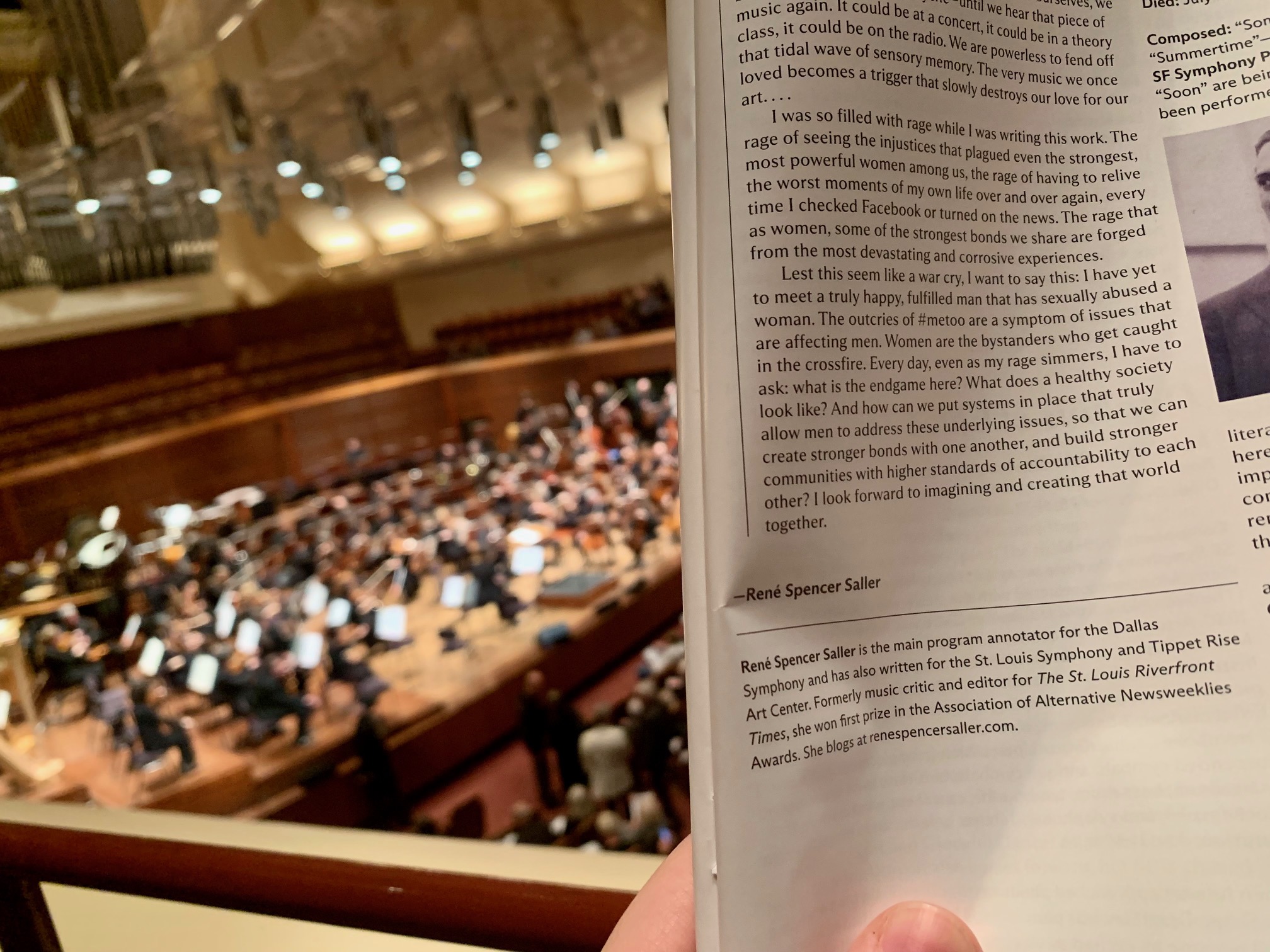
Black Iris at a Glance
Originally titled #metoo, Black Iris (2017) responds to composer Reena Esmail’s own experience of sexual abuse and that of other survivors. “I always get asked why there aren’t more women composers,” she explains. “This piece is one response—of many hundreds of responses—to that question.” Although the one-movement orchestral composition is performed on Western instruments and notated according to Western conventions, its slippery microtonal melodies and shadowy harmonies evoke the Hindustani art music that Esmail studied in India on a Fulbright-Nehru grant.
Black Iris
Reena Esmail
Born: February 11, 1983, in Chicago
Composed: 2017 (rev. 2022)
First San Francisco Symphony Performances
Instrumentation: 2 flutes (2nd doubling piccolo), 2 oboes (2nd doubling English horn), 2 clarinets, 2 bassoons, 4 horns, 2 trumpets, 3 trombones, tuba, timpani, percussion (triangle, cymbals, chimes, snare drum, bass drum, glockenspiel, vibraphone, and marimba), harp, piano (doubling celesta), and strings
Duration: About 14 mins
In both her work and her person, the composer Reena Esmail reflects the global diaspora. Her Indian mother, a member of India’s Portuguese-influenced Goan community, grew up in Kenya; her father, also Indian, lived in Pakistan, where his family moved after Partition. Esmail herself was born in Chicago and raised in Los Angeles, but she felt connected to her ancestral homeland. After earning an undergraduate degree in composition at Juilliard and midway through graduate studies at Yale, she knew that she needed to learn more about Indian classical music. She spent 2011–12 in India on a Fulbright-Nehru grant, studying under such masters as singer Srimati Lakshmi Shankar and sitarist Gaurav Mazumdar. Her doctoral dissertation at Yale outlined methods of collaboration between Western and Hindustani forms of art music. As an artistic director of the nonprofit Shastra, she promotes music that links the cultural traditions of India and the West. This devotion to cultural syncretism carries over to her substantial catalogue, which includes orchestral, chamber, and choral works.
Originally titled #metoo, the one-movement orchestral composition Black Iris responds to Esmail’s own experience of sexual abuse and that of other survivors. When the hashtag stopped trending, and the #metoo movement began to shift meaning, she decided to rename the piece after the famous Georgia O’Keeffe painting, explaining that “the light petals on the top, and the dark petals beneath—the image was so resonant with the experience about which this work was written.”
Approximately 10 minutes long, Black Iris is performed on Western instruments and notated according to Western conventions, but many of the melodies involve quicksilver microtonal shifts, subtle shadings of notes that slip between the lines and spaces of the staff or the steps on the scale. As any fan of Hindustani ragas or Delta blues or early Sonic Youth will attest, these liminal spaces contain vast stores of power and pleasure. Rather than “resolve” any harmonic ambiguities, Esmail delights in them.
The piece was commissioned by Chicago Sinfonetta, which premiered it in March 2018. Esmail substantially revised and reorchestrated it for its first San Francisco Symphony performances this week. In her original program note, Esmail wrote:
I always get asked why there aren’t more women composers. This piece is one response —of many hundreds of responses—to that question. So many of us decide to become composers when we are young women because we fall deeply in love with individual pieces of music. We listen to them incessantly, we memorize every note of them, we live our lives through the lens of that music. And then at some point, for some of us, as we engage with that music, something devastating happens to us—often by the very person who has introduced us to that music. We hate ourselves, we blame ourselves, we bury it deep within our psyche—until we hear that piece of music again. It could be at a concert, it could be in a theory class, it could be on the radio. We are powerless to fend off that tidal wave of sensory memory. The very music we once loved becomes a trigger that slowly destroys our love for our art. . . .
I was so filled with rage while I was writing this work. The rage of seeing the injustices that plagued even the strongest, most powerful women among us, the rage of having to relive the worst moments of my own life over and over again, every time I checked Facebook or turned on the news. The rage that as women, some of the strongest bonds we share are forged from the most devastating and corrosive experiences.
Lest this seem like a war cry, I want to say this: I have yet to meet a truly happy, fulfilled man that has sexually abused a woman. The outcries of #metoo are a symptom of issues that are affecting men. Women are the bystanders who get caught in the crossfire. Every day, even as my rage simmers, I have to ask: what is the endgame here? What does a healthy society look like? And how can we put systems in place that truly allow men to address these underlying issues, so that we can create stronger bonds with one another, and build stronger communities with higher standards of accountability to each other? I look forward to imagining and creating that world together.
—René Spencer Saller
Copyright 2023 by René Spencer Saller
 René Spencer Saller