

In recognition of Juneteenth tomorrow, here is a program I wrote about a couple of years ago for the Dallas Symphony Orchestra. I don’t think I ever uploaded it to the blog, and if I did, the link is surely dead by now, so it seems worth reposting. Juneteenth is an especially significant holiday for Texans, but I’m happy to say that Dallas is programming most of these composers all year round. In fact, Adolphus Hailstork, pictured above, has a new co-commission from Dallas Symphony scheduled for premiere next season, the subject of which is the last speech JFK gave before he was assassinated.
Jubilant Juneteenth
by René Spencer Saller
Variously known as Emancipation Day, Jubilee Day, and Black Independence Day, Juneteenth holds a special significance for Texans. The name, a portmanteau of June and nineteenth, refers to the date in 1865 when the Union General Gordon Granger read General Order No. 3 in Galveston. This proclamation freed the enslaved people of Texas—more than 250,000 men, women, and children. Technically speaking, President Abraham Lincoln’s Emancipation Proclamation had already banned slavery in Texas nearly two-and-a-half years earlier, but enforcing the law required the intervention of Union troops, and getting approximately 2,000 soldiers to the most remote Confederate state took time. (Contrary to popular belief, Texas wasn’t the last state to end slavery; it was still prevalent in Delaware and Kentucky until December 1865, when the 13th Amendment to the Constitution was ratified.)
In Texas Juneteenth festivities date to 1866, and the practice eventually spread throughout the nation. On June 7, 1979, Texas became the first state to make Juneteenth an official state holiday. Today Juneteenth is widely celebrated throughout the United States, and activists are currently lobbying Congress to recognize it as a national holiday. [Update: It became a federal holiday after I turned in my notes and remains a federal holiday today, hooray!]
Adolphus Hailstork (b. 1941): American Fanfare
Born in Rochester, New York, Adolphus Hailstork studied composition at Howard University, the Manhattan School of Music, and the American Institute at Fontainebleau before earning his doctorate from Michigan State University. His diverse catalogue includes works for orchestra, organ, piano, and solo voice, as well as chamber and jazz ensembles. In October 2020 he received a Distinguished Alumni Award from the Manhattan School of Music. Current projects include his Fourth Symphony and A Knee on a Neck, a tribute to George Floyd for chorus and orchestra. Completed in 1985, American Fanfare is scored for brass and percussion.
James Weldon Johnson (1871–1938) and John Rosamond Johnson (1873–1954): “Lift Every Voice and Sing” (arr. Tyzik)
To call James Weldon Johnson multifaceted is an understatement. The distinguished poet, novelist, newspaper publisher, lawyer, diplomat, translator, and civil rights activist also wrote what is commonly known as the Black National Anthem: “Lift Every Voice and Sing.” Born in Jacksonville, Florida, to a hotel headwaiter and a schoolteacher, he attended college at Atlanta University, where he earned his bachelor’s degree in 1894. He wrote “Lift Every Voice and Sing” as a poem in 1899; his older brother composed the music the following year.
“A group of young men in Jacksonville, Florida, arranged to celebrate Lincoln’s birthday in 1900,” Johnson later wrote. “My brother, J. Rosamond Johnson, and I decided to write a song to be sung at the exercises. […] Our New York publisher, Edward B. Marks, made mimeographed copies for us, and the song was taught to and sung by a chorus of 500 colored school children.
“Shortly afterwards my brother and I moved away from Jacksonville to New York, and the song passed out of our minds. But the school children of Jacksonville kept singing it; they went off to other schools and sang it; they became teachers and taught it to other children. Within 20 years it was being sung over the South and in some other parts of the country. […].
“The lines of this song repay me in an elation, almost of exquisite anguish, whenever I hear them sung by Negro children.”

Nkeiru Okoye (b. 1972): “I Am Harriet Tubman”
Born in New York City to a Nigerian father and an African American mother, Nkeiru Okoye [in KEAR roo oh KOY yeh] was brought up in the United States and Nigeria. She started piano lessons at age 8, and just five years later won a national competition for her first musical composition. She holds degrees from the Oberlin Conservatory of Music and Rutgers University and serves on the composition faculty at the State University of New York at New Paltz. The inaugural recipient of the International Florence Price Festival Award for Composition, Okoye is currently a Fellow of the John Simon Guggenheim Memorial Foundation. Her wide-ranging works have been performed by the Philadelphia Orchestra, Detroit Symphony Orchestra, Indianapolis Symphony, Virginia Symphony, Grand Rapids Symphony, New Jersey Symphony, and many other ensembles.
“I Am Harriet Tubman” comes from her two-act theatrical work Harriet Tubman: When I Crossed That Line to Freedom (2014). “I wanted to write an opera about a woman who did great things and survived,” she explained. “My music doesn’t easily fit into a single category, though I incorporate many musical influences in a way that creates a sound that is uniquely mine. I think a lot of people are surprised to hear connections between the gospel aria and the jazz aria in Harriet Tubman.”
Mary D. Watkins (b. 1939): Soul of Remembrance

Eclectic and prolific, the Denver-born composer and pianist Mary D. Watkins began studying piano at age three, in Pueblo, Colorado. Five years later, she was improvising and composing original works. At 15 she won second place in a piano competition with her own arrangement of Schubert’s “Ave Maria.” After earning a degree in music composition from Howard University in 1972, Watkins played with numerous jazz ensembles in Washington, D.C., and later moved to the West Coast, where she founded her own jazz quartet and recorded several albums. Among her many compositions are the scores for the jazz musical Lady Lester Sings the Blues, based on the life of legendary tenor saxophonist Lester Young, and The Revolutionary Nutcracker Sweetie, an adaptation of Tchaikovsky’s ballet The Nutcracker. In 2009 she composed and wrote the libretto for Dark River, an opera based on the life of the civil rights activist Fanny Lou Hamer.
Composed in 1993, Soul of Remembrance is the second movement of her orchestral suite Five Movements in Color. In a 2016 interview with the National Education Association, Watkins described the proudest moment of her career: “It was in 2009 when I was in Chicago standing in the corridor outside the auditorium. I heard the orchestra rehearsing [Soul of Remembrance]. The music wasn’t flashy, technically challenging, or anything like that. It was serene, beautifully executed, and I let go of whatever it was I had been holding on to. It was the first time I really felt validated as a composer.”
William Grant Still (1895–1978): Ennanga, for harp, piano, and strings (first movement)
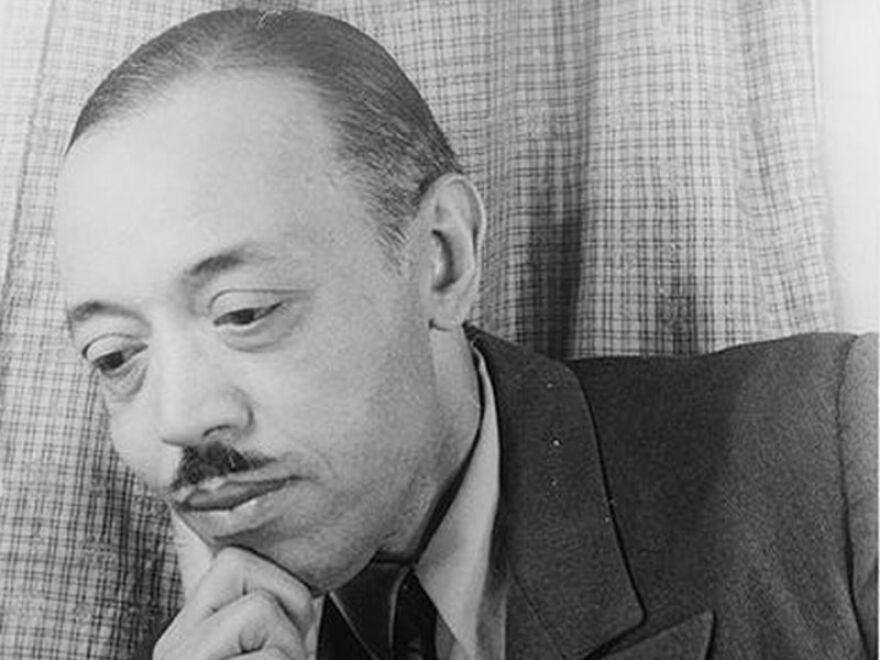
Nicknamed the “Dean of African-American composers,” Still completed more than 150 works, including eight operas and five symphonies. He was the first Black American to write a symphony that was performed by a major orchestra, and the first to conduct a major orchestra. In 1949 his opera about Haiti, Troubled Island, was produced by the New York City Opera—another historic first.
Still was born in Woodville, Mississippi, to college-educated teachers. His father, the town bandmaster, died when he was three months old. He and his mother moved to Little Rock, Arkansas, where she remarried. He began taking violin lessons at age 14 and taught himself viola, cello, double bass, clarinet, oboe, and saxophone. In 1911 he enrolled at Wilberforce College in Ohio, where he directed the band. His studies at Oberlin Conservatory of Music were interrupted by his Navy service. He played as a sideman for bluesman W.C. Handy, who brought him to Memphis and then New York City, where he became an oboist in Eubie Blake’s pit and made arrangements for theater orchestras and jazz and blues artists. He also studied with the influential atonalist Edgard Varèse.
Still completed the three-movement chamber composition Ennanga in 1956. The title is a Ugandan word that refers to a small harplike instrument, and the score contains a prominent part for the Western harp, as well as piano and string quintet. For technical advice, Still consulted the harp virtuoso Lois Adele Craft, who also performed at the Los Angeles premiere. In the first movement, the harp and piano alternate between percussive and melodic roles, often evoking Juba, or hambone, a centuries-old African-American dance form that calls for stomping, slapping, clapping, and patting the body.
Traditional: “A City Called Heaven” (arr. Tyzik)
Like many traditional spirituals, “A City Called Heaven” predates the American Civil War and exists in numerous versions, under many titles, including “Poor Pilgrim of Sorrow,” “Poor Pilgrim,” “Tossed and Driven,” and “Tryin’ To Make Heaven My Home.” It was first documented in the 1907 collection Folk Songs of the American Negro, compiled by John Wesley Work, Jr. (1871–1925), an influential African-American scholar of folk songs and spirituals.
Still: Symphony No. 1 in A-flat Major (Afro-American Symphony) (third movement, Animato)
Still began sketching his most famous work, the Afro-American Symphony, in 1924, not long after he played in the pit orchestra for Eubie Blake and Noble Sissle’s Shuffle Along, which featured Josephine Baker and Paul Robeson, among other luminaries of the nascent Harlem Renaissance. The sketches remained in limbo for some time while Still worked on other projects. As he later explained, “it was not until the Depression struck that I went jobless long enough to let the Symphony take shape. In 1930 I rented a room in a quiet building not far from my home in New York and began to work.” Two months later, Still’s First Symphony was complete. In a notebook that he kept during composition, he assigned alternative titles to each movement: the third, Animato, was designated “Humor.”
In 1931 Howard Hanson conducted the premiere—marking a milestone in Still’s career, as the first symphony by a Black composer to be performed by a major orchestra—and the 36-year-old composer’s career took off. He received commissions from several orchestras and a Guggenheim Fellowship. He eventually moved to Los Angeles, where he arranged film scores and popular music while honing his own powerful musical idiom: a blend of European post-Romanticism, jazz, blues, and spirituals.
In 1964 Still described the creative impetus behind his Afro-American Symphony: “I wanted, above all, to write music that would be recognizable as being in the idiom employed [by the American Negro] or recognized, I should say, as that of the American Negro. It was the object that I desired most of all.”
John Newton (1725–1807); William Walker (1809–1875): “Amazing Grace” (arr. Tyzik)
First published in 1779, the words to the iconic Christian hymn “Amazing Grace” were written by the English poet and Anglican clergyman John Newton. A former seaman and slave-ship captain, Newton experienced a spiritual epiphany, converted to Christianity, and eventually became an ordained curate in the Church of England, as well as an abolitionist. He wrote “Amazing Grace” to accompany a sermon for New Year’s Day of 1773. Although the poem has been associated with at least 20 different melodies over the years, its most famous iteration was created in 1835 by the American Baptist song leader and compiler William Walker, who set it to a tune called “New Britain” and transcribed it in a shape-note format.
Traditional: “Ride On, King Jesus” (arr. Tyzik)
Another anonymous antebellum spiritual, “Ride On, King Jesus” appeared under the title “No Man Can Hinder Me” in the first anthology of published spirituals, Slave Songs of the United States (1867). In the late 19th century, it became a concert staple of the Fisk Jubilee Singers, who performed several tours to raise money for Fisk University, a historically Black institution founded in 1866, in Nashville, Tennessee. Henry (“Harry”) T. Burleigh (1866–1949), who had studied with Dvořák, collected and arranged “Ride on, King Jesus” as well as many other songs in his Jubilee Songs of the United States of America, first published in 1916.
Antonín Dvořák (1841–1904): “Goin’ Home” (arr. Tyzik)
In the spring of 1893, when Antonín Dvořák was finishing his Symphony No. 9 in E minor (“From the New World”), the Czech composer made a bold prediction: “I am now satisfied that the future music of this country must be founded upon what are called the Negro melodies. This must be the real foundation of any serious and original school of composition to be developed in the United States.”
The Ninth Symphony was the first of several works that Dvořák wrote entirely in the United States. Although he urged his National Conservatory students to explore indigenous musical forms, he had at that point heard only a smattering of American folk songs, notably the spirituals that his Black student and assistant Henry (“Harry”) Thacker Burleigh sang for him.
For the symphony’s most famous theme, Dvořák chose the English horn because it reminded him of Burleigh’s voice. This deceptively simple, deeply moving melody—apotheosized in the second movement but present, in some form or another, throughout—gives many listeners the mistaken impression that they are listening to an existing spiritual. In 1922 William Arms Fisher, another of Dvořák’s former students, added lyrics to Dvořák’s original theme, thereby creating the nostalgic ballad “Goin’ Home.”
Traditional: Medley (arr. Tyzik): “Every Time I Feel the Spirit,” “Joshua Fit the Battle of Jericho,” “Sometimes I Feel Like a Motherless Child,” Swing Low, Sweet Chariot”
This medley is dedicated to Henry T. Burleigh, a gifted Black baritone singer, composer, and arranger who dedicated his life to promoting the spiritual as a serious American art form.
Of unknown authorship, “Every Time I Feel the Spirit” predates the American Civil War. The first stanza refers to Moses receiving the Ten Commandments on the mountaintop; the second describes being baptized in the Jordan River and the “heavenly train,” which is sometimes interpreted as a coded reference to the Underground Railroad.
“Joshua Fit the Battle of Jericho” is another anonymous spiritual of a similar vintage. (“Fit” is African-American Vernacular English for “fought.”) The words allude to the biblical story of the Battle of Jericho, when Joshua led the Israelites into battle against the Canaanites.
The haunting and heart-rending “Sometimes I Feel Like a Motherless Child” was composed by another unknown enslaved poet. The great American bass-baritone, actor, and political activist Paul Robeson—himself the son of a former slave—made multiple recordings of the song, beginning in 1926.
Although its exact origins are unknown, “Swing Low, Sweet Chariot” is often attributed to Wallis Willis, an enslaved Black man who was born in Mississippi and forcibly moved to Oklahoma by his enslaver, a member of the Choctaw Nation. Alexander Reid, a minister at the Choctaw boarding school where Willis and his wife were employed, heard the couple singing it and then transcribed the words and melody, which he sent to the Jubilee Singers of Fisk University. In 1909 the Jubilee Singers made the first recording of the song, which is worth seeking out on YouTube.
Copyright 2021 René Spencer Saller
 René Spencer Saller