I had the great honor of contributing some notes for a recent–and newly revised–orchestral composition by the singular composer Reena Esmail for the San Francisco Symphony program book. The concert runs this weekend, so by all means snag some tickets if you plan to be in San Francisco then.
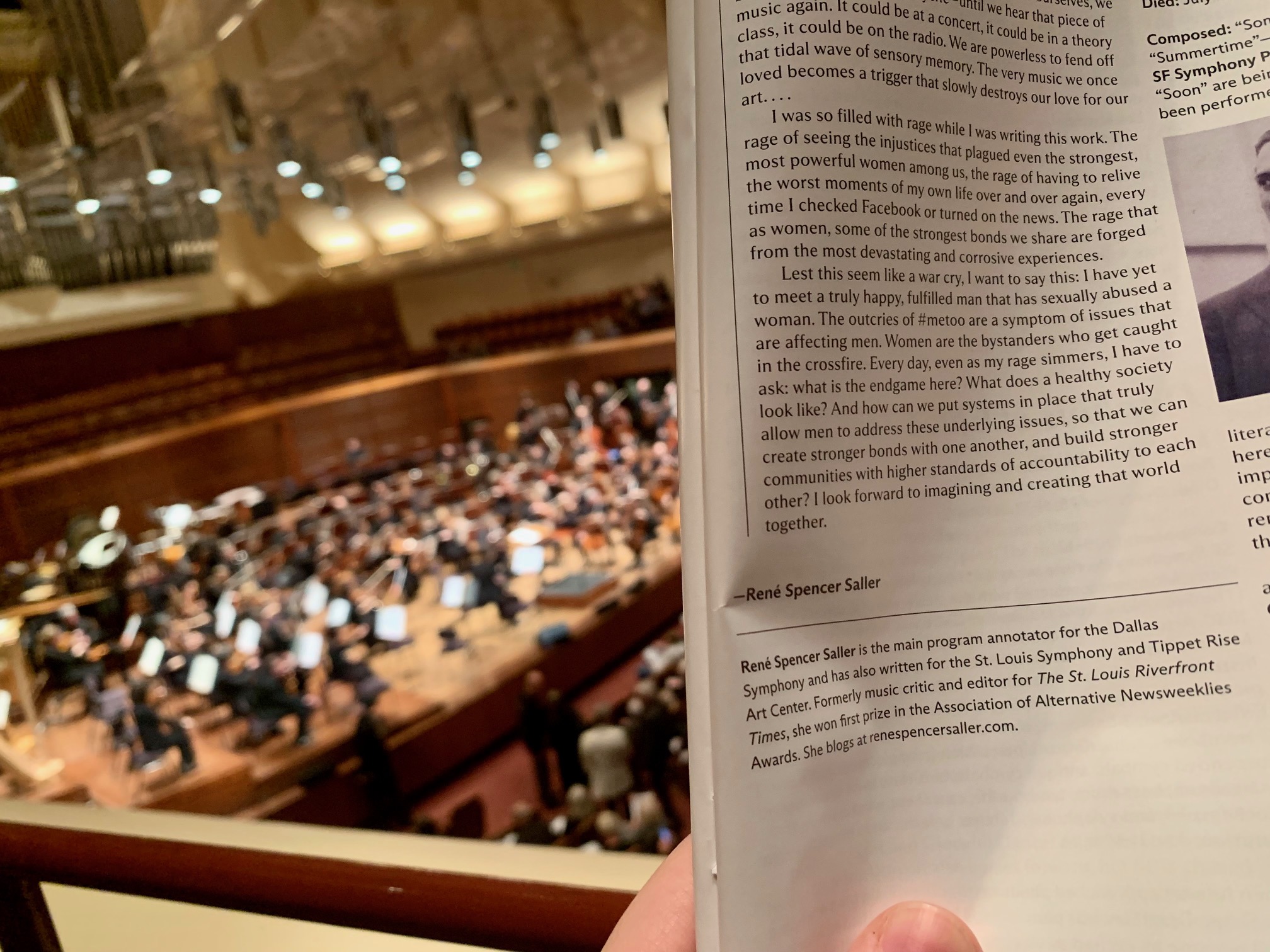
I wasn’t able to make the performance last night, but my friend and colleague Ben Pesetsky, the Associate Director of Editorial at the SF Symphony and a fine composer in his own right, was kind enough to take a photo of my byline in the paper version of the book and email it to me. (I will include the notes in a more legible format below the photo.)
Black Iris at a Glance
Originally titled #metoo,Black Iris (2017) responds to composer Reena Esmail’s own experience of sexual abuse and that of other survivors. “I always get asked why there aren’t more women composers,” she explains. “This piece is one response—of many hundreds of responses—to that question.” Although the one-movement orchestral composition is performed on Western instruments and notated according to Western conventions, its slippery microtonal melodies and shadowy harmonies evoke the Hindustani art music that Esmail studied in India on a Fulbright-Nehru grant.
Black Iris
Reena Esmail
Born: February 11, 1983, in Chicago
Composed: 2017 (rev. 2022) First San Francisco Symphony Performances Instrumentation: 2 flutes (2nd doubling piccolo), 2 oboes (2nd doubling English horn), 2 clarinets, 2 bassoons, 4 horns, 2 trumpets, 3 trombones, tuba, timpani, percussion (triangle, cymbals, chimes, snare drum, bass drum, glockenspiel, vibraphone, and marimba), harp, piano (doubling celesta), and strings Duration: About 14 mins
In both her work and her person, the composer Reena Esmail reflects the global diaspora. Her Indian mother, a member of India’s Portuguese-influenced Goan community, grew up in Kenya; her father, also Indian, lived in Pakistan, where his family moved after Partition. Esmail herself was born in Chicago and raised in Los Angeles, but she felt connected to her ancestral homeland. After earning an undergraduate degree in composition at Juilliard and midway through graduate studies at Yale, she knew that she needed to learn more about Indian classical music. She spent 2011–12 in India on a Fulbright-Nehru grant, studying under such masters as singer Srimati Lakshmi Shankar and sitarist Gaurav Mazumdar. Her doctoral dissertation at Yale outlined methods of collaboration between Western and Hindustani forms of art music. As an artistic director of the nonprofit Shastra, she promotes music that links the cultural traditions of India and the West. This devotion to cultural syncretism carries over to her substantial catalogue, which includes orchestral, chamber, and choral works.
Originally titled #metoo, the one-movement orchestral composition Black Iris responds to Esmail’s own experience of sexual abuse and that of other survivors. When the hashtag stopped trending, and the #metoo movement began to shift meaning, she decided to rename the piece after the famous Georgia O’Keeffe painting, explaining that “the light petals on the top, and the dark petals beneath—the image was so resonant with the experience about which this work was written.”
Approximately 10 minutes long, Black Iris is performed on Western instruments and notated according to Western conventions, but many of the melodies involve quicksilver microtonal shifts, subtle shadings of notes that slip between the lines and spaces of the staff or the steps on the scale. As any fan of Hindustani ragas or Delta blues or early Sonic Youth will attest, these liminal spaces contain vast stores of power and pleasure. Rather than “resolve” any harmonic ambiguities, Esmail delights in them.
The piece was commissioned by Chicago Sinfonetta, which premiered it in March 2018. Esmail substantially revised and reorchestrated it for its first San Francisco Symphony performances this week. In her original program note, Esmail wrote:
I always get asked why there aren’t more women composers. This piece is one response —of many hundreds of responses—to that question. So many of us decide to become composers when we are young women because we fall deeply in love with individual pieces of music. We listen to them incessantly, we memorize every note of them, we live our lives through the lens of that music. And then at some point, for some of us, as we engage with that music, something devastating happens to us—often by the very person who has introduced us to that music. We hate ourselves, we blame ourselves, we bury it deep within our psyche—until we hear that piece of music again. It could be at a concert, it could be in a theory class, it could be on the radio. We are powerless to fend off that tidal wave of sensory memory. The very music we once loved becomes a trigger that slowly destroys our love for our art. . . .
I was so filled with rage while I was writing this work. The rage of seeing the injustices that plagued even the strongest, most powerful women among us, the rage of having to relive the worst moments of my own life over and over again, every time I checked Facebook or turned on the news. The rage that as women, some of the strongest bonds we share are forged from the most devastating and corrosive experiences.
Lest this seem like a war cry, I want to say this: I have yet to meet a truly happy, fulfilled man that has sexually abused a woman. The outcries of #metoo are a symptom of issues that are affecting men. Women are the bystanders who get caught in the crossfire. Every day, even as my rage simmers, I have to ask: what is the endgame here? What does a healthy society look like? And how can we put systems in place that truly allow men to address these underlying issues, so that we can create stronger bonds with one another, and build stronger communities with higher standards of accountability to each other? I look forward to imagining and creating that world together.
In recognition of Juneteenth tomorrow, here is a program I wrote about a couple of years ago for the Dallas Symphony Orchestra. I don’t think I ever uploaded it to the blog, and if I did, the link is surely dead by now, so it seems worth reposting. Juneteenth is an especially significant holiday for Texans, but I’m happy to say that Dallas is programming most of these composers all year round. In fact, Adolphus Hailstork, pictured above, has a new co-commission from Dallas Symphony scheduled for premiere next season, the subject of which is the last speech JFK gave before he was assassinated.
Jubilant Juneteenth
by René Spencer Saller
Variously known as Emancipation Day, Jubilee Day, and Black Independence Day, Juneteenth holds a special significance for Texans. The name, a portmanteau of June and nineteenth, refers to the date in 1865 when the Union General Gordon Granger read General Order No. 3 in Galveston. This proclamation freed the enslaved people of Texas—more than 250,000 men, women, and children. Technically speaking, President Abraham Lincoln’s Emancipation Proclamation had already banned slavery in Texas nearly two-and-a-half years earlier, but enforcing the law required the intervention of Union troops, and getting approximately 2,000 soldiers to the most remote Confederate state took time. (Contrary to popular belief, Texas wasn’t the last state to end slavery; it was still prevalent in Delaware and Kentucky until December 1865, when the 13th Amendment to the Constitution was ratified.)
In Texas Juneteenth festivities date to 1866, and the practice eventually spread throughout the nation. On June 7, 1979, Texas became the first state to make Juneteenth an official state holiday. Today Juneteenth is widely celebrated throughout the United States, and activists are currently lobbying Congress to recognize it as a national holiday. [Update: It became a federal holiday after I turned in my notes and remains a federal holiday today, hooray!]
Adolphus Hailstork(b. 1941): American Fanfare Born in Rochester, New York, Adolphus Hailstork studied composition at Howard University, the Manhattan School of Music, and the American Institute at Fontainebleau before earning his doctorate from Michigan State University. His diverse catalogue includes works for orchestra, organ, piano, and solo voice, as well as chamber and jazz ensembles. In October 2020 he received a Distinguished Alumni Award from the Manhattan School of Music. Current projects include his Fourth Symphony and A Knee on a Neck, a tribute to George Floyd for chorus and orchestra. Completed in 1985, American Fanfare is scored for brass and percussion.
James Weldon Johnson (1871–1938) and John Rosamond Johnson (1873–1954): “Lift Every Voice and Sing” (arr. Tyzik)
To call James Weldon Johnson multifaceted is an understatement. The distinguished poet, novelist, newspaper publisher, lawyer, diplomat, translator, and civil rights activist also wrote what is commonly known as the Black National Anthem: “Lift Every Voice and Sing.” Born in Jacksonville, Florida, to a hotel headwaiter and a schoolteacher, he attended college at Atlanta University, where he earned his bachelor’s degree in 1894. He wrote “Lift Every Voice and Sing” as a poem in 1899; his older brother composed the music the following year.
“A group of young men in Jacksonville, Florida, arranged to celebrate Lincoln’s birthday in 1900,” Johnson later wrote. “My brother, J. Rosamond Johnson, and I decided to write a song to be sung at the exercises. […] Our New York publisher, Edward B. Marks, made mimeographed copies for us, and the song was taught to and sung by a chorus of 500 colored school children.
“Shortly afterwards my brother and I moved away from Jacksonville to New York, and the song passed out of our minds. But the school children of Jacksonville kept singing it; they went off to other schools and sang it; they became teachers and taught it to other children. Within 20 years it was being sung over the South and in some other parts of the country. […].
“The lines of this song repay me in an elation, almost of exquisite anguish, whenever I hear them sung by Negro children.”
Nkeiru Okoye, courtesy of the composer
Nkeiru Okoye (b. 1972): “I Am Harriet Tubman”
Born in New York City to a Nigerian father and an African American mother, Nkeiru Okoye [in KEAR roo oh KOY yeh] was brought up in the United States and Nigeria. She started piano lessons at age 8, and just five years later won a national competition for her first musical composition. She holds degrees from the Oberlin Conservatory of Music and Rutgers University and serves on the composition faculty at the State University of New York at New Paltz. The inaugural recipient of the International Florence Price Festival Award for Composition, Okoye is currently a Fellow of the John Simon Guggenheim Memorial Foundation. Her wide-ranging works have been performed by the Philadelphia Orchestra, Detroit Symphony Orchestra, Indianapolis Symphony, Virginia Symphony, Grand Rapids Symphony, New Jersey Symphony, and many other ensembles.
“I Am Harriet Tubman” comes from her two-act theatrical work Harriet Tubman: When I Crossed That Line to Freedom (2014). “I wanted to write an opera about a woman who did great things and survived,” she explained. “My music doesn’t easily fit into a single category, though I incorporate many musical influences in a way that creates a sound that is uniquely mine. I think a lot of people are surprised to hear connections between the gospel aria and the jazz aria in Harriet Tubman.”
Mary D. Watkins (b. 1939): Soul of Remembrance
Mary D. Watkins
Eclectic and prolific, the Denver-born composer and pianist Mary D. Watkins began studying piano at age three, in Pueblo, Colorado. Five years later, she was improvising and composing original works. At 15 she won second place in a piano competition with her own arrangement of Schubert’s “Ave Maria.” After earning a degree in music composition from Howard University in 1972, Watkins played with numerous jazz ensembles in Washington, D.C., and later moved to the West Coast, where she founded her own jazz quartet and recorded several albums. Among her many compositions are the scores for the jazz musical Lady Lester Sings the Blues, based on the life of legendary tenor saxophonist Lester Young, and The Revolutionary Nutcracker Sweetie, an adaptation of Tchaikovsky’s ballet The Nutcracker. In 2009 she composed and wrote the libretto for Dark River, an opera based on the life of the civil rights activist Fanny Lou Hamer.
Composed in 1993, Soul of Remembrance is the second movement of her orchestral suite Five Movements in Color. In a 2016 interview with the National Education Association, Watkins described the proudest moment of her career: “It was in 2009 when I was in Chicago standing in the corridor outside the auditorium. I heard the orchestra rehearsing [Soul of Remembrance]. The music wasn’t flashy, technically challenging, or anything like that. It was serene, beautifully executed, and I let go of whatever it was I had been holding on to. It was the first time I really felt validated as a composer.”
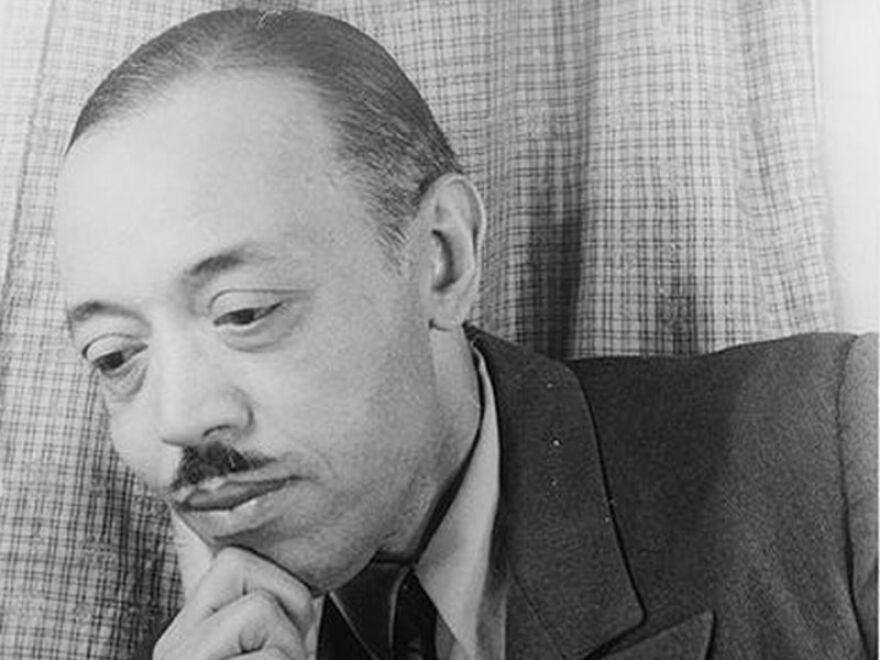
William Grant Still (1895–1978): Ennanga, for harp, piano, and strings (first movement)
William Grant Still
Nicknamed the “Dean of African-American composers,” Still completed more than 150 works, including eight operas and five symphonies. He was the first Black American to write a symphony that was performed by a major orchestra, and the first to conduct a major orchestra. In 1949 his opera about Haiti, Troubled Island, was produced by the New York City Opera—another historic first.
Still was born in Woodville, Mississippi, to college-educated teachers. His father, the town bandmaster, died when he was three months old. He and his mother moved to Little Rock, Arkansas, where she remarried. He began taking violin lessons at age 14 and taught himself viola, cello, double bass, clarinet, oboe, and saxophone. In 1911 he enrolled at Wilberforce College in Ohio, where he directed the band. His studies at Oberlin Conservatory of Music were interrupted by his Navy service. He played as a sideman for bluesman W.C. Handy, who brought him to Memphis and then New York City, where he became an oboist in Eubie Blake’s pit and made arrangements for theater orchestras and jazz and blues artists. He also studied with the influential atonalist Edgard Varèse.
Still completed the three-movement chamber composition Ennanga in 1956. The title is a Ugandan word that refers to a small harplike instrument, and the score contains a prominent part for the Western harp, as well as piano and string quintet. For technical advice, Still consulted the harp virtuoso Lois Adele Craft, who also performed at the Los Angeles premiere. In the first movement, the harp and piano alternate between percussive and melodic roles, often evoking Juba, or hambone, a centuries-old African-American dance form that calls for stomping, slapping, clapping, and patting the body.
Traditional: “A City Called Heaven” (arr. Tyzik)
Like many traditional spirituals, “A City Called Heaven” predates the American Civil War and exists in numerous versions, under many titles, including “Poor Pilgrim of Sorrow,” “Poor Pilgrim,” “Tossed and Driven,” and “Tryin’ To Make Heaven My Home.” It was first documented in the 1907 collection Folk Songs of the American Negro, compiled by John Wesley Work, Jr. (1871–1925), an influential African-American scholar of folk songs and spirituals.
Still: Symphony No. 1 in A-flat Major (Afro-American Symphony) (third movement, Animato)
Still began sketching his most famous work, the Afro-American Symphony, in 1924, not long after he played in the pit orchestra for Eubie Blake and Noble Sissle’s Shuffle Along, which featured Josephine Baker and Paul Robeson, among other luminaries of the nascent Harlem Renaissance. The sketches remained in limbo for some time while Still worked on other projects. As he later explained, “it was not until the Depression struck that I went jobless long enough to let the Symphony take shape. In 1930 I rented a room in a quiet building not far from my home in New York and began to work.” Two months later, Still’s First Symphony was complete. In a notebook that he kept during composition, he assigned alternative titles to each movement: the third, Animato, was designated “Humor.”
In 1931 Howard Hanson conducted the premiere—marking a milestone in Still’s career, as the first symphony by a Black composer to be performed by a major orchestra—and the 36-year-old composer’s career took off. He received commissions from several orchestras and a Guggenheim Fellowship. He eventually moved to Los Angeles, where he arranged film scores and popular music while honing his own powerful musical idiom: a blend of European post-Romanticism, jazz, blues, and spirituals.
In 1964 Still described the creative impetus behind his Afro-American Symphony: “I wanted, above all, to write music that would be recognizable as being in the idiom employed [by the American Negro] or recognized, I should say, as that of the American Negro. It was the object that I desired most of all.”
John Newton (1725–1807); William Walker (1809–1875): “Amazing Grace” (arr. Tyzik) First published in 1779, the words to the iconic Christian hymn “Amazing Grace” were written by the English poet and Anglican clergyman John Newton. A former seaman and slave-ship captain, Newton experienced a spiritual epiphany, converted to Christianity, and eventually became an ordained curate in the Church of England, as well as an abolitionist. He wrote “Amazing Grace” to accompany a sermon for New Year’s Day of 1773. Although the poem has been associated with at least 20 different melodies over the years, its most famous iteration was created in 1835 by the American Baptist song leader and compiler William Walker, who set it to a tune called “New Britain” and transcribed it in a shape-note format.
Traditional: “Ride On, King Jesus” (arr. Tyzik)
Another anonymous antebellum spiritual, “Ride On, King Jesus” appeared under the title “No Man Can Hinder Me” in the first anthology of published spirituals, Slave Songs of the United States (1867). In the late 19th century, it became a concert staple of the Fisk Jubilee Singers, who performed several tours to raise money for Fisk University, a historically Black institution founded in 1866, in Nashville, Tennessee. Henry (“Harry”) T. Burleigh (1866–1949), who had studied with Dvořák, collected and arranged “Ride on, King Jesus” as well as many other songs in his Jubilee Songs of the United States of America, first published in 1916.
Antonín Dvořák (1841–1904): “Goin’ Home” (arr. Tyzik) In the spring of 1893, when Antonín Dvořák was finishing his Symphony No. 9 in E minor (“From the New World”), the Czech composer made a bold prediction: “I am now satisfied that the future music of this country must be founded upon what are called the Negro melodies. This must be the real foundation of any serious and original school of composition to be developed in the United States.”
The Ninth Symphony was the first of several works that Dvořák wrote entirely in the United States. Although he urged his National Conservatory students to explore indigenous musical forms, he had at that point heard only a smattering of American folk songs, notably the spirituals that his Black student and assistant Henry (“Harry”) Thacker Burleigh sang for him.
For the symphony’s most famous theme, Dvořák chose the English horn because it reminded him of Burleigh’s voice. This deceptively simple, deeply moving melody—apotheosized in the second movement but present, in some form or another, throughout—gives many listeners the mistaken impression that they are listening to an existing spiritual. In 1922 William Arms Fisher, another of Dvořák’s former students, added lyrics to Dvořák’s original theme, thereby creating the nostalgic ballad “Goin’ Home.”
Traditional: Medley (arr. Tyzik): “Every Time I Feel the Spirit,” “Joshua Fit the Battle of Jericho,” “Sometimes I Feel Like a Motherless Child,” Swing Low, Sweet Chariot”
This medley is dedicated to Henry T. Burleigh, a gifted Black baritone singer, composer, and arranger who dedicated his life to promoting the spiritual as a serious American art form.
Of unknown authorship, “Every Time I Feel the Spirit” predates the American Civil War. The first stanza refers to Moses receiving the Ten Commandments on the mountaintop; the second describes being baptized in the Jordan River and the “heavenly train,” which is sometimes interpreted as a coded reference to the Underground Railroad.
“Joshua Fit the Battle of Jericho” is another anonymous spiritual of a similar vintage. (“Fit” is African-American Vernacular English for “fought.”) The words allude to the biblical story of the Battle of Jericho, when Joshua led the Israelites into battle against the Canaanites.
The haunting and heart-rending “Sometimes I Feel Like a Motherless Child” was composed by another unknown enslaved poet. The great American bass-baritone, actor, and political activist Paul Robeson—himself the son of a former slave—made multiple recordings of the song, beginning in 1926.
Although its exact origins are unknown, “Swing Low, Sweet Chariot” is often attributed to Wallis Willis, an enslaved Black man who was born in Mississippi and forcibly moved to Oklahoma by his enslaver, a member of the Choctaw Nation. Alexander Reid, a minister at the Choctaw boarding school where Willis and his wife were employed, heard the couple singing it and then transcribed the words and melody, which he sent to the Jubilee Singers of Fisk University. In 1909 the Jubilee Singers made the first recording of the song, which is worth seeking out on YouTube.
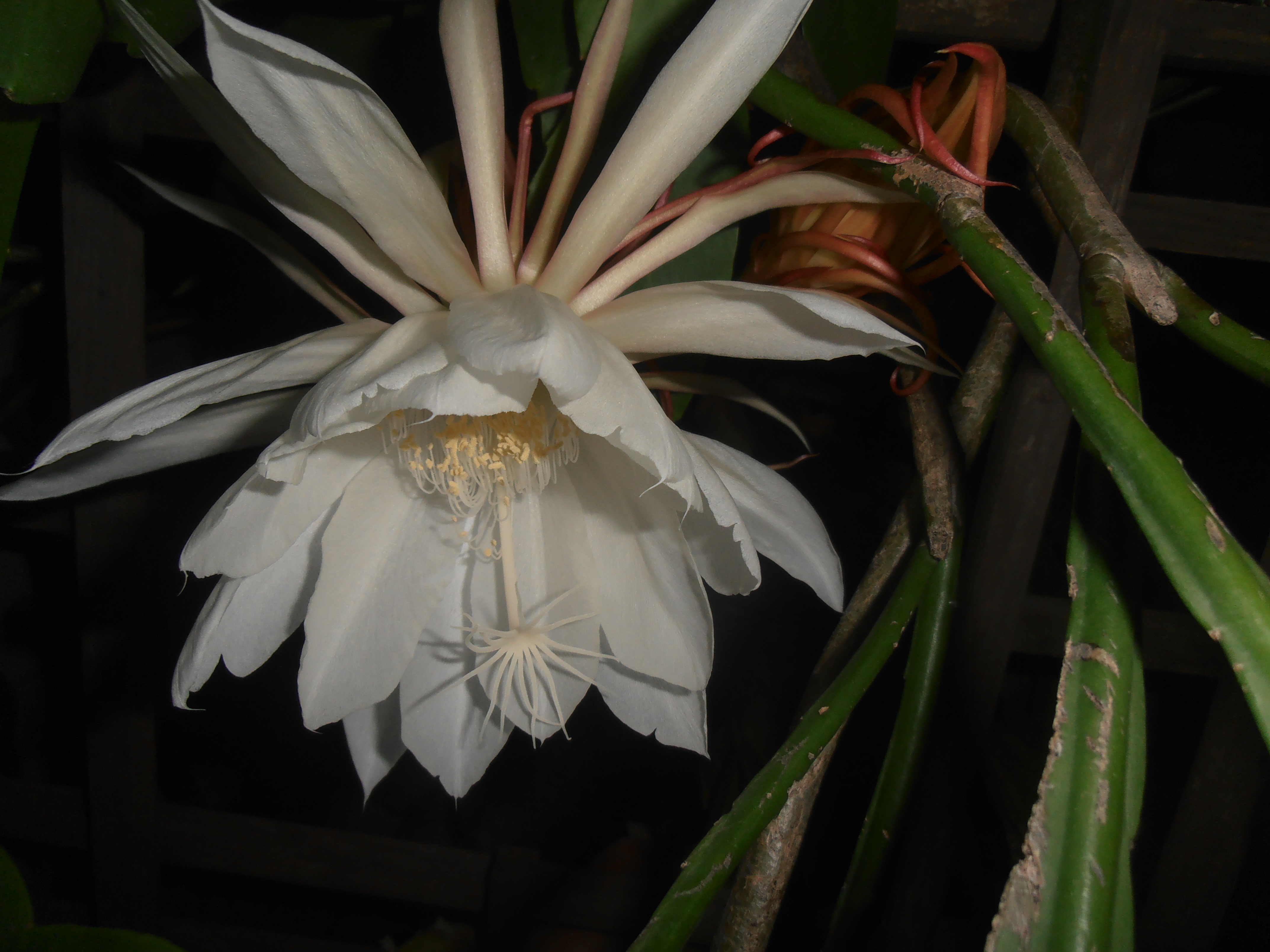
I took this photo with my inexpensive digital camera (a 10-year-old Olympus that has been a true champ). I took it either the night of June 13 or the night of June 14; I got four big blooms in a 48-hour period, but I can’t keep the photos straight because the blossoms all look very similar).
I neglected to update my blog last week, even though I made a mental note that I could, say, celebrate the birthday of Richard Strauss (June 11) by posting a bunch of annotations from my vast backlog of notes that have been published but not online.
In my defense, I have been busy writing marketing client for a new client, one I value enormously and would like to retain, and I have also been doing other things, like studying French again on the free Mango app (free with my St. Louis Public Library card anyway–such a fantastic deal!), and reading books (I highly recommend the new Megan Abbott novel, Beware the Woman), learning to recognize the birdsong of various species in my backyard with the Merlin app, tending to our menagerie of geriatric companion animals (three cats in their mid to late teens, one dog who is estimated to be about 12), and, most relevant to this post, enjoying our small but fertile and fragrant garden.
Our night-blooming cereus is a reliable bloomer in the late spring and throughout the summer. Really, as soon as we put it outside on the patio, after its winter sabbatical indoors, which it seems to resent mightily, a sulking, drooping, morose succulent deprived of the only thing it really seems to care about, being outdoors. My mother-in-law was given this plant in the early ’80s, I believe, but the plant was already mature when she got it. She used to keep it on their brick patio on Westminster, but when they moved, they didn’t want to deal with it anymore (it’s extremely large and cumbersome and, if I’m being perfectly honest, not at all beautiful aside from the blooms, which last only one night and keep their own unpredictable blooming schedules).
That said, it’s hard to imagine a blossom more beautiful. Some people call it Queen of the Night, which I like because it reminds me of the famous Mozart aria, from The Magic Flute, but I haven’t adopted the nickname myself because night-blooming cereus is what I have known it, since I first encountered it on my in-laws’ patio back in the mid-90s.
I could include a lot more information about the n-b c, as my husband and I have taken to calling it, but instead I will just let you look at the photos. The petals remind me of swan feathers, elegantly curved and impossibly delicate. There’s that weird little sculptural stamen, like one of those Louise Bourgeois spiders, only small and pale. The bud, before it opens, looks like a frightening David Cronenberg creature, perhaps something out of eXistenZ. When more than two blossoms are opening at once–we had three on the night of June 14–the fragrance is almost overpowering. Imagine a gardenia on steroids. There’s a strong lemony floral top note, so dominant that it almost smells acrid, like mass-market kitchen cleaners, but this gradually fades to a much more pleasant, almost creamy classic white-petal scent.
By sunrise, the blossoms are spent and sad, resembling nothing so much as a used condom you might see on the street.
More classical music content coming soon, I promise.
me at about 7 (left), not wearing the glasses I desperately needed, and my best/only human friend, Lisa Jackson, who was born on June 3; she was just shy of 2 months younger than I was, but we went to different schools (public for me, Catholic for her).
When I was almost five, before I started kindergarten, my parents moved us from their student-housing apartment at Spring and Delor, in South St. Louis, to an old ramshackle stucco house on Bompart, in Webster Groves. I don’t remember how I met Lisa, but we were the same age and lived nearby (less than a minute away if we ran through the Gibsons’ yard, which we always did), and so we became best friends. I admired her beauty and athleticism, her exotic Catholic customs–preparing for First Communion in her frilly little bride’s dress, reciting the rosary, enumerating the various features of Hell–and her ability to make friends and not come off as unforgivably weird, which is eventually what caused our friendship to founder, in the tween years, when the chasm between the popular and the unpopular widens with the onslaught of hormones.
When Lisa was in her early teens, her mother died–her mother had been very loving, the kind of woman who would take you in her arms and hold you when you are sobbing in terror and shame–and unfortunately, her father behaved the way too many dads behaved back then. I remember him as an ambulatory Bad Mood, a sudden stink of cigar and angry sweat, a basement bellow. I was terrified of him, but unlike Lisa I could always run home when he started shouting. Once when we were seven or eight, Lisa cried out in tears to me from her second-floor bedroom window, begging me to come back inside to play, assuring me that he didn’t mean it and wasn’t really that mad. I had run out of her house after her dad had screamed at us, and even though I never stopped feeling sorry for her and ashamed of myself, I was more scared of him, so I barely even hesitated: I just ran home. Her dad’s threats always struck me as credible. My dad was human, which is to say imperfect, but he was kind, especially to children and animals; he wasn’t violent, and he seldom raised his voice. My grandpa was similarly gentle. I wasn’t used to volatile men, and I couldn’t have protected Lisa even if I had been brave enough to try. But I still wish I had tried. I wish I had been braver, a more loving friend.
No one needed to stand up for her when her mom was alive. Her mom constantly appeased her dad while also lavishing love on her many kids. Lisa was the seventh of seven kids, which was common back then, when birth control was legal but still a grievous sin for good Catholics. I always thought Lisa was her mom’s favorite, but it’s possible that all her siblings felt that they were Mrs. Jackson’s favorites. Even after she became ill with emphysema, she had endless energy for mothering. She was as talented at love as her husband was bad at it.
Lisa and I fell out of touch a few years before her mom died, and I saw her maybe once when we were young adults, in our early 20s. She was surprisingly tall, even though she had been short for her age as a kid, shorter than me anyway. We were at a loud and crowded Painkillers show, at the Great Grizzly Bear in Soulard, so we didn’t have much time to chat, but I remember being happy that she had made it through somehow, that she had survived her childhood and the unthinkable loss of her mom. We reconnected on Facebook a couple of decades after that, but unfortunately that was the same year she died, not long before what would have been her 47th birthday; we never got the chance to see each other again in real life, even though she lived a few neighborhoods over, perhaps a five-minute drive away. I cherish our few Facebook messages, as I do my many memories of her. I know she must have been a superb mother, and it breaks my heart that her only, much-loved daughter lost her at about the same age that Lisa was when she lost her own mother. (I’m consoled by the knowledge that Lisa chose a man who was the opposite of her dad, a good and loving father.)
I prefer to dwell on the happy memories of Lisa. Her abundant beauty: she could have been a child model, with her shining flaxen hair and her honest blue eyes. Although she didn’t share my love of lazing around all day reading from her mom’s old box of Nancy Drew mysteries, the ones with the tweedy blue covers from the 1940s, she was a cheerful participant in most of my idiot schemes and projects, and I hope I returned the favor. We devised inscrutable choreography to “Hit the Road, Jack” and “Maxwell Silver Hammer” and made squirrel costumes out of my mom’s old nylons. We sold her dead grandfather’s wide silk ties on the street to skeptical pedestrians and Webster College students, and then cut up the rest to make Barbie attire. We bought a frozen chocolate-cream pie at the grocery store with coins we had scrounged from various couch and sofa cushions, and then ate the entire thing, semi-thawed, in her basement before getting violently ill. We caught a praying mantis and named him Hermie, a compromise name because one of us thought Herman would be better, and the other thought Herbie would be better, and I no longer remember who preferred which name because we both had equally dumb reasons for our choices, related to the cinematic sentient VW Bug and the patriarch of the Munsters. We caught a few cockroaches in my old dilapidated house’s upstairs bathroom and fed them to Hermie, feeling brave and resourceful. I don’t remember what happened to Hermie, but I hope he escaped our ministrations somehow. We were fine with our dogs, cats, guinea pigs, and rodents, but we didn’t know the first thing about mantids.
No one has ever asked me to name my favorite Taylor Swift song, but if asked (and apparently even if unasked) I would not hesitate to say “seven,” from folklore, which, as cornball as this sounds, gave me chills of recognition the first time I heard it and sometimes still does. It sounds like my memories of Lisa: a foundational friendship that was entirely based on proximity and coincidence and yet also perfect for a time. Under duress, I could probably come up with some semipersuasive blah-blah-blah about Swift’s subtle enjambment, or the way the verse melody veers off into slight variations that almost make it sound through-composed, instead of the supposed “folk song” it supposedly is. But I would be lying if I said I loved the song for those peripheral tricks instead of my real reason, which is that it makes me think of Lisa, who died years before “seven” was written.
Back in 2013, when we briefly reconnected, I told Lisa that I still remembered her birthday every year, which is unusual for me, someone who seldom remembers dates or numbers in general. She instantly shot back a message with my correct birthday.
Passed down like folk songs, the love lasts so long. (This time I tried to embed the video, but YouTube wouldn’t let me. So you will have to click on the link if you want to hear this Taylor Swift song, sorry.)
Kaija Saariaho, b. October 14, 1952; died June 2, 2023
I just learned that the great Finnish composer Kaija Saariaho died today, at 70, as a result of brain cancer. If you’re not familiar with her strange and seductive sound world, you might start with Laterna Magica. I wrote about it for the Dallas Symphony (the 19-20 concert season), but I don’t believe I ever posted my notes (which are mostly her own quoted program notes–and the better for it). One of these days I’m going to figure out how to embed YouTube videos instead of just linking to them, and perhaps this will be that day, but if not, listen to Laterna Magicahere. (Update: Indeed, it is that day!)
Kaija Saariaho: Laterna Magica. I don’t own the rights to this music and in fact barely know how to insert videos, so please don’t sue me.
KaijaSaariaho: Laterna Magica
Born in Finland, in 1952, Kaija Saariaho studied music at the Sibelius Academy in Helsinki, where she was the sole woman in a class taught by Paavo Heininen. She joined an experimental collective with likeminded composers (including Esa-Pekka Salonen and Magnus Lindberg) called Korvat Auki! (Ears Open!). In the early 1980s, she moved to France, where she discovered the spectralists, who use computers and other equipment to analyze soundwaves. She became involved in IRCAM, an institute in Paris founded by Pierre Boulez and dedicated to the study of electro-acoustical art music.
Like Messiaen, Saariaho is a synesthete: someone who associates particular sounds with other sensory phenomenon. “Different senses, shades of color, or textures and tones of light, even fragrances and sounds blend in my mind,” Saariaho has said. “They form a complete world in itself.”
The Composer Speaks
“Laterna Magica (The Magic Lantern) alludes to the autobiography of the same name by film director Ingmar Bergman. The book caught my eye after many years whilst I was tidying my bookcases in autumn 2007.
“In time, as I read the book, the variation of musical motifs at different tempos emerged as one of the basic ideas behind the orchestral piece on which I was beginning to work. Symbolizing this was the Laterna Magica, the first machine to create the illusion of a moving image: as the handle turns faster and faster, the individual images disappear and instead the eye sees continuous movement.
“Musically speaking, different tempos underline different parameters: the rhythmic continuity is accentuated at relatively fast tempos, whereas delicate shades require more time and space for the ear to interpret and appreciate them.
“While I was working with tempos, rhythms with different characters became a major part of the piece’s identity: a fiery dance rhythm inspired by flamenco, a shifting, asmmetrical rhythm provided by speech, and an accelerating ostinato that ultimately loses its rhythmic character and becomes a texture. In contrast to this, there emerged music without a clear rhythm or pulse. This material is dominated by strongly sensed colorful planes and airy textures, such as the unified color of six horns, which divides the orchestral phrases. This use of horns points to Bergman’s film Cries and Whispers, in which the scenes are often changing through sequences of plain red color.
“When reading the autobiography I was also touched by the way Bergman described the different lights which his favorite photographer, Sven Nykvist, was able to capture with his camera. Part of the text found its way into the piece in German—for the work was commissioned by the Berlin Philharmonic. The extract, in English, goes as follows:
Author of SAINT OF THE NARROWS STREET, SHOOT THE MOONLIGHT OUT, CITY OF MARGINS, A FRIEND IS A GIFT YOU GIVE YOURSELF, THE LONELY WITNESS, EVERYTHING IS BROKEN, DEATH DON'T HAVE NO MERCY, and GRAVESEND








 René Spencer Saller