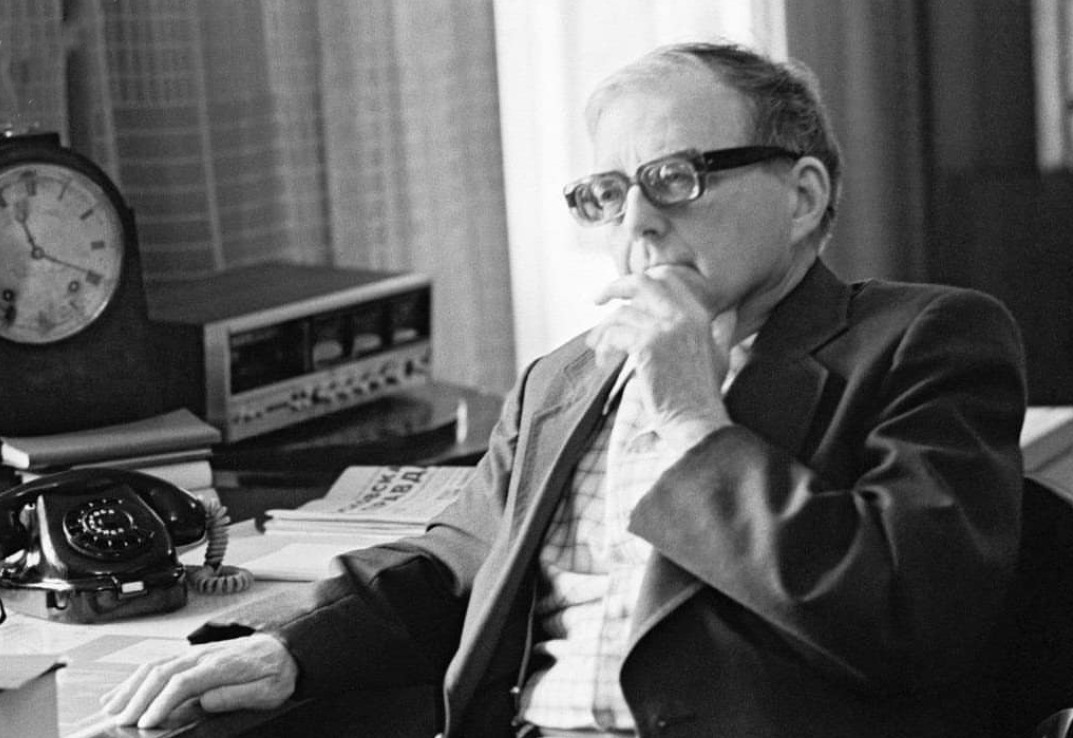
Shostakovich’s 15th

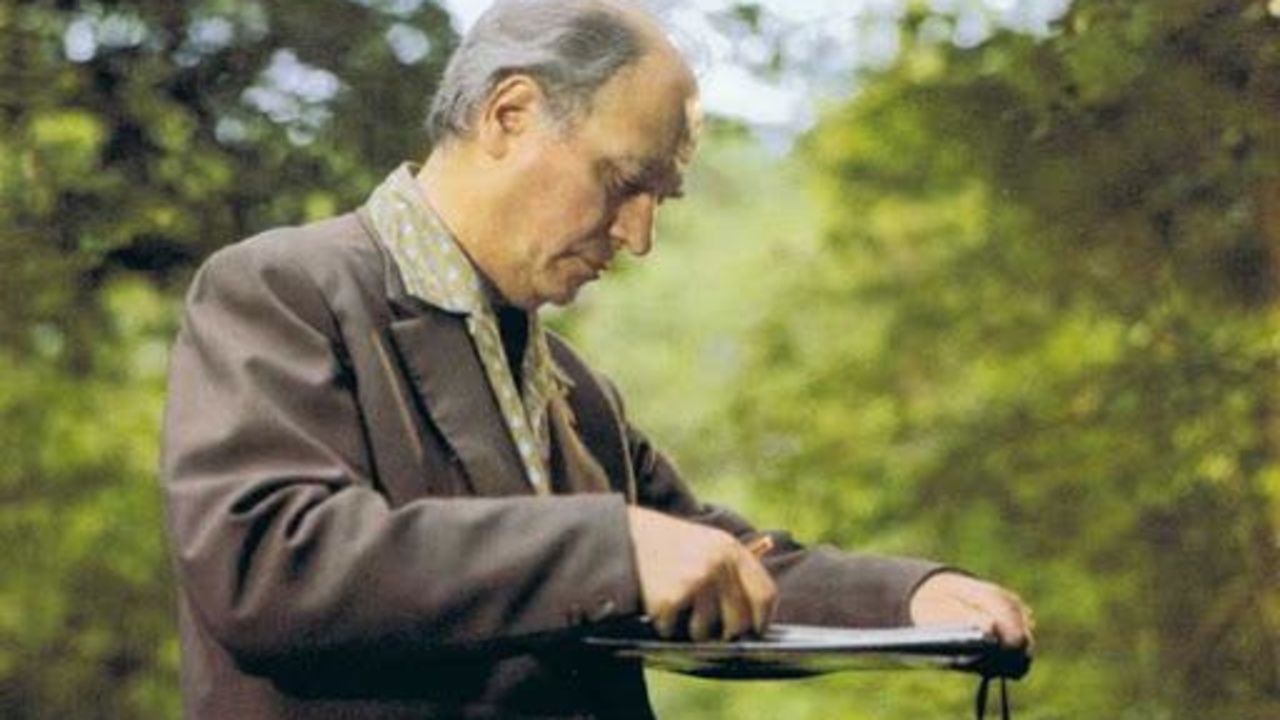
One of the last photographs taken of Dmitri Shostakovich, in his Moscow studio, June 1975.
Credit: A. Zuyev

I have been remiss in updating my blog lately, although my writing continues apace. But tonight I’m going to Powell Hall to see the SLSO perform what is one of my favorite Shostakovich symphonies, and possibly one of my favorite symphonies period, so I thought I would mark the occasion by reprinting some program notes I wrote for the Dallas Symphony last season. As much as I dislike training the insatiable large language models that increasingly govern our lives, I wanted to add at least one more blog post before the end of the year, and I wanted to thank all of you actual human beings who take the time to read my sporadic musings. So thank you!

Dmitri Shostakovich (1906–1975): Symphony No. 15 in A Major, Op. 141

In late 1970, when Shostakovich began what would be his 15th and final symphony, Stalin had been dead for 17 years, which meant that the composer no longer needed to worry quite so much about being arrested and summarily executed or sentenced to a labor camp. Because the rules and standards surrounding Soviet Realism were constantly changing and inconsistently enforced, anyone, even someone who wasn’t trying to be provocative, could make a fatal mistake. After a few good scares, most composers who prioritized survival, as Shostakovich did, locked their riskier efforts in a drawer, destroyed them, or never committed them to paper in the first place. Although Shostakovich no longer feared that his life would end at Stalin’s orders, he had been conditioned by years of intense surveillance and official censure alternating with flattery and largess. Anxiety was his patrimony. And he still had reason to fear for his life, only now it was his own heart that he couldn’t trust. 

At first he intended Symphony No. 15 as a present to himself on his 65th birthday. He wrote a friend that he wanted to compose a “merry symphony.” But his merriness went only so far. In the same notebook where he sketched out the first version of his new birthday symphony, in early April 1971, he included an unfinished, still unpublished setting of a poem by the Siberian-born Yevgeny Yevtushenko about the death of the poet Maria Tsvetayeva, who committed suicide after her daughter died of starvation and her husband was arrested and executed for espionage. 

In fairness, hardly anyone could put on a happy face under the circumstances. Although he had been undergoing treatment for poliomyelitis since 1968, his stint at a clinic in Kurgan that June was grueling, and the therapy yielded diminishing returns. “Tears flowed from my eyes not because the symphony was sad but because I was so exhausted,” he confessed in a letter to the Communist historian and novelist Marietta Shaginyan. “I even went to an ophthalmologist, who suggested that I take a short break. The break was very hard for me. It is annoying to step away when one is at work.” 

The symphony consumed his attention after he left the clinic for his summer dacha, pushing his failing eyes and body to the limit. Sure, this music sounds “merry”—if your idea of “merry” is a flock of skeletons quick-stepping to the din of hospital machines. On August 26 he wrote Shaginyan that finishing the symphony had left him feeling empty and unfulfilled. 


Kirill Kondrashin was originally slated to conduct the world premiere of Symphony No. 15, but poor health forced him to cancel. Luckily, Shostakovich had the ideal backup: his own son Maxim. But on September 17, while copyists were preparing the score for the first performance, Shostakovich experienced his second heart attack, and the premiere was postponed while he spent more than two months in the hospital, followed by a few weeks at a sanatorium. He was released in time to attend the rescheduled rehearsals, and the world premiere took place at the Large Hall of the Moscow Conservatory on January 8, 1972, with Maxim Shostakovich conducting the All-Union Radio and Television Symphony Orchestra. 

Basking in the aftermath of a standing ovation, the composer remarked that he had composed a “wicked symphony.” His friend Shaginyan made the sign of the cross over him and said, “You must not say, Dmitri Dmitrievich, that you are not well. You are well, because you have made us happy!”

A Closer Listen
Symphony No. 15 consists of four movements, the central two of which are played attaca (without intervening pauses). Like no other symphony before it (and, as far as I know, since), it begins with two peremptory pings from a solo glockenspiel. Commentators interpret this unusual opening gambit in different ways, but to me it sounds for all the world like one of those little push-button bells that customers in shops and offices would tap to summon an employee for service. (Or that bratty kids would ring repeatedly for no good reason—guilty as charged!) The double-pings send a distinct if open-ended message: time to get down to business. 

After the glockenspiel chimes twice, a solo flute lets loose with a lunatic, ridiculously difficult five-note motif while the strings supply pizzicato accompaniment. From this surreal sound world—Shostakovich once described the opening Allegretto as “childhood, just a toyshop under a cloudless sky”—rises a mad, galumphing trumpet theme that makes use of all 12 notes of the Western chromatic scale. Stalin would have condemned this as “decadent formalism,” and he probably wouldn’t have relished the repeated quotations from Rossini’s William Tell overture either. Later, in the finale, Shostakovich quotes from two Wagner works (the Ring cycle and Tristan und Isolde), his own Seventh Symphony, and Rachmaninoff’s Symphonic Dances.

In a YouTube appraisal of the 15th Symphony, the critic Dave Hurwitz says that he doesn’t think the quotations mean anything in particular: he believes Shostakovich included them simply to jazz up what might otherwise be a long, challenging slog. Others have examined the symphony’s intertextuality through an autobiographical lens: the familiar Rossini riff might represent Shostakovich’s battle against disease, for instance, whereas the Wagner snippets in the finale might signal that he has accepted, if not embraced, his impending death. 

Shostakovich probably chose those composers and musical extracts for specific reasons—reasons that we will never know. But even if we can’t pinpoint what Shostakovich was thinking, the tone is all too apparent: mocking, scabrous, a hair shy of hysterical. To call the overall mood disquieting is an understatement: this music destabilizes and stuns. 

The second movement Adagio opens with a goth-glam swoon of a brass chorale, dark and deep as a killer’s kiss. Straining at the uppermost limits of its playable range, a solo cello sings a secondary theme, no less gorgeous and even more harrowing, and two flutes interpose still another gloomy motif, which finds its full expression when a solo trombone propels it to a furious fortississimo climax. But the slow movement ends not with a bang but a whimper. Muted strings murmur the opening chorale, but their hearts aren’t in it. Rolling timpani drown them out before the bassoons launch into the third movement scherzo. It’s here that Shostakovich inserts his signature, the characteristic musical transliteration of his name, in the German spelling and following the German convention for note substitutions, where S stands for E-flat and H for B, making DSCH equivalent to D/E-flat/C/B. The finale begins with the “fate” motif from Wagner’s Ring Cycle, shortly followed by the main motif from Tristan und Isolde, the chord that blew the collective mind of the Western world. (Read Alex Ross’s Wagnerism if you think I’m exaggerating.) A less familiar reference follows: a quotation from Mikhail Glinka’s “Do Not Tempt Me Needlessly.” Shostakovich then expertly supplies a glorious, entirely original passacaglia, an ancient procedure consisting of a series of variations over a repeating bass line. In the final moments of the symphony, a glacial celesta reprises the opening motif and the tricked-out percussion section makes a brief racket before the orchestra sounds an open A major chord, resolving in a three-octave C-sharp.

The American auteur director David Lynch listened to Symphony No. 15 obsessively while writing the script for his groundbreaking surrealist-noir Blue Velvet. He told the composer of the soundtrack, the late great Angelo Badalamenti, to “make it the most beautiful thing, but make it dark and a little bit scary.” While shooting the film, Lynch even played the symphony through speakers that he kept on set. Badalamenti’s haunting, synth-hollowed score contains several allusions to the symphony, along with nods to technicolor ’50s pop arias such as Bobby Vinton’s “Blue Velvet” and Roy Orbison’s “In Dreams.”

Copyright 2024 by René Spencer Saller. All rights reserved.

The Muse Known as Misia

Misia photographed by her great friend and admirer Edouard Vuillard, in 1901

In 2009 the French musicologist David Lamaze identified a distinctively Ravelian three-note motif, E-B-A, as a musical cipher for “Misia.” The concise theme, which surfaces at critical points in La Valse and throughout Ravel’s work, is expressed as mi-si-la in French solfège intervals. This is likely a coded reference to the composer’s friend Misia Sert (née Maria Zofia Olga Zenajda Godebska), the glamorous and enigmatic pianist, muse, patron, painter, and artist’s model who was known as the Queen of Paris. Ravel dedicated La Valse to her, along with his famous song “Le Cygne” (The Swan). Her piano teacher, Gabriel Fauré, was disappointed when she chose not to follow his advice and pursue a career as a concertizing pianist. She decided instead to marry, which she did three times (and was thrice divorced).
 
Because she was a great friend of its founder, the designer Gabrielle “Coco” Chanel, the French luxury brand Chanel named a limited-edition fragrance after Sert in 2016. Created by the parfumier Olivier Polge, Misia is meant to conjure the ambience of opera-hall dressing rooms: a complex concoction of rose, iris, and violet, with hints of talcum powder, amber, leather, and tonka bean. Like my beloved bottle of Misia eau de parfum, which I store in the refrigerator to delay the inevitable process of oxidation, La Valse is decadent: laden with a sense of lateness, the ripe promise of rot. And to quote the great philosopher Peggy Lee, “If that’s all there is, my friend, then let’s keep dancing.”
 
 
Misia by Pierre Bonnard
Misia by Henri Toulouse-Lautrec
Misia with Renoir and friends
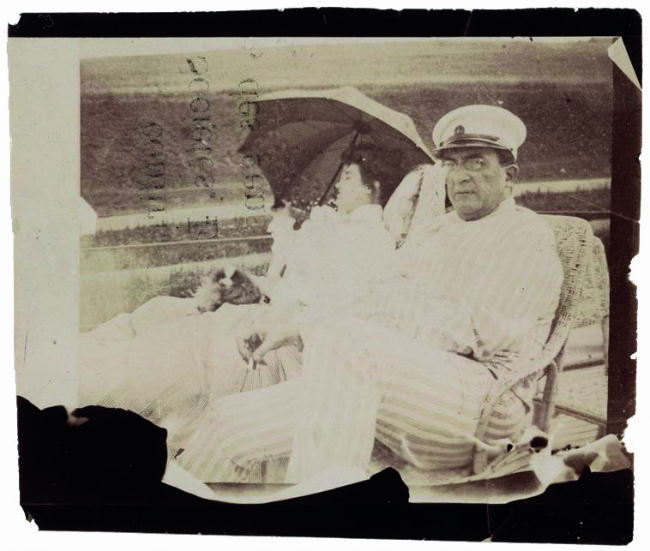
Misia with her first husband and their dog, by Bonnard
Misia with her second husband, whom she married at the urging of her first husband, who was badly in debt. This one, she said, turned her into the most spoiled girl in the world (she didn’t mean this in a good way).
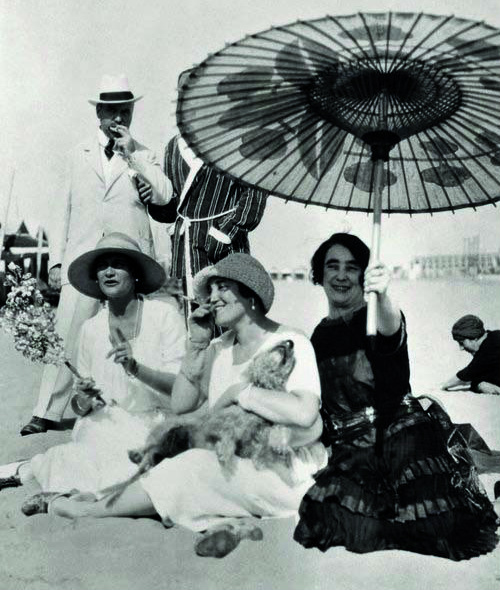
Misia with her great friend Coco Chanel and Diaghilev (background). I don’t know who the woman holding the parasol is. Misia is the one holding the happy dog.

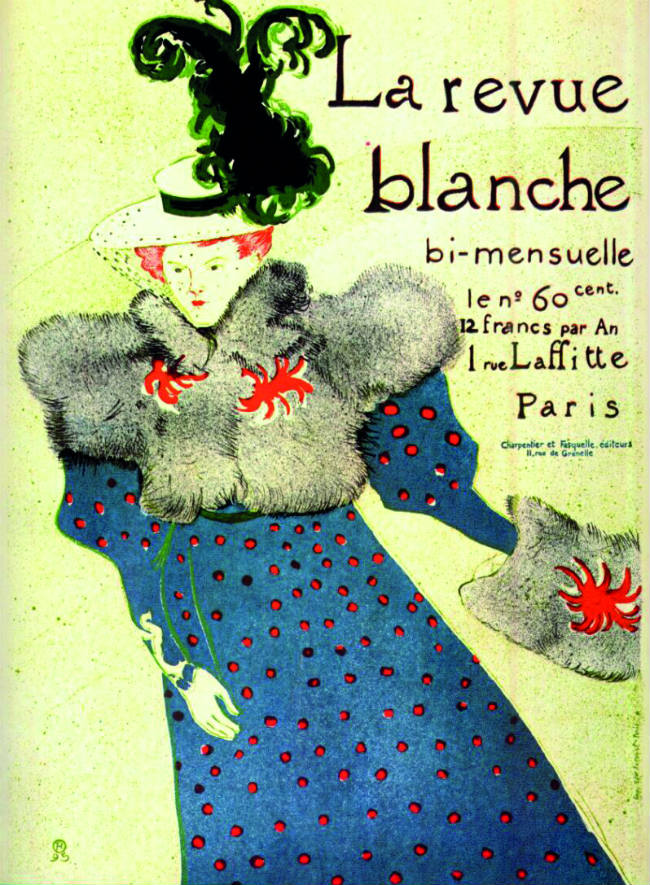
Misia on the cover of the literary journal she founded with her first husband
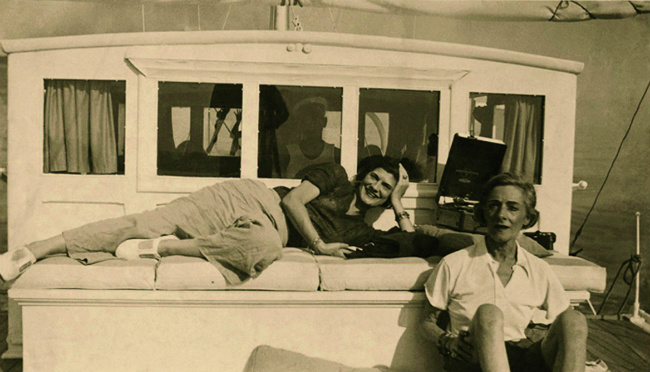
Misia (foreground) with her great friend Coco Chanel, who would prepare her body for burial and mourn her the rest of her life.

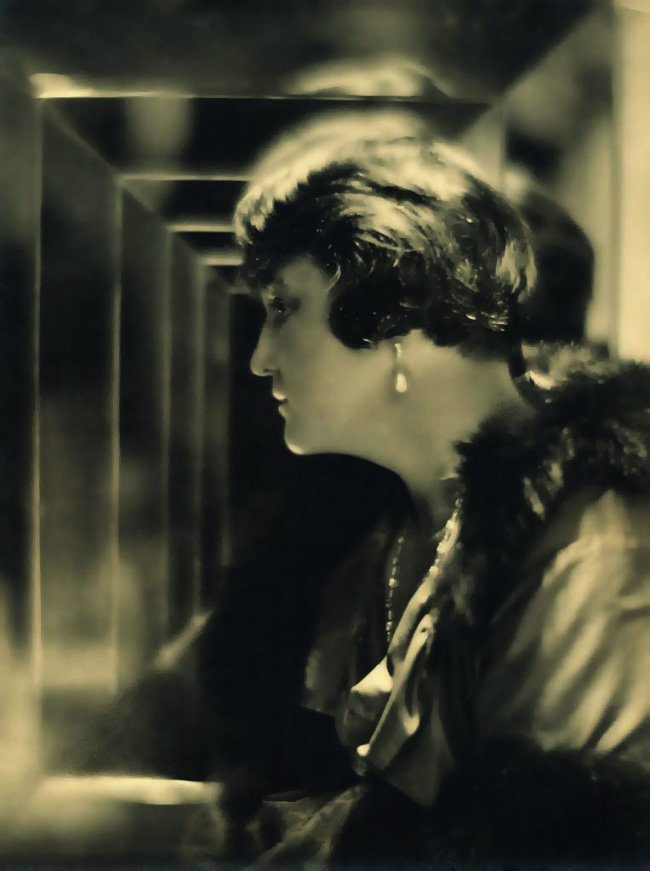
Misia in profile

Weird Work in Progress

Sergio Larrain, 1957

I kept thinking I ought to update my blog because I was probably falling behind, but I didn’t bother to check to see when my last update was, and I’m genuinely surprised to learn that it was nearly a month ago. I don’t feel like I have been messing around and slacking off, but the page views don’t lie.

I have been busy writing, but I am not always writing what I ought to be writing, the writing for which I am paid and which my clients have a reasonable expectation of receiving. I have been writing the first draft of a novel that has been marinating in my mind for the past three years or so, maybe longer. I know I am definitely using sections that I wrote back in 2021.

I’m too superstitious to say too much about it, and I don’t want to jinx it by discussing the plot too much before the first draft is complete, but it’s kind of a magical-realist horror novel about identity, art, and motherhood, with a special emphasis on muses and monsters.

Instead of prattle on too much about something I may very well never finish, I will share some of the photos that are inspiring me for reasons that I hope will be clear to at least a few people someday. As a lifelong compulsive reader, I have always suspected that there are far more great novels out there than I will ever be able to read, which is a huge disincentive to write, because why contribute to the glut, right? Most people don’t read anything close to the 70 or so novels that I’ll probably end up reading this year, and believe me I don’t make a dent in my Daunting Queue. I could show you my Goodreads stats, but why bother? We all know that the world needs another novel like it needs another novel coronavirus.

And yet why not finish it, even if it never gets published? I already know it’s not going to be another Moby Dick, and that manuscript was a total flop in Melville’s lifetime, so who can say what will happen? But if I never finish writing it, I’ll for sure never know.

All the subjects in these photos are somehow significant in the novel, but it is not a historical novel. And that’s the last thing I’ll say about it because I hate enigmatic posts and related forms of rhetorical coyness!

Many of these photos are of Manon Gropius, whose Wikipedia entry lists her occupation as Muse.

Some gig, huh? Berg called her an angel, and Canetti called her a gazelle, and her polarizing mother pawned her off on Austrofascists. Kid never stood a chance.


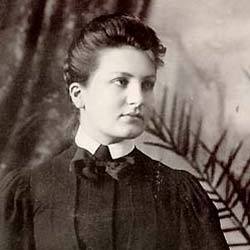
The young Alma Mahler (Alma Schindler)
Alma Mahler with her daughters Maria and Anna
Alma with her daughter Manon Gropius
Manon Gropius, with her father, Walter
Manon and Walter
Manon Gropius, 1933, shortly before she contracted the polio that eventually killed her.

Oh, and just to keep this connected to my regular writing career, here are some program notes that I wrote about Alban Berg’s Violin Concerto, which he wrote in memory of Manon, whom he called an angel.

A Double Requiem

Berg’s Violin Concerto, his last completed composition and arguably his most beloved, serves both as an elegy for Manon Gropius, the 18-year-old girl that he had loved like a surrogate daughter, and as a requiem for himself. Indeed, he died shortly after finishing it. According to his wife, he worked at a frantic pace, as if he knew his days were numbered. “I cannot stop,” he explained when she begged him to slow down. “I do not have time.” 

In 1904, when Berg was 19 years old, his older brother brought a stack of his lieder to Arnold Schoenberg, who had placed a newspaper ad seeking composition students. Although Berg’s family was too poor to pay for lessons, Schoenberg took him on anyway. Between 1901 and 1908, Berg wrote approximately 150 songs and other vocal works. After the dismal failure of his Altenberg Lieder in 1912, he stopped writing songs. Until his sudden, squalid death at age 50, from an infected insect bite, Berg focused almost exclusively on two operas: Wozzeck, which he completed in 1922, and Lulu, which remained unfinished when he died, on Christmas Eve, 1935.

Commissioned by the American violinist Louis Krasner, the Violin Concerto was Berg’s last completed work. When Krasner first approached Berg with the proposal, the composer was busy with Lulu and reluctant to crank out a glitzy showpiece. “You know that is not my kind of music,” he told Krasner. He needed money badly, however, so he eventually relented. On April 22, two months after he had accepted Krasner’s commission, he learned that Manon Gropius, the beautiful 18-year-old daughter of Alma Mahler (Gustav’s widow) and the architect Walter Gropius, had succumbed to poliomyelitis. Inspired by the death of a girl that he “loved as if she were his own child, from the beginning of her life,” as her mother phrased it, Berg began to work in earnest. He composed most of the Violin Concerto at his country home, Waldhaus, in Velden am Wörthersee, in the Carinthia region of Austria. 

In early June, Berg invited Krasner to join him and his wife, Helene, at Waldhaus. The two men played through the first part of the concerto together, hashing out the solo part. As Berg worked on the second half of the concerto, he asked Krasner to improvise in another room. When the violinist would tire, after playing nonstop for hours on end, Berg would suddenly appear and urge him to continue. By July 15, the score was more or less complete; the orchestration was finished less than one month later. “I have never worked harder in my life,” Berg declared, “and what’s more, the work gave me increasing pleasure.” After obtaining permission from Alma Mahler, he dedicated the Violin Concerto “to the memory of an angel.”

Berg never got the chance to review and correct the published score, and he died before the premiere could take place. Krasner performed the solo role on April 19, 1936, at the International Society for Contemporary Music Festival in Barcelona. 

A Closer Listen

Cast in two large movements instead of the conventional three, Berg’s Violin Concerto can be further divided into four parts. The first movement comprises an Andante section and a longer Allegretto section. The second movement begins with an Allegro section and concludes with a substantial Adagio. According to many commentators, the first movement represents life, the second death and transfiguration. In the first movement, Berg quotes from a Carinthian folksong, a rustic Ländler that some scholars interpret as a wistful allusion to Marie “Mizzi” Scheucl, the servant girl who bore his illegitimate daughter in 1902, when he was 17 years old. 

Early in the summer of 1935, Berg asked his research assistant, Willi Reich, to send him some of Bach’s cantatas. In the last part of the second movement, Berg incorporates a series of variations on “Es ist genug!” (“It is finished!”), using some of Bach’s original harmonies. The chorale’s melody begins with the last four notes of Berg’s tone row: B, C-sharp, E-flat, and F. Because it contains all twelve notes of the chromatic scale, the tone row is the foundation for twelve-tone composition, a formal procedure that Schoenberg developed and taught to Berg. But Berg’s series of notes also lends itself to a looser, more tonal mode of expression, which accounts for the Violin Concerto’s considerable emotive power.

Copyright 2018 by René Spencer Saller

A bit of bonus content for the true fans:

Alban Berg (born in Vienna, 1885; died in Vienna, 1935, reportedly from an infected insect bite.
Manon and her dad, who doted on her (he wanted custody of her when he and Alma split, but sadly it didn’t work out because Alma, despite her promises during the divorce negotiations, had other ideas).

Teenage opera ephemera

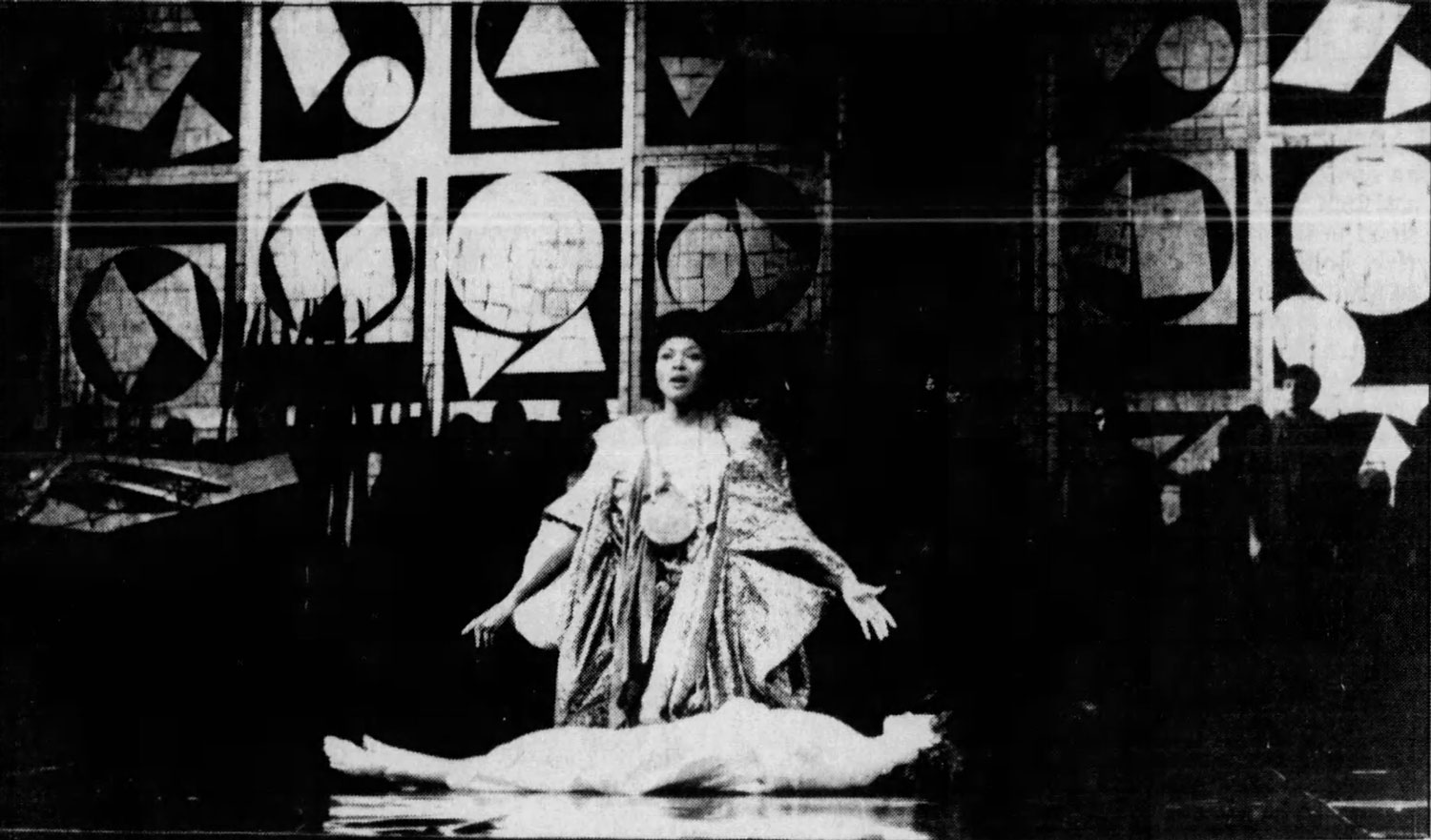
Alteouise Devaughn as Orfeo, with beautiful sets and costumes by Louise Nevelson, from an Opera Theater St. Louis production that took place in early June, 1984. This photo ran in the Post-Dispatch originally, and I apologize to whoever holds the copyright and will take it down if need be (although I hope not, because I didn’t take photos and do not have a time machine).

My friend Greg Kessler, who runs and holds the copyright to the invaluable blog St. Louis Punk Archive and its associated Facebook page, was kind enough to scan what I believe is my first foray into writing about what is loosely called classical music (in this case, though, Baroque opera). I won’t lie: rereading this piece after many years–written by a (very) recent high school graduate–it does make me cringe in a few places. I could probably do a lot better now–I hope so, anyway!–but mostly I am just moved by the knowledge that the punk rock fanzine Jet Lag, to which most of my closest friends regularly contributed, scored comp tickets to this fancy-ass Gluck opera–with set and costume designs by Louise Nevelson (!!!), a BFD that even my callow teenage self recognized as such, well, that is just a delightful snapshot of what St. Louis arts culture was like in the mid-80s: “Hey, we have some extra tickets to this opera; maybe we should offer them to the punk rock fanzine people, why not?” And then my editors probably thought, “oh, why not let the girl who last wrote about The Time and Black Flag cover it?” (I’m kidding. We were all good friends by that point, so they knew I had “facets.”)

I also think it’s cool that I went with my friend Cat Pick, whose name then was Cathy Renner. She has her own Substack now, as does her husband and our Jet Lag editor, the first person to recruit me to write for publication, Steve Pick. I urge you to check out both Substacks. If I could remember how to edit or augment my website’s blogroll, I would, but that’s a project for another day.

Another fun local fact that might make me seem hyperprovincial (or more so, that is): my friend Patty Kofron, whom I quoted most recently in my Verdi Requiem notes, was singing in the chorus for that production I saw. I didn’t know her at the time, and it never occurred to me to think in my first exposure to Gluck’s Orfeo ed Euridice that 40 years later I’d be friends with someone who was singing that night. Time, the mindfuck revelator!

I suppose I’ll tag this as juvenilia. I’ll add for benefit of younger readers, who don’t remember how regular people published stuff before the Internet, the convention was to underline or capitalize type that would get italicized today. Sometimes we would go in and draw diacritical marks. That’s why I never got too fussy about the acute accent over the second e in my first name. For years I simply didn’t have the option (on my birth certificate, I think someone typed in an apostrophe or something). And the reason this byline has the surname Spencer instead of Saller is that I had not yet married. Although in a strange coincidence that also suggests hyperprovinciality, I did meet my husband a few months later, in a poetry class at Webster University. We did not start dating until the mid-90s, however.

For Lisa, on her birthday

me at about 7 (left), not wearing the glasses I desperately needed, and my best/only human friend, Lisa Jackson, who was born on June 3; she was just shy of 2 months younger than I was, but we went to different schools (public for me, Catholic for her).

When I was almost five, before I started kindergarten, my parents moved us from their student-housing apartment at Spring and Delor, in South St. Louis, to an old ramshackle stucco house on Bompart, in Webster Groves. I don’t remember how I met Lisa, but we were the same age and lived nearby (less than a minute away if we ran through the Gibsons’ yard, which we always did), and so we became best friends. I admired her beauty and athleticism, her exotic Catholic customs–preparing for First Communion in her frilly little bride’s dress, reciting the rosary, enumerating the various features of Hell–and her ability to make friends and not come off as unforgivably weird, which is eventually what caused our friendship to founder, in the tween years, when the chasm between the popular and the unpopular widens with the onslaught of hormones.

When Lisa was in her early teens, her mother died–her mother had been very loving, the kind of woman who would take you in her arms and hold you when you are sobbing in terror and shame–and unfortunately, her father behaved the way too many dads behaved back then. I remember him as an ambulatory Bad Mood, a sudden stink of cigar and angry sweat, a basement bellow. I was terrified of him, but unlike Lisa I could always run home when he started shouting. Once when we were seven or eight, Lisa cried out in tears to me from her second-floor bedroom window, begging me to come back inside to play, assuring me that he didn’t mean it and wasn’t really that mad. I had run out of her house after her dad had screamed at us, and even though I never stopped feeling sorry for her and ashamed of myself, I was more scared of him, so I barely even hesitated: I just ran home. Her dad’s threats always struck me as credible. My dad was human, which is to say imperfect, but he was kind, especially to children and animals; he wasn’t violent, and he seldom raised his voice. My grandpa was similarly gentle. I wasn’t used to volatile men, and I couldn’t have protected Lisa even if I had been brave enough to try. But I still wish I had tried. I wish I had been braver, a more loving friend.

No one needed to stand up for her when her mom was alive. Her mom constantly appeased her dad while also lavishing love on her many kids. Lisa was the seventh of seven kids, which was common back then, when birth control was legal but still a grievous sin for good Catholics. I always thought Lisa was her mom’s favorite, but it’s possible that all her siblings felt that they were Mrs. Jackson’s favorites. Even after she became ill with emphysema, she had endless energy for mothering. She was as talented at love as her husband was bad at it.

Lisa and I fell out of touch a few years before her mom died, and I saw her maybe once when we were young adults, in our early 20s. She was surprisingly tall, even though she had been short for her age as a kid, shorter than me anyway. We were at a loud and crowded Painkillers show, at the Great Grizzly Bear in Soulard, so we didn’t have much time to chat, but I remember being happy that she had made it through somehow, that she had survived her childhood and the unthinkable loss of her mom. We reconnected on Facebook a couple of decades after that, but unfortunately that was the same year she died, not long before what would have been her 47th birthday; we never got the chance to see each other again in real life, even though she lived a few neighborhoods over, perhaps a five-minute drive away. I cherish our few Facebook messages, as I do my many memories of her. I know she must have been a superb mother, and it breaks my heart that her only, much-loved daughter lost her at about the same age that Lisa was when she lost her own mother. (I’m consoled by the knowledge that Lisa chose a man who was the opposite of her dad, a good and loving father.)

I prefer to dwell on the happy memories of Lisa. Her abundant beauty: she could have been a child model, with her shining flaxen hair and her honest blue eyes. Although she didn’t share my love of lazing around all day reading from her mom’s old box of Nancy Drew mysteries, the ones with the tweedy blue covers from the 1940s, she was a cheerful participant in most of my idiot schemes and projects, and I hope I returned the favor. We devised inscrutable choreography to “Hit the Road, Jack” and “Maxwell Silver Hammer” and made squirrel costumes out of my mom’s old nylons. We sold her dead grandfather’s wide silk ties on the street to skeptical pedestrians and Webster College students, and then cut up the rest to make Barbie attire. We bought a frozen chocolate-cream pie at the grocery store with coins we had scrounged from various couch and sofa cushions, and then ate the entire thing, semi-thawed, in her basement before getting violently ill. We caught a praying mantis and named him Hermie, a compromise name because one of us thought Herman would be better, and the other thought Herbie would be better, and I no longer remember who preferred which name because we both had equally dumb reasons for our choices, related to the cinematic sentient VW Bug and the patriarch of the Munsters. We caught a few cockroaches in my old dilapidated house’s upstairs bathroom and fed them to Hermie, feeling brave and resourceful. I don’t remember what happened to Hermie, but I hope he escaped our ministrations somehow. We were fine with our dogs, cats, guinea pigs, and rodents, but we didn’t know the first thing about mantids.

No one has ever asked me to name my favorite Taylor Swift song, but if asked (and apparently even if unasked) I would not hesitate to say “seven,” from folklore, which, as cornball as this sounds, gave me chills of recognition the first time I heard it and sometimes still does. It sounds like my memories of Lisa: a foundational friendship that was entirely based on proximity and coincidence and yet also perfect for a time. Under duress, I could probably come up with some semipersuasive blah-blah-blah about Swift’s subtle enjambment, or the way the verse melody veers off into slight variations that almost make it sound through-composed, instead of the supposed “folk song” it supposedly is. But I would be lying if I said I loved the song for those peripheral tricks instead of my real reason, which is that it makes me think of Lisa, who died years before “seven” was written.

Back in 2013, when we briefly reconnected, I told Lisa that I still remembered her birthday every year, which is unusual for me, someone who seldom remembers dates or numbers in general. She instantly shot back a message with my correct birthday.

Passed down like folk songs, the love lasts so long. (This time I tried to embed the video, but YouTube wouldn’t let me. So you will have to click on the link if you want to hear this Taylor Swift song, sorry.)

Rest in Peace, Kaija Saariaho

Kaija Saariaho, b. October 14, 1952; died June 2, 2023

I just learned that the great Finnish composer Kaija Saariaho died today, at 70, as a result of brain cancer. If you’re not familiar with her strange and seductive sound world, you might start with Laterna Magica. I wrote about it for the Dallas Symphony (the 19-20 concert season), but I don’t believe I ever posted my notes (which are mostly her own quoted program notes–and the better for it). One of these days I’m going to figure out how to embed YouTube videos instead of just linking to them, and perhaps this will be that day, but if not, listen to Laterna Magica here. (Update: Indeed, it is that day!)

Kaija Saariaho: Laterna Magica. I don’t own the rights to this music and in fact barely know how to insert videos, so please don’t sue me.

Kaija Saariaho: Laterna Magica

Born in Finland, in 1952, Kaija Saariaho studied music at the Sibelius Academy in Helsinki, where she was the sole woman in a class taught by Paavo Heininen. She joined an experimental collective with likeminded composers (including Esa-Pekka Salonen and Magnus Lindberg) called Korvat Auki! (Ears Open!). In the early 1980s, she moved to France, where she discovered the spectralists, who use computers and other equipment to analyze soundwaves. She became involved  in IRCAM, an institute in Paris founded by Pierre Boulez and dedicated to the study of electro-acoustical art music. 

Like Messiaen, Saariaho is a synesthete: someone who associates particular sounds with other sensory phenomenon. “Different senses, shades of color, or textures and tones of light, even fragrances and sounds blend in my mind,” Saariaho has said. “They form a complete world in itself.”

The Composer Speaks

Laterna Magica (The Magic Lantern) alludes to the autobiography of the same name by film director Ingmar Bergman. The book caught my eye after many years whilst I was tidying my bookcases in autumn 2007.

“In time, as I read the book, the variation of musical motifs at different tempos emerged as one of the basic ideas behind the orchestral piece on which I was beginning to work. Symbolizing this was the Laterna Magica, the first machine to create the illusion of a moving image: as the handle turns faster and faster, the individual images disappear and instead the eye sees continuous movement.

“Musically speaking, different tempos underline different parameters: the rhythmic continuity is accentuated at relatively fast tempos, whereas delicate shades require more time and space for the ear to interpret and appreciate them.

“While I was working with tempos, rhythms with different characters became a major part of the piece’s identity: a fiery dance rhythm inspired by flamenco, a shifting, asmmetrical rhythm provided by speech, and an accelerating ostinato that ultimately loses its rhythmic character and becomes a texture. In contrast to this, there emerged music without a clear rhythm or pulse. This material is dominated by strongly sensed colorful planes and airy textures, such as the unified color of six horns, which divides the orchestral phrases. This use of horns points to Bergman’s film Cries and Whispers, in which the scenes are often changing through sequences of plain red color.

“When reading the autobiography I was also touched by the way Bergman described the different lights which his favorite photographer, Sven Nykvist, was able to capture with his camera. Part of the text found its way into the piece in German—for the work was commissioned by the Berlin Philharmonic. The extract, in English, goes as follows:

“Gentle, dangerous, dream-like, lively, dead, clear, hazy, hot, strong, naked, sudden, dark, spring-like, penetrating, pressing, direct, oblique, sensuous, overpowering, restricting, poisonous, pacifying, bright light. Light.” —Kaija Saariaho

Copyright 2020 by René Spencer Saller

Ligeti, Liszt, and Bartók

Ligeti gettin jiggy wit it.

This weekend (May 25-28), guest conductor Jaime Martín conducts the Dallas Symphony Orchestra in music by Bartók, Liszt, and Ligeti. It’s Ligeti’s centenary–he was born on May 28, 2023, and died June 12, 2006–which means that he’s getting programmed a bit more often than usual, although still not as often as some of us would like. Also on the program is the rising young virtuoso George Li, whose presence on a Liszt and Ligeti bill pleases me with its lilting plethora of ells.

I wrote these notes for the concert, the last installment of the regular concert season. (I’ll keep updating my blog, though; I have a capacious backlog.)

Martín Conducts Ligeti, Liszt, and Bartók

by Rene Spencer Saller

György Ligeti (1923–2006): Concert Românesc für Orchester (Romanian Concerto)

Ligeti was born into a Jewish Hungarian family in Transylvania who moved to Kolozsvár (now Cluj-Napoca, in northwestern Romania) during his infancy. In 1941, unable to pursue his goal of becoming a scientist because of the Jewish quotas at the local university, he began studying composition at the nearby conservatory, then walking all the way to Budapest in the summertime so he could take lessons there as well. World War II not only interrupted his formal training but also destroyed his family: his father and brother were forced into Nazi concentration camps, where they died, and in 1944 Ligeti himself was sent to a labor camp. He survived the Holocaust, as did his mother, who had been imprisoned at Auschwitz.

When the war ended, Ligeti resumed his studies at the Franz Liszt Academy in Budapest. After graduating in 1949, he spent a year researching Romanian folk music, collecting recordings and making transcriptions much as the Hungarian composers Bartók and Kodály—both significant influences on the young Ligeti—had done a generation or two earlier. In 1950 he was appointed professor of harmony and counterpoint at the Academy. As a composer, he focused on exploring the folk idiom (the Romanian Concerto is a sterling example) and tried not to violate the dictates of Socialist Realism, however tedious and oppressive he found them. 

When the Hungarian Uprising of 1956 failed and he could no longer endure the creative and political restrictions imposed by the Soviets, he moved to Vienna and then Cologne, where his style underwent a dramatic change, moving away from the essentially tonal, folk-derived idiom of his Soviet years to a less accessible, sometimes even strategically hostile, musical language. He worked with Karlheinz Stockhausen at the Electronic Music Studio of Westdeutscher Rundfunk until 1959, when Ligeti chose a still more independent path, moving away from formulaic and systematic compositional techniques—all those established schools and scenes—to an equally challenging but more organic and inquisitive approach.

It is this Ligeti—dense, uncompromising, micropolyphonic—whom my friends in noise ensembles and experimental rock bands mostly worship, and for good reason: Ligeti was hardcore before there was a word for it. Many of us were formed by our first, indelible exposure to his music by way of the soundtrack to Stanley Kubrick’s 2001: A Space Odyssey, which used Ligeti’s 1966 choral piece Lux aeterna (without his authorization) to accompany the scene in which the rocket shuttle approaches the lunar monolith site. Elsewhere in the film Kubrick used portions of Ligeti’s Atmosphères and Requiem (1963–65). However disrespectful, the director’s violation of Ligeti’s intellectual property rights spawned legions of ardent young Ligeti fans, allowing his music to reach listeners who likely would never have heard of him otherwise. His influence is incalculable, but it often goes unnoticed, possibly because his style never stagnated over the many decades of his career, and it touched so many people who don’t attend conservatories or engage with traditional concert culture, from aging punk rockers to Gen Z–ish aspiring cinéastes encountering Kubrick and Ligeti for the first time in college film classes. 

A Closer Listen

Completed in 1951, the Romanian Concerto reflects Ligeti’s attempt to sneak his microtonal experiments into a seemingly “safe” (under Soviet strictures) musical context: the folk-derived concerto, in the tradition of Bartók and others. But as Ligeti explains in his program note, even traditional folk music could end up in the censors’ crosshairs if it was sufficiently dissonant. 

Cast in four movements, the concerto lasts about 15 minutes in the average performance. The orchestra calls for three horns, with the third seated at some distance. Ligeti composed the first two movements by adapting his 1950 composition Ballad and Dance for Two Violins. The first movement, a gracious and enveloping Andantino, deploys fourth and fifth intervals to create harmonies that sound both ancient and (to our modern ears anyway) crazy-future. The second movement, a fleet-footed, percussion-rich dance with scampering violin and piccolo passages, is played attaca, which means it immediately follows the first, without the customary pause between movements. In the third-movement Adagio ma non troppo, also played attaca, one horn recalls material from the opening Andantino while another, positioned at some distance, evokes a distant alphorn response; rather than the conventional equal temperament, Ligeti calls for the horns to use natural tuning, which often sounds dissonant to modern ears. The “alphorn” effect returns at the end of the finale, but not until Ligeti has doled out generous portions of mysteriously buzzing strings and a fiddle-flavored, Roma-inspired violin solo that whips the rest of the orchestra into a righteous tizzy.     

The Composer Speaks

“In 1949… I learned how to transcribe folk songs from wax cylinders at the Folklore Institute in Bucharest. Many of these melodies stuck in my memory and led in 1951 to the composition of my Romanian Concerto. However, not everything in it is genuinely Romanian as I also invented elements in the spirit of the village bands. I was later able to hear the piece at an orchestral rehearsal in Budapest—a public performance had been forbidden. Under Stalin’s dictatorship, even folk music was allowed only in a ‘politically correct’ form, in other words, if forced into the straitjacket of the norms of Socialist Realism: major–minor harmonizations… were welcome, and even modal orientalisms in the style of Khachaturian were still permitted, but Stravinsky was excommunicated. The peculiar way in which village bands harmonized their music, often full of dissonances and ‘against the grain,’ was regarded as incorrect. In the fourth movement of my Romanian Concerto there is a passage in which an F sharp is heard in the context of F major. This was reason enough for the apparatchiks responsible for the arts to ban the entire piece.” —György Ligeti

Franz Liszt (1811–1886): Piano Concerto No. 1 in E-flat Major for Piano and Orchestra

Liszt may not have invented the symphonic poem, but he was the first to call it by that name. He also may not have been the first Romantic rock star—he styled himself after the demonically gifted violinist Niccolò Paganini and wasn’t too proud to admit it—but no one was better suited to the role. He was handsome, exciting, and wildly talented, forever at the vanguard of pianistic technique. He redefined what it meant to be a virtuoso, an entertainer, a celebrity. Rival concertizers came off like sausage-fingered dolts by comparison; noblewomen swooned and bore him illegitimate children. He was gracious to the rude, and he was loyal to the insufferable (including his son-in-law, the brilliant monster Richard Wagner). On and off for almost 60 years, Liszt taught hundreds of students for free. He was a tireless booster of other composers, living and dead. 

He also managed to compose a massive body of work: 13 symphonic poems, two symphonies, two piano concertos, several sonatas, hundreds of vocal pieces, and even organ music. Imaginative and wide-ranging, his music not only distilled the spirit of Romanticism but also gestured beyond it. 

Although Liszt composed at least 20 pieces for piano and orchestra, he completed only two full-fledged piano concertos. The First Piano Concerto, in E-flat major, didn’t receive its premiere until 1855, and he revised it over a quarter-century. A third piano concerto, left unfinished at his death in 1886, was reconstructed in the 1980s.

Liszt’s Piano Concerto No. 1 took years to write. The composer sketched out the main themes in 1830, when he was just 19. For more than two decades, he worked on the score, tweaking and polishing it even after the 1855 premiere. By the time the First Concerto was finished, he was experienced enough to recognize stale formal habits and subvert them in ways that seemed both startling and inevitable. For concert pianists, it is the ultimate bravura showpiece, the Mount Everest of concertos. But its technical difficulties are never an end in themselves. 

A Closer Listen

From the sumptuous first movement to the dreamy, proto-Impressionist second movement, the boldly original scherzo, and the breakneck finale, the concerto’s four movements are richly varied. Yet they feel coherent, thanks to the compulsively hummable main theme, always a reliable presence behind its myriad disguises. 

Although it’s impossible not to gape in wonder at the shivery trills and fleet-fingered polyrhythms, to marvel over the ways Liszt transforms the piano into a harp, a drum, some kind of strange hybrid instrument, the orchestra is never shortchanged. Liszt, generous on so many levels, gives important cameos to the other instruments: the clarinet that duets with the piano in the first movement; the cellos and basses that introduce the luminous song of the second movement; the assertively pinging triangle that punctuates the scherzo; the oboe that brings it all back home. In the end, the orchestra gets the last two notes.


Béla Bartók (18811945): Concerto for Orchestra

You’d never guess that the Concerto for Orchestrawhich ranks among Bartók’s most popular and accessible works, was the product of a sad, impoverished, terminally ill man. But working on the commission gave the Hungarian expat a much-needed boost, and his concerto traced a similar per aspera ad astra trajectory. He explained his intentions in his own program notes: “The general mood of the work represents, apart from the jesting second movement, a gradual transition from the sternness of the first moment and the lugubrious death-song of the third to the life-assertion of the last one.” His theme isn’t about mere survival; it’s about the will to live.

In 1940, after the death of his mother, Bartók fled Nazi-occupied Hungary for the United States, where he spent the last five years of his life. Although he settled in New York, with his much-younger wife, he never truly left his native country behind. His musical language was steeped in the folk idioms of the Eastern European countryside. 

For years he and Zoltán Kodály had logged countless hours as musical documentarians, using Western notation and early portable recording phonographs to capture Hungarian, Slovak, and Romanian folk melodies from indigenous singers. Those years of immersive field work meant that Bartók carried his homeland with him, no matter where he happened to be living. 

When Boston Symphony Orchestra music director Serge Koussevitzky commissioned the concerto, Bartók was perilously poor, depressed, and racked with high fevers caused by undiagnosed leukemia. He weighed only 87 pounds. Aware of Bartók’s grim circumstances and his stoic refusal of charity, Koussevitzky offered him a $1000 advance to compose a new orchestral work in memory of Koussevitzky’s late wife. Although the Russian-born entrepreneur really wanted to cover Bartók’s medical expenses and probably never expected him to fulfill the assignment, Bartók was buoyed by the prospect. He set out for a sanatorium at Lake Saranac in upstate New York, where he finished the Concerto for Orchestra in less than eight weeks. He orchestrated it the following winter, while recuperating in North Carolina.

The Composer Speaks

“The title of this symphony-like orchestral work is explained by its tendency to treat the single orchestral instruments in a concertante or soloistic manner. The ‘virtuoso’ treatment appears, for instance, in the fugato sections of the development of the first movement (brass instruments), or in the perpetuum mobile–like passage of the principal theme in the last movement (strings), and especially in the second movement, in which pairs of instruments consecutively appear with brilliant passages.” —Béla Bartók, from his own program notes

A Closer Listen

Cast in five movements, the concerto boasts brisk contrasts and weird symmetries. It’s a storehouse of stylistic touchstones: Bach fugues, peasant folk songs, angular tonal experiments, birdsong, night music. There’s even a jab at Dmitri Shostakovich’s recent “Leningrad” Symphony, which Bartók considered a celebration of state violence and duly despised. 

The first movement, Introduzione, starts slowly and mysteriously, then develops into a swifter fugato section. Presentando le coppie, or “Presentation of the Couples,” contains five sections in which instrumental pairs (bassoons, oboes, clarinets, flutes, and muted trumpets) are separated by specific intervals (minor sixths, minor thirds, minor sevenths, fifths, and major seconds, respectively). Elegia, the central Andante, is a poignant nocturne based on three themes derived from the first movement. The fourth movement, Intermezzo interotto (“interrupted intermezzo”), pits Eastern European folk tunes against a parodic quotation from Shostakovich (itself a quotation from Franz Lehár’s The Merry Widow, which Bartók probably didn’t realize at the time). The propulsive fifth movement brings it all back home with more fugal splendor and folky exuberance. 

Copyright 2023 by René Spencer Saller

Bela Bartók listening to his wax-cylinder field recordings, collected all over the countryside of Eastern Europe, in countries that no longer exist, really, at least with the same borders. Anyway, Bartók and his pal Zoltan Kodály went around with their recording equipment (they also transcribed folk songs using standard Western notation, making performance notes as needed) like a couple of proto-Lomaxes, and we are all in their debt because they captured tons of stuff that few people cared all that much about at the time. And I am aware that he was young in this photo–young and so handsome!–whereas he was looking quite sick and decrepit when he wrote the Concerto for Orchestra, but hey, it’s my blog, and I’m an admitted flibbertigibbet.

Franz Liszt, in his later years.


On Birdsong and Messiaen

Olivier Messiaen, transcribing birdsong, which he incorporated in most of his compositions, especially in later decades.

The synesthete and mystic-slash-ecstatic composer and organist Olivier Messiaen (1908-1992) has long been a favorite of mine, but lately I find myself thinking a lot about his use of birdsong. He wasn’t the only composer to transcribe birdsong–Mozart and Beethoven did it, too–but no one listened to birdsong more closely or with greater devotion. According to some estimates, he incorporated the songs of more than 320 birds in his music. According to his colleague and sometime frenemy Pierre Boulez, “what he wrote was his imagination of birdsong.” Imagination aside, Messiaen did meticulous research on his beloved subjects and became something of an ornithological expert in France, and certainly one of the leading authorities on bird vocalizations. When he died, at 83, his widow, Yvonne Martenot, commissioned a bird sculpture for his headstone.

I learned a lot about Messiaen’s use of birdsong from this website, to which I’m sure I will return often.

And why have I been thinking about birdsong so much? It’s the Merlin Bird ID app from Cornell Ornithology lab, my new favorite addiction. So far in my backyard I have recorded a good couple dozen different species, and I’m learning to distinguish them without the Sound ID app being on, although I love to have it on anyway just in case it picks up something I miss. Messiaen lacked this app, but he more than made up for it in his listening and transcribing skills.

I could share any number of bird-related links, but I have chosen Catalogue d’oiseaux, composed between 1956 and 1958; he dedicated it to his second wife, former pupil, and forever muse, the brilliant Yvonne Loriod (1924-2010). Her sister, Jeanne, played the recently invented Ondes Martenot in Messiaen’s extraordinary Turangalîla Symphonie, the only symphony in his substantial catalogue.

Catalogue d’oiseaux contains his transcriptions of songs by more than 80 species of birds, all lovingly labeled in the score. The 13 movements feature birds from the eastern French Alps, then the southern Spanish border, then the northern coast. The composition, which takes about 2 hours and 45 minutes to perform in its entirety, is dedicated to Yvonne, like all of Messiaen’s major piano works since about 1942, when he met the former child prodigy in his harmony class, the first he had taught after being imprisoned in a Nazi concentration camp. Loriod impressed him from the start by playing his Eight Preludes from memory. (It wasn’t difficult for her in the slightest, thanks to her photographic memory. By 12 she had memorized all of Beethoven’s piano sonatas, as well as Mozart’s concertos. Two years later she had committed Bach’s Well-Tempered Clavier and all of Chopin and Schumann to memory.) The pupil and professor fell in love right away, but they couldn’t marry until 1961, two years after Messiaen’s first wife, the violinist and composer Claire Delbos, died as a result of cerebral atrophy, after nearly 20 years of suffering from total amnesia and other cognitive problems. Messiaen, a devout if somewhat unconventional Roman Catholic, had sole custody of their only son and wouldn’t consider divorcing her, even after falling in love with Loriod. He visited Delbos often, even though she never recognized him.

Loriod is fascinating in her own right. She was also a respected composer, although her works, unsurprisingly, were seldom performed, and she remains underprogrammed. She spent most of her life playing and promoting her husband’s music.

Yvonne Loriod and Olivier Messiaen
Olivier and Yvonne, poring over a score, their love language.

The Composer Speaks

“I give bird songs to those who dwell in cities and have never heard them, make rhythms for those who know only military marches or jazz, and paint colors for those who see none.”

*********************************
“It’s probable that in the artistic hierarchy birds are the greatest musicians existing on our planet.”

**********************************

“The birds are the opposite of time. They represent our longing for light, for stars, for rainbows, and for jubilant song.”

***********************************
A bird’s song is something extraordinary, an absolutely impenetrable chaos, a prodigious entanglement.” 

***************************************
“[…] In order to translate these timbres, harmonic combinations are absolutely necessary. Even in very fast movements, where I reproduce bird songs either in the orchestra, or on the piano, each note is provided with a chord, not a traditional chord, but a complex of sounds destined to give the timbre of that note. There are as many invented chords as there are notes, which is to say for a bird piece comprising of one or two thousand notes, there are one or two thousand invented chords. It is an enormous task for the imagination….”

“…Birds always sing in a given fashion.  They do not know the octave interval. Their melodic lines often recall the inflections of Gregorian chant. Their rhythms are of infinite complexity and variety, but always of perfect precision and clarity.”

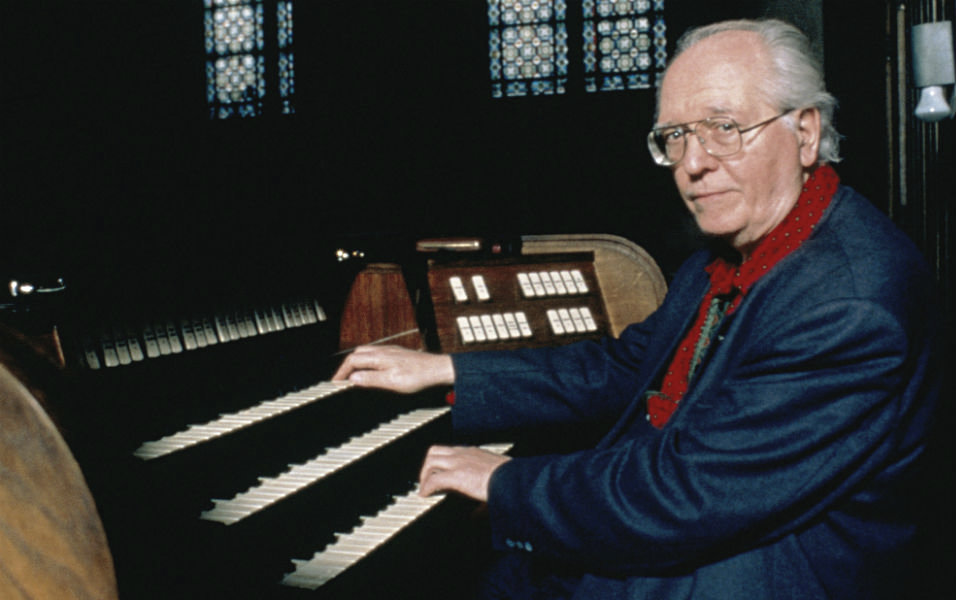
Messiaen at the organ. He would serve as organist at La Trinité, in Paris, for more than 60 years.

Rest easy, Rita Lee

Rita Lee in 2010

The sui generis Brazilian singer Rita Lee died a few days ago, on May 8, and I didn’t want to let the sad occasion go unremarked here, even though I don’t have time to write the tribute she deserves right now. (Filthy lucre! But the good kind.) So I went through the ol’ archives and found a record review that I wrote in 1999 about the great Luaka Bop compilation (curated by David Byrne) Everything is Possible!

The RFT links are always iffy for me, so I’m cutting and pasting the review here instead. And if you don’t have any Os Mutantes records, you could do worse than start with this collection. Really, though, you can’t go wrong with any of it. Back when I did a weekly community radio show on KDHX FM-88, I played a lot of Os Mutantes, probably at least a track or two every month, and found that it always went over well. It’s impossible to quantify but safe to say that Rita Lee’s artistry and charisma are a big part of the timeless appeal.

OS MUTANTES

Everything Is Possible! (Luaka Bop)

By René Spencer Saller on Wed, Jul 21, 1999 at 4:00 am

To say Os Mutantes, a Brazilian trio formed in the late ’60s, were ahead of their time is to understate their singular genius, to suggest that we’ve somehow caught up with them. If only! The music founding members Arnaldo Baptista, Rita Lee Jones, and Sergio Dias created together, a crazy amalgam of psychedelia, bossa nova, experimental rock, samba and pop, is timeless: it sounds as innovative today as it must have sounded 30 years ago, and it will probably sound just as brilliant 30 years from now. Everything Is Possible! is a fabulous compilation of songs the Mutantes recorded between 1968 and 1972, ranging from the trippy, cannabis-inspired “Ando Meio Desligado,” which sets Jones’ silvery vocals against a bass line cribbed from the Zombies’ “Time of the Season,” whacked-out keyboards, and distorted electric guitars, to the exquisite “Fuga No. 11,” with its tinkly bells and majestic Sgt. Pepper-inflected strings and horns. Every song on the CD is at once gorgeous and freakish, catchy and cacophonous, familiar and deeply mysterious. It’s no surprise that fans of the Mutantes include Beck, David Byrne, Stereolab’s Tim Gane, Arto Lindsay, and the late Kurt Cobain (who tried unsuccessfully to convince them to reunite so they could open for Nirvana in 1993).

With Gilberto Gil, Caetano Veloso, Tom Z, and Gal Costa, Os Mutantes were part of the Tropicália movement, an avant-garde group of leftist musicians who sought to revolutionize Brazilian pop culture with the use of electric instruments, subversive humor, far-out stage personas, and surreal arrangements. They pissed off just about everybody, from uptight leftist folkies (think of the guy who screamed “Judas!” during Bob Dylan’s electric tour in 1966) to the draconian military dictatorship, which effectively killed the movement shortly after its inception by arresting Gil and Velosa and forcing them into exile. Even under censorship, however, Os Mutantes continued to record, releasing a handful of albums (the first three, reissued on the Omplatten label, are highly recommended) before they broke up for good in 1978. Live, they dressed up like Sancho Panza, a pregnant bride, and space aliens. They wrote songs with outrageous titles such as “Ave Lucifer” (“Hail Lucifer”). They created their own instruments, from the backwards wah-wah pedal on “Dia 36” to the can of bug spray used in place of a high hat on “Le Premier Bonheur du Jour.” What more could anyone want from a band? They’ll blow your mind, they’ll crack you up, they’ll steal your heart, and they’ll make you believe that everything is possible.

Copyright 1999 by René Spencer Saller


A marital collaboration

This is what happens when they let long-married, refrigerator-sharing people have magnetic poetry sets. We move the words around a lot, between the two of us, usually when we are waiting for our geriatric feline hospice patient Hodiamont to finish eating one of the six to eight meals that he must eat daily to maintain his wraithlike corporeal substance. (He eats a special food for cats who have thyroid disease but who are allergic to the standard medication, which Hodiamont is.)

Anyway, I liked this one, so I thought I’d take a snapshot of it with the iPad to preserve it. The authorship breakdown is five lines by Mr. Christian Saller, four lines by Mrs. Christian Saller, but I will leave it to you to guess who wrote what.

And yes, the little word magnets, which are more than a decade old now, could use a good scrubbing. They don’t look nearly that dirty when they’re not blown up, but still that is no excuse for the filth. I will leave it here as a chastening exercise (as well as a reminder to bust out the Dr. Bronners, stat).