Gustav Mahler was born on July 7, 1860 (happy belated birthday, G!), which made me think I might as well post some notes I wrote a few years back for the Dallas Symphony and Das Lied von der Erde, in chamber reduction. (I have written about the full orchestral version, too, I’m pretty sure, but I think both versions of the work are fascinating and urge you to listen to both, if you haven’t already.) I’m pretty sure I have never posted them before, but if I’m repeating myself, please take it up with the subscriptions department, which will reimburse you in full.
If you’d like to listen to a lovely performance that’s readily available on YouTube, I recommend this performance by Cantata Profana, from 2018:
In 1907, about a year before he started writing Das Lied von der Erde (The Song of the Earth), Gustav Mahler (1860–1911) endured three brutal losses. First, through no fault of his own, he was forced out of his longtime position as conductor of the Vienna Court Opera. Next, his cherished four-year-old daughter died from scarlet fever. Then his physician told him that he had a fatal heart condition. Frightened and grieving, Mahler confronted his mortality crisis by working harder than ever. Despite being warned by his doctor to get more rest, he wouldn’t—or couldn’t—slow down.
In July of 1908, he wrote to Bruno Walter, who would conduct the posthumous premiere in Munich, not quite six months after the composer’s death:
“If I am to find my way back to myself, I have got to accept the horrors of loneliness, since you do not know what has gone on and is going on within me. It is, assuredly, no hypochondriac fear of death, as you suppose. I have long known that I have got to die…. Without trying to explain or describe something for which there probably are no words, I simply say that with a single fell stroke I have lost any calm and peace of mind I ever achieved. I stand vis-à-vis de rien [face-to-face with nothingness], and now, at the end of my life, have to begin to learn to walk and stand.”
Two months later, he wrote another, less morbid letter to the conductor. “I have been hard at work,” he reported. “I do not know what the whole thing should be called. I have been granted a time that was good, and I think it is the most personal thing that I have done so far.”
Unsure how to classify Das Lied von der Erde, Mahler finally settled on “a symphony for tenor and alto (or baritone) and orchestra.” Nominally a song cycle, with alternating movements for two singers—usually, but not always, male and female—the composition was originally scored for a large orchestra, although Mahler’s many small instrumental groupings often suggest the intimacy and expressive clarity of chamber music. He indicated that a tenor should sing movements 1, 3, and 5, and assigned the remaining three, including the sprawling sixth, to either a contralto or a baritone. (In most cases, a contralto is chosen.)
Schoenberg/Riehn Arrangement
Thanks to Mahler’s gossamer textures, the score for Das Lied von der Erde lends itself to a chamber-music reduction. In 1921 the largely self-taught Austrian composer Arnold Schoenberg (1874–1951) began an arrangement for a small (14-instrument) ensemble. Schoenberg never meant for the arrangement to be published or performed publicly. He created it mostly for educational purposes, under the auspices of The Society for Private Musical Performance, which he and his musical disciples Alban Berg and Anton Webern had co-founded in Vienna in 1919.
The goal of the Society—which denied entry to music critics and forbade applause during or after performances—was to promote new and underperformed music by contemporary composers such as Stravinsky, Debussy, and Bartók. Over its roughly three-year existence, the Society staged more than 100 performances. Each piece on the program was performed twice in a single evening to help subscribers absorb and appreciate what were likely to be totally unfamiliar works. Owing to financial constraints and other practical considerations, many scores (such as Mahler’s) were stripped down to more economical arrangements for piano or chamber ensemble.
Schoenberg arranged Das Lied von der Erde for string quintet (standard quartet, plus double bass), wind quintet, bassoon, horn, piano, harmonium, and percussion (glockenspiel, cymbals, tam-tam, tambourine, small and large drum). By the time the Society folded in 1922, he had abandoned the project, after orchestrating only the first song. For the remaining songs, he left extensive notes, which, in 1983, decades after his death in 1951, the German composer, conductor, and musicologist Rainer Riehn (1941–2015) used to finish the score. Making a slight adjustment to Schoenberg’s instrumentation, Riehn added a part for celesta in “Der Abschied.”
Instead of the lustrous orchestration of Mahler’s original, the Schoenberg/Riehn arrangement calls for solo instrumentalists to accompany the singer, with a single violin or cello standing in for Mahler’s massed strings. Comparing Mahler’s original orchestral score to a painting, Riehn called the chamber arrangement a woodcut rendition.
Song by Song
The lyrics are based on texts from Die chinescische Flöte (The Chinese Flute), a collection of ancient Chinese poems translated into German by Hans Bethge. Mahler chose poems by Li Tai-Po, Mong Kao-Yen, Wang Wei, and Tchan Tsi, but adapted the lines as needed, sometimes augmenting them with his own words. All six songs touch on the brevity of life and the certainty of death.
The first song, “Das Trinklied von Jammer der Erde” (The Drinking Song of the Earth’s Sorrow), seems at first like a jovial tribute to the analgesic properties of alcohol, but each of the three stanzas ends with the same ominous refrain: “Dark is life, and so is death.” Mahler raises the pitch of this line with every repetition, ramping up the emotional tension.
Next, in the delicately scored “Der Einsame in Herbst” (The Solitary One in Autumn), a seamstress laments her loneliness over a long, sleepless night: “Sun of love, will you never shine again/To dry my bitter tears?” A spectral oboe and spare, shuddering strings intensify the autumnal flavor.
The third and briefest song, “Von der Jugend” (Of Youth), describes a gaggle of pretty young things under a porcelain pavilion. Pentatonic patterns and Asian-inspired percussion set the scene while darting woodwinds mimic the partygoers’ passing remarks.
In “Von der Schönheit” (Beauty), the singer depicts a group of maidens gathering lotus blossoms by a riverbank. The loveliest one gazes longingly at a young man, who doesn’t notice her. Despite the sad lyrics, the music is sprightly, buoyed by frisky winds, pizzicato strings, and dotted rhythms.
In the fifth song, “Der Trunkene im Frühling” (The Drunkard in Spring), the booze-fueled male protagonist tries in vain to obliterate his thoughts while birds twitter mindlessly in the background: “What does spring matter to me?” he concludes. “Let me be drunk!”
A sinuous, sorrowful solo oboe glides over swaying strings and pulsing rhythms in the half-hour-long finale, “Der Abschied” (The Farewell). “I shall no longer seek the far horizon,” the singer declares. “My heart is still….” Mahler combined two poems by different authors, punctuated by a magnificent orchestral death march. He marked the end Gäzlich esterbend (completely dying away), and added his own words as conclusion: “Everywhere and forever the luminous blue of the horizon… Forever… forever…” That last word, ewig, summoned from the depths of the contralto’s register, is repeated nine times as the music melts into radiant silence.
One of four blossoms that opened tonight on our night-blooming cereus plant, along with one of the beautiful Cronenbergian buds that will probably open tomorrow night.
Instead of updating the blog with some of my program notes, of which I have a huge backlog, I feel like celebrating the fact that (a) we have electricity for the third night in a row, which is still heavenly after three nights without it and (b) we had four blooms open tonight on the night-blooming cereus. We had a few more last week, and I don’t want to get jaded. They really are the most extraordinary flowers. I hope they draw all sorts of exotic moths, bats, and nightbirds to our patio, even if I never see them with my own myopic old night-blind eyeballs. Do your thing, furtive nocturnal pollinators, and know that I love you!
Before I hit you with the night-blooming cereus shots, though, I’m going to throw in a funny one I took of the passionflower vine, which is doing quite well on our back decks. It’s a native (Passiflora incarnata), and I hope it comes back abundantly, even though the fragrance is disappointingly salami-like. The important thing is that it attracts and feeds a variety of interesting moths, so I suppose it smells the way it needs to smell to perpetuate itself. (As for me, I’ll stick to Chanel Misia for now.) I’d probably grow the Passiflora incarnata even if it smelled totally rancid, like a corpseflower, which it does not, thank goodness. I like the way it looks. It reminds me of Phyllis Diller. This lil maypop doesn’t take itself too seriously!
Passiflora incarnata at night
This and all the other photos are night-blooming cereus blossoms and buds, along with the strangely veiny succulent leaves. The buds form from the same veins that cause new little leaves. Weird.OLYMPUS DIGITAL CAMERA
I had the great honor of contributing some notes for a recent–and newly revised–orchestral composition by the singular composer Reena Esmail for the San Francisco Symphony program book. The concert runs this weekend, so by all means snag some tickets if you plan to be in San Francisco then.
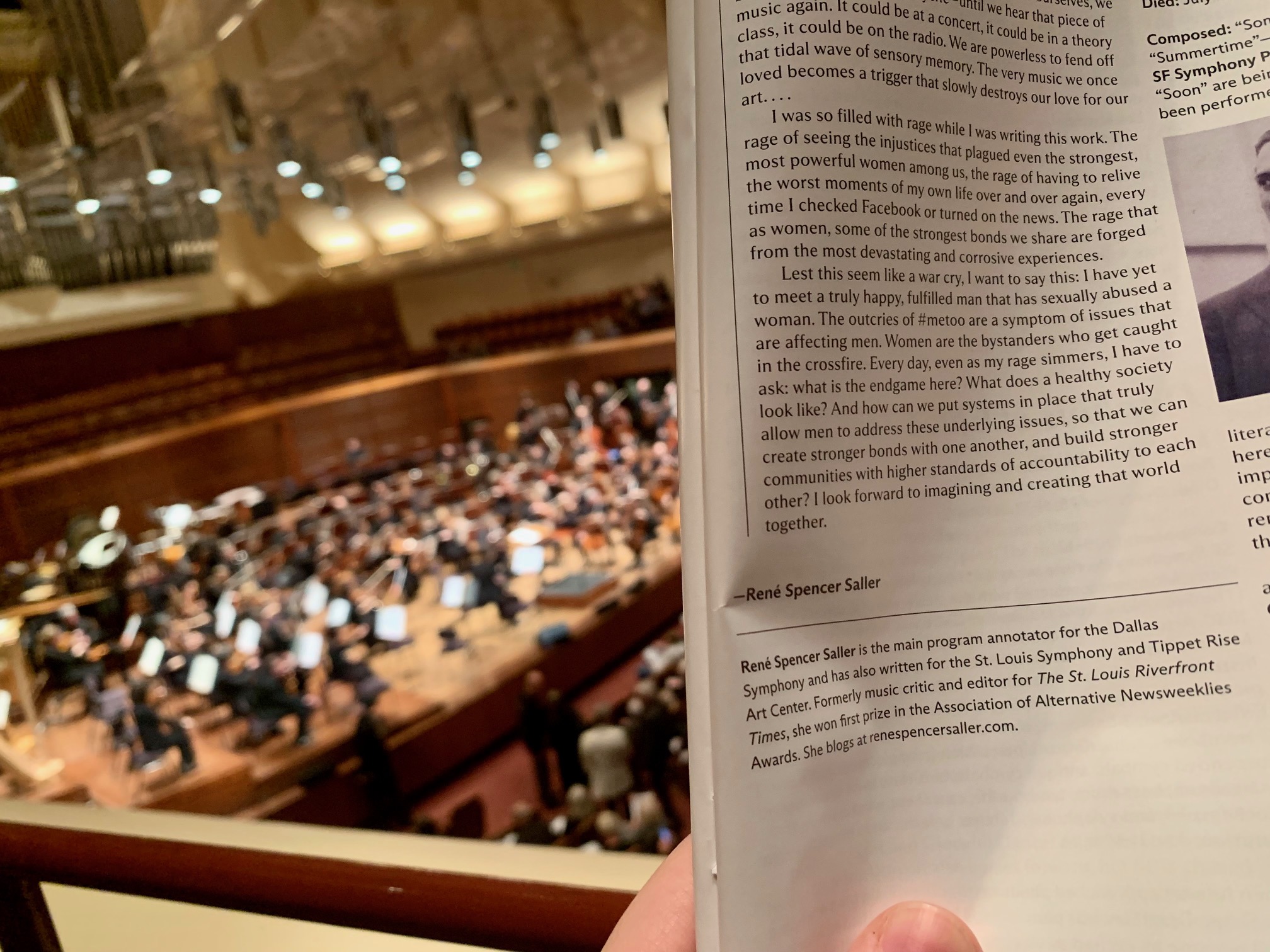
I wasn’t able to make the performance last night, but my friend and colleague Ben Pesetsky, the Associate Director of Editorial at the SF Symphony and a fine composer in his own right, was kind enough to take a photo of my byline in the paper version of the book and email it to me. (I will include the notes in a more legible format below the photo.)
Black Iris at a Glance
Originally titled #metoo,Black Iris (2017) responds to composer Reena Esmail’s own experience of sexual abuse and that of other survivors. “I always get asked why there aren’t more women composers,” she explains. “This piece is one response—of many hundreds of responses—to that question.” Although the one-movement orchestral composition is performed on Western instruments and notated according to Western conventions, its slippery microtonal melodies and shadowy harmonies evoke the Hindustani art music that Esmail studied in India on a Fulbright-Nehru grant.
Black Iris
Reena Esmail
Born: February 11, 1983, in Chicago
Composed: 2017 (rev. 2022) First San Francisco Symphony Performances Instrumentation: 2 flutes (2nd doubling piccolo), 2 oboes (2nd doubling English horn), 2 clarinets, 2 bassoons, 4 horns, 2 trumpets, 3 trombones, tuba, timpani, percussion (triangle, cymbals, chimes, snare drum, bass drum, glockenspiel, vibraphone, and marimba), harp, piano (doubling celesta), and strings Duration: About 14 mins
In both her work and her person, the composer Reena Esmail reflects the global diaspora. Her Indian mother, a member of India’s Portuguese-influenced Goan community, grew up in Kenya; her father, also Indian, lived in Pakistan, where his family moved after Partition. Esmail herself was born in Chicago and raised in Los Angeles, but she felt connected to her ancestral homeland. After earning an undergraduate degree in composition at Juilliard and midway through graduate studies at Yale, she knew that she needed to learn more about Indian classical music. She spent 2011–12 in India on a Fulbright-Nehru grant, studying under such masters as singer Srimati Lakshmi Shankar and sitarist Gaurav Mazumdar. Her doctoral dissertation at Yale outlined methods of collaboration between Western and Hindustani forms of art music. As an artistic director of the nonprofit Shastra, she promotes music that links the cultural traditions of India and the West. This devotion to cultural syncretism carries over to her substantial catalogue, which includes orchestral, chamber, and choral works.
Originally titled #metoo, the one-movement orchestral composition Black Iris responds to Esmail’s own experience of sexual abuse and that of other survivors. When the hashtag stopped trending, and the #metoo movement began to shift meaning, she decided to rename the piece after the famous Georgia O’Keeffe painting, explaining that “the light petals on the top, and the dark petals beneath—the image was so resonant with the experience about which this work was written.”
Approximately 10 minutes long, Black Iris is performed on Western instruments and notated according to Western conventions, but many of the melodies involve quicksilver microtonal shifts, subtle shadings of notes that slip between the lines and spaces of the staff or the steps on the scale. As any fan of Hindustani ragas or Delta blues or early Sonic Youth will attest, these liminal spaces contain vast stores of power and pleasure. Rather than “resolve” any harmonic ambiguities, Esmail delights in them.
The piece was commissioned by Chicago Sinfonetta, which premiered it in March 2018. Esmail substantially revised and reorchestrated it for its first San Francisco Symphony performances this week. In her original program note, Esmail wrote:
I always get asked why there aren’t more women composers. This piece is one response —of many hundreds of responses—to that question. So many of us decide to become composers when we are young women because we fall deeply in love with individual pieces of music. We listen to them incessantly, we memorize every note of them, we live our lives through the lens of that music. And then at some point, for some of us, as we engage with that music, something devastating happens to us—often by the very person who has introduced us to that music. We hate ourselves, we blame ourselves, we bury it deep within our psyche—until we hear that piece of music again. It could be at a concert, it could be in a theory class, it could be on the radio. We are powerless to fend off that tidal wave of sensory memory. The very music we once loved becomes a trigger that slowly destroys our love for our art. . . .
I was so filled with rage while I was writing this work. The rage of seeing the injustices that plagued even the strongest, most powerful women among us, the rage of having to relive the worst moments of my own life over and over again, every time I checked Facebook or turned on the news. The rage that as women, some of the strongest bonds we share are forged from the most devastating and corrosive experiences.
Lest this seem like a war cry, I want to say this: I have yet to meet a truly happy, fulfilled man that has sexually abused a woman. The outcries of #metoo are a symptom of issues that are affecting men. Women are the bystanders who get caught in the crossfire. Every day, even as my rage simmers, I have to ask: what is the endgame here? What does a healthy society look like? And how can we put systems in place that truly allow men to address these underlying issues, so that we can create stronger bonds with one another, and build stronger communities with higher standards of accountability to each other? I look forward to imagining and creating that world together.
In recognition of Juneteenth tomorrow, here is a program I wrote about a couple of years ago for the Dallas Symphony Orchestra. I don’t think I ever uploaded it to the blog, and if I did, the link is surely dead by now, so it seems worth reposting. Juneteenth is an especially significant holiday for Texans, but I’m happy to say that Dallas is programming most of these composers all year round. In fact, Adolphus Hailstork, pictured above, has a new co-commission from Dallas Symphony scheduled for premiere next season, the subject of which is the last speech JFK gave before he was assassinated.
Jubilant Juneteenth
by René Spencer Saller
Variously known as Emancipation Day, Jubilee Day, and Black Independence Day, Juneteenth holds a special significance for Texans. The name, a portmanteau of June and nineteenth, refers to the date in 1865 when the Union General Gordon Granger read General Order No. 3 in Galveston. This proclamation freed the enslaved people of Texas—more than 250,000 men, women, and children. Technically speaking, President Abraham Lincoln’s Emancipation Proclamation had already banned slavery in Texas nearly two-and-a-half years earlier, but enforcing the law required the intervention of Union troops, and getting approximately 2,000 soldiers to the most remote Confederate state took time. (Contrary to popular belief, Texas wasn’t the last state to end slavery; it was still prevalent in Delaware and Kentucky until December 1865, when the 13th Amendment to the Constitution was ratified.)
In Texas Juneteenth festivities date to 1866, and the practice eventually spread throughout the nation. On June 7, 1979, Texas became the first state to make Juneteenth an official state holiday. Today Juneteenth is widely celebrated throughout the United States, and activists are currently lobbying Congress to recognize it as a national holiday. [Update: It became a federal holiday after I turned in my notes and remains a federal holiday today, hooray!]
Adolphus Hailstork(b. 1941): American Fanfare Born in Rochester, New York, Adolphus Hailstork studied composition at Howard University, the Manhattan School of Music, and the American Institute at Fontainebleau before earning his doctorate from Michigan State University. His diverse catalogue includes works for orchestra, organ, piano, and solo voice, as well as chamber and jazz ensembles. In October 2020 he received a Distinguished Alumni Award from the Manhattan School of Music. Current projects include his Fourth Symphony and A Knee on a Neck, a tribute to George Floyd for chorus and orchestra. Completed in 1985, American Fanfare is scored for brass and percussion.
James Weldon Johnson (1871–1938) and John Rosamond Johnson (1873–1954): “Lift Every Voice and Sing” (arr. Tyzik)
To call James Weldon Johnson multifaceted is an understatement. The distinguished poet, novelist, newspaper publisher, lawyer, diplomat, translator, and civil rights activist also wrote what is commonly known as the Black National Anthem: “Lift Every Voice and Sing.” Born in Jacksonville, Florida, to a hotel headwaiter and a schoolteacher, he attended college at Atlanta University, where he earned his bachelor’s degree in 1894. He wrote “Lift Every Voice and Sing” as a poem in 1899; his older brother composed the music the following year.
“A group of young men in Jacksonville, Florida, arranged to celebrate Lincoln’s birthday in 1900,” Johnson later wrote. “My brother, J. Rosamond Johnson, and I decided to write a song to be sung at the exercises. […] Our New York publisher, Edward B. Marks, made mimeographed copies for us, and the song was taught to and sung by a chorus of 500 colored school children.
“Shortly afterwards my brother and I moved away from Jacksonville to New York, and the song passed out of our minds. But the school children of Jacksonville kept singing it; they went off to other schools and sang it; they became teachers and taught it to other children. Within 20 years it was being sung over the South and in some other parts of the country. […].
“The lines of this song repay me in an elation, almost of exquisite anguish, whenever I hear them sung by Negro children.”
Nkeiru Okoye, courtesy of the composer
Nkeiru Okoye (b. 1972): “I Am Harriet Tubman”
Born in New York City to a Nigerian father and an African American mother, Nkeiru Okoye [in KEAR roo oh KOY yeh] was brought up in the United States and Nigeria. She started piano lessons at age 8, and just five years later won a national competition for her first musical composition. She holds degrees from the Oberlin Conservatory of Music and Rutgers University and serves on the composition faculty at the State University of New York at New Paltz. The inaugural recipient of the International Florence Price Festival Award for Composition, Okoye is currently a Fellow of the John Simon Guggenheim Memorial Foundation. Her wide-ranging works have been performed by the Philadelphia Orchestra, Detroit Symphony Orchestra, Indianapolis Symphony, Virginia Symphony, Grand Rapids Symphony, New Jersey Symphony, and many other ensembles.
“I Am Harriet Tubman” comes from her two-act theatrical work Harriet Tubman: When I Crossed That Line to Freedom (2014). “I wanted to write an opera about a woman who did great things and survived,” she explained. “My music doesn’t easily fit into a single category, though I incorporate many musical influences in a way that creates a sound that is uniquely mine. I think a lot of people are surprised to hear connections between the gospel aria and the jazz aria in Harriet Tubman.”
Mary D. Watkins (b. 1939): Soul of Remembrance
Mary D. Watkins
Eclectic and prolific, the Denver-born composer and pianist Mary D. Watkins began studying piano at age three, in Pueblo, Colorado. Five years later, she was improvising and composing original works. At 15 she won second place in a piano competition with her own arrangement of Schubert’s “Ave Maria.” After earning a degree in music composition from Howard University in 1972, Watkins played with numerous jazz ensembles in Washington, D.C., and later moved to the West Coast, where she founded her own jazz quartet and recorded several albums. Among her many compositions are the scores for the jazz musical Lady Lester Sings the Blues, based on the life of legendary tenor saxophonist Lester Young, and The Revolutionary Nutcracker Sweetie, an adaptation of Tchaikovsky’s ballet The Nutcracker. In 2009 she composed and wrote the libretto for Dark River, an opera based on the life of the civil rights activist Fanny Lou Hamer.
Composed in 1993, Soul of Remembrance is the second movement of her orchestral suite Five Movements in Color. In a 2016 interview with the National Education Association, Watkins described the proudest moment of her career: “It was in 2009 when I was in Chicago standing in the corridor outside the auditorium. I heard the orchestra rehearsing [Soul of Remembrance]. The music wasn’t flashy, technically challenging, or anything like that. It was serene, beautifully executed, and I let go of whatever it was I had been holding on to. It was the first time I really felt validated as a composer.”
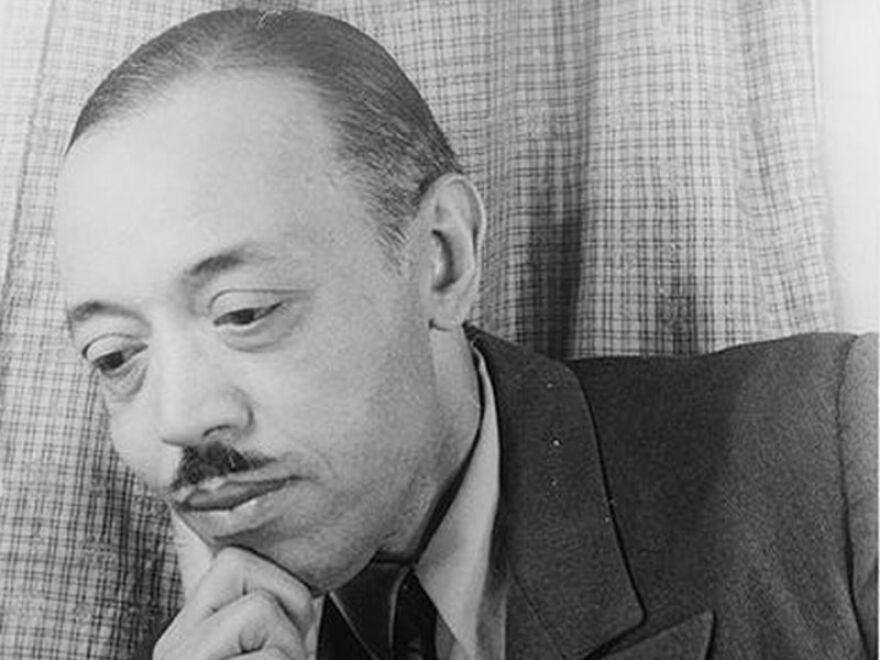
William Grant Still (1895–1978): Ennanga, for harp, piano, and strings (first movement)
William Grant Still
Nicknamed the “Dean of African-American composers,” Still completed more than 150 works, including eight operas and five symphonies. He was the first Black American to write a symphony that was performed by a major orchestra, and the first to conduct a major orchestra. In 1949 his opera about Haiti, Troubled Island, was produced by the New York City Opera—another historic first.
Still was born in Woodville, Mississippi, to college-educated teachers. His father, the town bandmaster, died when he was three months old. He and his mother moved to Little Rock, Arkansas, where she remarried. He began taking violin lessons at age 14 and taught himself viola, cello, double bass, clarinet, oboe, and saxophone. In 1911 he enrolled at Wilberforce College in Ohio, where he directed the band. His studies at Oberlin Conservatory of Music were interrupted by his Navy service. He played as a sideman for bluesman W.C. Handy, who brought him to Memphis and then New York City, where he became an oboist in Eubie Blake’s pit and made arrangements for theater orchestras and jazz and blues artists. He also studied with the influential atonalist Edgard Varèse.
Still completed the three-movement chamber composition Ennanga in 1956. The title is a Ugandan word that refers to a small harplike instrument, and the score contains a prominent part for the Western harp, as well as piano and string quintet. For technical advice, Still consulted the harp virtuoso Lois Adele Craft, who also performed at the Los Angeles premiere. In the first movement, the harp and piano alternate between percussive and melodic roles, often evoking Juba, or hambone, a centuries-old African-American dance form that calls for stomping, slapping, clapping, and patting the body.
Traditional: “A City Called Heaven” (arr. Tyzik)
Like many traditional spirituals, “A City Called Heaven” predates the American Civil War and exists in numerous versions, under many titles, including “Poor Pilgrim of Sorrow,” “Poor Pilgrim,” “Tossed and Driven,” and “Tryin’ To Make Heaven My Home.” It was first documented in the 1907 collection Folk Songs of the American Negro, compiled by John Wesley Work, Jr. (1871–1925), an influential African-American scholar of folk songs and spirituals.
Still: Symphony No. 1 in A-flat Major (Afro-American Symphony) (third movement, Animato)
Still began sketching his most famous work, the Afro-American Symphony, in 1924, not long after he played in the pit orchestra for Eubie Blake and Noble Sissle’s Shuffle Along, which featured Josephine Baker and Paul Robeson, among other luminaries of the nascent Harlem Renaissance. The sketches remained in limbo for some time while Still worked on other projects. As he later explained, “it was not until the Depression struck that I went jobless long enough to let the Symphony take shape. In 1930 I rented a room in a quiet building not far from my home in New York and began to work.” Two months later, Still’s First Symphony was complete. In a notebook that he kept during composition, he assigned alternative titles to each movement: the third, Animato, was designated “Humor.”
In 1931 Howard Hanson conducted the premiere—marking a milestone in Still’s career, as the first symphony by a Black composer to be performed by a major orchestra—and the 36-year-old composer’s career took off. He received commissions from several orchestras and a Guggenheim Fellowship. He eventually moved to Los Angeles, where he arranged film scores and popular music while honing his own powerful musical idiom: a blend of European post-Romanticism, jazz, blues, and spirituals.
In 1964 Still described the creative impetus behind his Afro-American Symphony: “I wanted, above all, to write music that would be recognizable as being in the idiom employed [by the American Negro] or recognized, I should say, as that of the American Negro. It was the object that I desired most of all.”
John Newton (1725–1807); William Walker (1809–1875): “Amazing Grace” (arr. Tyzik) First published in 1779, the words to the iconic Christian hymn “Amazing Grace” were written by the English poet and Anglican clergyman John Newton. A former seaman and slave-ship captain, Newton experienced a spiritual epiphany, converted to Christianity, and eventually became an ordained curate in the Church of England, as well as an abolitionist. He wrote “Amazing Grace” to accompany a sermon for New Year’s Day of 1773. Although the poem has been associated with at least 20 different melodies over the years, its most famous iteration was created in 1835 by the American Baptist song leader and compiler William Walker, who set it to a tune called “New Britain” and transcribed it in a shape-note format.
Traditional: “Ride On, King Jesus” (arr. Tyzik)
Another anonymous antebellum spiritual, “Ride On, King Jesus” appeared under the title “No Man Can Hinder Me” in the first anthology of published spirituals, Slave Songs of the United States (1867). In the late 19th century, it became a concert staple of the Fisk Jubilee Singers, who performed several tours to raise money for Fisk University, a historically Black institution founded in 1866, in Nashville, Tennessee. Henry (“Harry”) T. Burleigh (1866–1949), who had studied with Dvořák, collected and arranged “Ride on, King Jesus” as well as many other songs in his Jubilee Songs of the United States of America, first published in 1916.
Antonín Dvořák (1841–1904): “Goin’ Home” (arr. Tyzik) In the spring of 1893, when Antonín Dvořák was finishing his Symphony No. 9 in E minor (“From the New World”), the Czech composer made a bold prediction: “I am now satisfied that the future music of this country must be founded upon what are called the Negro melodies. This must be the real foundation of any serious and original school of composition to be developed in the United States.”
The Ninth Symphony was the first of several works that Dvořák wrote entirely in the United States. Although he urged his National Conservatory students to explore indigenous musical forms, he had at that point heard only a smattering of American folk songs, notably the spirituals that his Black student and assistant Henry (“Harry”) Thacker Burleigh sang for him.
For the symphony’s most famous theme, Dvořák chose the English horn because it reminded him of Burleigh’s voice. This deceptively simple, deeply moving melody—apotheosized in the second movement but present, in some form or another, throughout—gives many listeners the mistaken impression that they are listening to an existing spiritual. In 1922 William Arms Fisher, another of Dvořák’s former students, added lyrics to Dvořák’s original theme, thereby creating the nostalgic ballad “Goin’ Home.”
Traditional: Medley (arr. Tyzik): “Every Time I Feel the Spirit,” “Joshua Fit the Battle of Jericho,” “Sometimes I Feel Like a Motherless Child,” Swing Low, Sweet Chariot”
This medley is dedicated to Henry T. Burleigh, a gifted Black baritone singer, composer, and arranger who dedicated his life to promoting the spiritual as a serious American art form.
Of unknown authorship, “Every Time I Feel the Spirit” predates the American Civil War. The first stanza refers to Moses receiving the Ten Commandments on the mountaintop; the second describes being baptized in the Jordan River and the “heavenly train,” which is sometimes interpreted as a coded reference to the Underground Railroad.
“Joshua Fit the Battle of Jericho” is another anonymous spiritual of a similar vintage. (“Fit” is African-American Vernacular English for “fought.”) The words allude to the biblical story of the Battle of Jericho, when Joshua led the Israelites into battle against the Canaanites.
The haunting and heart-rending “Sometimes I Feel Like a Motherless Child” was composed by another unknown enslaved poet. The great American bass-baritone, actor, and political activist Paul Robeson—himself the son of a former slave—made multiple recordings of the song, beginning in 1926.
Although its exact origins are unknown, “Swing Low, Sweet Chariot” is often attributed to Wallis Willis, an enslaved Black man who was born in Mississippi and forcibly moved to Oklahoma by his enslaver, a member of the Choctaw Nation. Alexander Reid, a minister at the Choctaw boarding school where Willis and his wife were employed, heard the couple singing it and then transcribed the words and melody, which he sent to the Jubilee Singers of Fisk University. In 1909 the Jubilee Singers made the first recording of the song, which is worth seeking out on YouTube.
I took this photo with my inexpensive digital camera (a 10-year-old Olympus that has been a true champ). I took it either the night of June 13 or the night of June 14; I got four big blooms in a 48-hour period, but I can’t keep the photos straight because the blossoms all look very similar).
I neglected to update my blog last week, even though I made a mental note that I could, say, celebrate the birthday of Richard Strauss (June 11) by posting a bunch of annotations from my vast backlog of notes that have been published but not online.
In my defense, I have been busy writing marketing client for a new client, one I value enormously and would like to retain, and I have also been doing other things, like studying French again on the free Mango app (free with my St. Louis Public Library card anyway–such a fantastic deal!), and reading books (I highly recommend the new Megan Abbott novel, Beware the Woman), learning to recognize the birdsong of various species in my backyard with the Merlin app, tending to our menagerie of geriatric companion animals (three cats in their mid to late teens, one dog who is estimated to be about 12), and, most relevant to this post, enjoying our small but fertile and fragrant garden.
Our night-blooming cereus is a reliable bloomer in the late spring and throughout the summer. Really, as soon as we put it outside on the patio, after its winter sabbatical indoors, which it seems to resent mightily, a sulking, drooping, morose succulent deprived of the only thing it really seems to care about, being outdoors. My mother-in-law was given this plant in the early ’80s, I believe, but the plant was already mature when she got it. She used to keep it on their brick patio on Westminster, but when they moved, they didn’t want to deal with it anymore (it’s extremely large and cumbersome and, if I’m being perfectly honest, not at all beautiful aside from the blooms, which last only one night and keep their own unpredictable blooming schedules).
That said, it’s hard to imagine a blossom more beautiful. Some people call it Queen of the Night, which I like because it reminds me of the famous Mozart aria, from The Magic Flute, but I haven’t adopted the nickname myself because night-blooming cereus is what I have known it, since I first encountered it on my in-laws’ patio back in the mid-90s.
I could include a lot more information about the n-b c, as my husband and I have taken to calling it, but instead I will just let you look at the photos. The petals remind me of swan feathers, elegantly curved and impossibly delicate. There’s that weird little sculptural stamen, like one of those Louise Bourgeois spiders, only small and pale. The bud, before it opens, looks like a frightening David Cronenberg creature, perhaps something out of eXistenZ. When more than two blossoms are opening at once–we had three on the night of June 14–the fragrance is almost overpowering. Imagine a gardenia on steroids. There’s a strong lemony floral top note, so dominant that it almost smells acrid, like mass-market kitchen cleaners, but this gradually fades to a much more pleasant, almost creamy classic white-petal scent.
By sunrise, the blossoms are spent and sad, resembling nothing so much as a used condom you might see on the street.
More classical music content coming soon, I promise.
me at about 7 (left), not wearing the glasses I desperately needed, and my best/only human friend, Lisa Jackson, who was born on June 3; she was just shy of 2 months younger than I was, but we went to different schools (public for me, Catholic for her).
When I was almost five, before I started kindergarten, my parents moved us from their student-housing apartment at Spring and Delor, in South St. Louis, to an old ramshackle stucco house on Bompart, in Webster Groves. I don’t remember how I met Lisa, but we were the same age and lived nearby (less than a minute away if we ran through the Gibsons’ yard, which we always did), and so we became best friends. I admired her beauty and athleticism, her exotic Catholic customs–preparing for First Communion in her frilly little bride’s dress, reciting the rosary, enumerating the various features of Hell–and her ability to make friends and not come off as unforgivably weird, which is eventually what caused our friendship to founder, in the tween years, when the chasm between the popular and the unpopular widens with the onslaught of hormones.
When Lisa was in her early teens, her mother died–her mother had been very loving, the kind of woman who would take you in her arms and hold you when you are sobbing in terror and shame–and unfortunately, her father behaved the way too many dads behaved back then. I remember him as an ambulatory Bad Mood, a sudden stink of cigar and angry sweat, a basement bellow. I was terrified of him, but unlike Lisa I could always run home when he started shouting. Once when we were seven or eight, Lisa cried out in tears to me from her second-floor bedroom window, begging me to come back inside to play, assuring me that he didn’t mean it and wasn’t really that mad. I had run out of her house after her dad had screamed at us, and even though I never stopped feeling sorry for her and ashamed of myself, I was more scared of him, so I barely even hesitated: I just ran home. Her dad’s threats always struck me as credible. My dad was human, which is to say imperfect, but he was kind, especially to children and animals; he wasn’t violent, and he seldom raised his voice. My grandpa was similarly gentle. I wasn’t used to volatile men, and I couldn’t have protected Lisa even if I had been brave enough to try. But I still wish I had tried. I wish I had been braver, a more loving friend.
No one needed to stand up for her when her mom was alive. Her mom constantly appeased her dad while also lavishing love on her many kids. Lisa was the seventh of seven kids, which was common back then, when birth control was legal but still a grievous sin for good Catholics. I always thought Lisa was her mom’s favorite, but it’s possible that all her siblings felt that they were Mrs. Jackson’s favorites. Even after she became ill with emphysema, she had endless energy for mothering. She was as talented at love as her husband was bad at it.
Lisa and I fell out of touch a few years before her mom died, and I saw her maybe once when we were young adults, in our early 20s. She was surprisingly tall, even though she had been short for her age as a kid, shorter than me anyway. We were at a loud and crowded Painkillers show, at the Great Grizzly Bear in Soulard, so we didn’t have much time to chat, but I remember being happy that she had made it through somehow, that she had survived her childhood and the unthinkable loss of her mom. We reconnected on Facebook a couple of decades after that, but unfortunately that was the same year she died, not long before what would have been her 47th birthday; we never got the chance to see each other again in real life, even though she lived a few neighborhoods over, perhaps a five-minute drive away. I cherish our few Facebook messages, as I do my many memories of her. I know she must have been a superb mother, and it breaks my heart that her only, much-loved daughter lost her at about the same age that Lisa was when she lost her own mother. (I’m consoled by the knowledge that Lisa chose a man who was the opposite of her dad, a good and loving father.)
I prefer to dwell on the happy memories of Lisa. Her abundant beauty: she could have been a child model, with her shining flaxen hair and her honest blue eyes. Although she didn’t share my love of lazing around all day reading from her mom’s old box of Nancy Drew mysteries, the ones with the tweedy blue covers from the 1940s, she was a cheerful participant in most of my idiot schemes and projects, and I hope I returned the favor. We devised inscrutable choreography to “Hit the Road, Jack” and “Maxwell Silver Hammer” and made squirrel costumes out of my mom’s old nylons. We sold her dead grandfather’s wide silk ties on the street to skeptical pedestrians and Webster College students, and then cut up the rest to make Barbie attire. We bought a frozen chocolate-cream pie at the grocery store with coins we had scrounged from various couch and sofa cushions, and then ate the entire thing, semi-thawed, in her basement before getting violently ill. We caught a praying mantis and named him Hermie, a compromise name because one of us thought Herman would be better, and the other thought Herbie would be better, and I no longer remember who preferred which name because we both had equally dumb reasons for our choices, related to the cinematic sentient VW Bug and the patriarch of the Munsters. We caught a few cockroaches in my old dilapidated house’s upstairs bathroom and fed them to Hermie, feeling brave and resourceful. I don’t remember what happened to Hermie, but I hope he escaped our ministrations somehow. We were fine with our dogs, cats, guinea pigs, and rodents, but we didn’t know the first thing about mantids.
No one has ever asked me to name my favorite Taylor Swift song, but if asked (and apparently even if unasked) I would not hesitate to say “seven,” from folklore, which, as cornball as this sounds, gave me chills of recognition the first time I heard it and sometimes still does. It sounds like my memories of Lisa: a foundational friendship that was entirely based on proximity and coincidence and yet also perfect for a time. Under duress, I could probably come up with some semipersuasive blah-blah-blah about Swift’s subtle enjambment, or the way the verse melody veers off into slight variations that almost make it sound through-composed, instead of the supposed “folk song” it supposedly is. But I would be lying if I said I loved the song for those peripheral tricks instead of my real reason, which is that it makes me think of Lisa, who died years before “seven” was written.
Back in 2013, when we briefly reconnected, I told Lisa that I still remembered her birthday every year, which is unusual for me, someone who seldom remembers dates or numbers in general. She instantly shot back a message with my correct birthday.
Passed down like folk songs, the love lasts so long. (This time I tried to embed the video, but YouTube wouldn’t let me. So you will have to click on the link if you want to hear this Taylor Swift song, sorry.)
Kaija Saariaho, b. October 14, 1952; died June 2, 2023
I just learned that the great Finnish composer Kaija Saariaho died today, at 70, as a result of brain cancer. If you’re not familiar with her strange and seductive sound world, you might start with Laterna Magica. I wrote about it for the Dallas Symphony (the 19-20 concert season), but I don’t believe I ever posted my notes (which are mostly her own quoted program notes–and the better for it). One of these days I’m going to figure out how to embed YouTube videos instead of just linking to them, and perhaps this will be that day, but if not, listen to Laterna Magicahere. (Update: Indeed, it is that day!)
Kaija Saariaho: Laterna Magica. I don’t own the rights to this music and in fact barely know how to insert videos, so please don’t sue me.
KaijaSaariaho: Laterna Magica
Born in Finland, in 1952, Kaija Saariaho studied music at the Sibelius Academy in Helsinki, where she was the sole woman in a class taught by Paavo Heininen. She joined an experimental collective with likeminded composers (including Esa-Pekka Salonen and Magnus Lindberg) called Korvat Auki! (Ears Open!). In the early 1980s, she moved to France, where she discovered the spectralists, who use computers and other equipment to analyze soundwaves. She became involved in IRCAM, an institute in Paris founded by Pierre Boulez and dedicated to the study of electro-acoustical art music.
Like Messiaen, Saariaho is a synesthete: someone who associates particular sounds with other sensory phenomenon. “Different senses, shades of color, or textures and tones of light, even fragrances and sounds blend in my mind,” Saariaho has said. “They form a complete world in itself.”
The Composer Speaks
“Laterna Magica (The Magic Lantern) alludes to the autobiography of the same name by film director Ingmar Bergman. The book caught my eye after many years whilst I was tidying my bookcases in autumn 2007.
“In time, as I read the book, the variation of musical motifs at different tempos emerged as one of the basic ideas behind the orchestral piece on which I was beginning to work. Symbolizing this was the Laterna Magica, the first machine to create the illusion of a moving image: as the handle turns faster and faster, the individual images disappear and instead the eye sees continuous movement.
“Musically speaking, different tempos underline different parameters: the rhythmic continuity is accentuated at relatively fast tempos, whereas delicate shades require more time and space for the ear to interpret and appreciate them.
“While I was working with tempos, rhythms with different characters became a major part of the piece’s identity: a fiery dance rhythm inspired by flamenco, a shifting, asmmetrical rhythm provided by speech, and an accelerating ostinato that ultimately loses its rhythmic character and becomes a texture. In contrast to this, there emerged music without a clear rhythm or pulse. This material is dominated by strongly sensed colorful planes and airy textures, such as the unified color of six horns, which divides the orchestral phrases. This use of horns points to Bergman’s film Cries and Whispers, in which the scenes are often changing through sequences of plain red color.
“When reading the autobiography I was also touched by the way Bergman described the different lights which his favorite photographer, Sven Nykvist, was able to capture with his camera. Part of the text found its way into the piece in German—for the work was commissioned by the Berlin Philharmonic. The extract, in English, goes as follows:
This weekend (May 25-28), guest conductor Jaime Martín conducts the Dallas Symphony Orchestra in music by Bartók, Liszt, and Ligeti. It’s Ligeti’s centenary–he was born on May 28, 2023, and died June 12, 2006–which means that he’s getting programmed a bit more often than usual, although still not as often as some of us would like. Also on the program is the rising young virtuoso George Li, whose presence on a Liszt and Ligeti bill pleases me with its lilting plethora of ells.
I wrote these notes for the concert, the last installment of the regular concert season. (I’ll keep updating my blog, though; I have a capacious backlog.)
Martín Conducts Ligeti, Liszt, and Bartók
by Rene Spencer Saller
György Ligeti (1923–2006): Concert Românesc für Orchester (Romanian Concerto)
Ligeti was born into a Jewish Hungarian family in Transylvania who moved to Kolozsvár (now Cluj-Napoca, in northwestern Romania) during his infancy. In 1941, unable to pursue his goal of becoming a scientist because of the Jewish quotas at the local university, he began studying composition at the nearby conservatory, then walking all the way to Budapest in the summertime so he could take lessons there as well. World War II not only interrupted his formal training but also destroyed his family: his father and brother were forced into Nazi concentration camps, where they died, and in 1944 Ligeti himself was sent to a labor camp. He survived the Holocaust, as did his mother, who had been imprisoned at Auschwitz.
When the war ended, Ligeti resumed his studies at the Franz Liszt Academy in Budapest. After graduating in 1949, he spent a year researching Romanian folk music, collecting recordings and making transcriptions much as the Hungarian composers Bartók and Kodály—both significant influences on the young Ligeti—had done a generation or two earlier. In 1950 he was appointed professor of harmony and counterpoint at the Academy. As a composer, he focused on exploring the folk idiom (the Romanian Concerto is a sterling example) and tried not to violate the dictates of Socialist Realism, however tedious and oppressive he found them.
When the Hungarian Uprising of 1956 failed and he could no longer endure the creative and political restrictions imposed by the Soviets, he moved to Vienna and then Cologne, where his style underwent a dramatic change, moving away from the essentially tonal, folk-derived idiom of his Soviet years to a less accessible, sometimes even strategically hostile, musical language. He worked with Karlheinz Stockhausen at the Electronic Music Studio of Westdeutscher Rundfunk until 1959, when Ligeti chose a still more independent path, moving away from formulaic and systematic compositional techniques—all those established schools and scenes—to an equally challenging but more organic and inquisitive approach.
It is this Ligeti—dense, uncompromising, micropolyphonic—whom my friends in noise ensembles and experimental rock bands mostly worship, and for good reason: Ligeti was hardcore before there was a word for it. Many of us were formed by our first, indelible exposure to his music by way of the soundtrack to Stanley Kubrick’s 2001: A Space Odyssey, which used Ligeti’s 1966 choral piece Lux aeterna (without his authorization) to accompany the scene in which the rocket shuttle approaches the lunar monolith site. Elsewhere in the film Kubrick used portions of Ligeti’s Atmosphères and Requiem (1963–65). However disrespectful, the director’s violation of Ligeti’s intellectual property rights spawned legions of ardent young Ligeti fans, allowing his music to reach listeners who likely would never have heard of him otherwise. His influence is incalculable, but it often goes unnoticed, possibly because his style never stagnated over the many decades of his career, and it touched so many people who don’t attend conservatories or engage with traditional concert culture, from aging punk rockers to Gen Z–ish aspiring cinéastes encountering Kubrick and Ligeti for the first time in college film classes.
A Closer Listen
Completed in 1951, the Romanian Concerto reflects Ligeti’s attempt to sneak his microtonal experiments into a seemingly “safe” (under Soviet strictures) musical context: the folk-derived concerto, in the tradition of Bartók and others. But as Ligeti explains in his program note, even traditional folk music could end up in the censors’ crosshairs if it was sufficiently dissonant.
Cast in four movements, the concerto lasts about 15 minutes in the average performance. The orchestra calls for three horns, with the third seated at some distance. Ligeti composed the first two movements by adapting his 1950 composition Ballad and Dance for Two Violins. The first movement, a gracious and enveloping Andantino, deploys fourth and fifth intervals to create harmonies that sound both ancient and (to our modern ears anyway) crazy-future. The second movement, a fleet-footed, percussion-rich dance with scampering violin and piccolo passages, is played attaca, which means it immediately follows the first, without the customary pause between movements. In the third-movement Adagio ma non troppo, also played attaca, one horn recalls material from the opening Andantino while another, positioned at some distance, evokes a distant alphorn response; rather than the conventional equal temperament, Ligeti calls for the horns to use natural tuning, which often sounds dissonant to modern ears. The “alphorn” effect returns at the end of the finale, but not until Ligeti has doled out generous portions of mysteriously buzzing strings and a fiddle-flavored, Roma-inspired violin solo that whips the rest of the orchestra into a righteous tizzy.
The Composer Speaks
“In 1949… I learned how to transcribe folk songs from wax cylinders at the Folklore Institute in Bucharest. Many of these melodies stuck in my memory and led in 1951 to the composition of my Romanian Concerto. However, not everything in it is genuinely Romanian as I also invented elements in the spirit of the village bands. I was later able to hear the piece at an orchestral rehearsal in Budapest—a public performance had been forbidden. Under Stalin’s dictatorship, even folk music was allowed only in a ‘politically correct’ form, in other words, if forced into the straitjacket of the norms of Socialist Realism: major–minor harmonizations… were welcome, and even modal orientalisms in the style of Khachaturian were still permitted, but Stravinsky was excommunicated. The peculiar way in which village bands harmonized their music, often full of dissonances and ‘against the grain,’ was regarded as incorrect. In the fourth movement of my RomanianConcertothere is a passage in which an F sharp is heard in the context of F major. This was reason enough for the apparatchiks responsible for the arts to ban the entire piece.” —György Ligeti
Franz Liszt (1811–1886): Piano Concerto No. 1 in E-flat Major for Piano and Orchestra
Liszt may not have invented the symphonic poem, but he was the first to call it by that name. He also may not have been the first Romantic rock star—he styled himself after the demonically gifted violinist Niccolò Paganini and wasn’t too proud to admit it—but no one was better suited to the role. He was handsome, exciting, and wildly talented, forever at the vanguard of pianistic technique. He redefined what it meant to be a virtuoso, an entertainer, a celebrity. Rival concertizers came off like sausage-fingered dolts by comparison; noblewomen swooned and bore him illegitimate children. He was gracious to the rude, and he was loyal to the insufferable (including his son-in-law, the brilliant monster Richard Wagner). On and off for almost 60 years, Liszt taught hundreds of students for free. He was a tireless booster of other composers, living and dead.
He also managed to compose a massive body of work: 13 symphonic poems, two symphonies, two piano concertos, several sonatas, hundreds of vocal pieces, and even organ music. Imaginative and wide-ranging, his music not only distilled the spirit of Romanticism but also gestured beyond it.
Although Liszt composed at least 20 pieces for piano and orchestra, he completed only two full-fledged piano concertos. The First Piano Concerto, in E-flat major, didn’t receive its premiere until 1855, and he revised it over a quarter-century. A third piano concerto, left unfinished at his death in 1886, was reconstructed in the 1980s.
Liszt’s Piano Concerto No. 1 took years to write. The composer sketched out the main themes in 1830, when he was just 19. For more than two decades, he worked on the score, tweaking and polishing it even after the 1855 premiere. By the time the First Concerto was finished, he was experienced enough to recognize stale formal habits and subvert them in ways that seemed both startling and inevitable. For concert pianists, it is the ultimate bravura showpiece, the Mount Everest of concertos. But its technical difficulties are never an end in themselves.
A Closer Listen
From the sumptuous first movement to the dreamy, proto-Impressionist second movement, the boldly original scherzo, and the breakneck finale, the concerto’s four movements are richly varied. Yet they feel coherent, thanks to the compulsively hummable main theme, always a reliable presence behind its myriad disguises.
Although it’s impossible not to gape in wonder at the shivery trills and fleet-fingered polyrhythms, to marvel over the ways Liszt transforms the piano into a harp, a drum, some kind of strange hybrid instrument, the orchestra is never shortchanged. Liszt, generous on so many levels, gives important cameos to the other instruments: the clarinet that duets with the piano in the first movement; the cellos and basses that introduce the luminous song of the second movement; the assertively pinging triangle that punctuates the scherzo; the oboe that brings it all back home. In the end, the orchestra gets the last two notes.
Béla Bartók (1881–1945):Concerto for Orchestra
You’d never guess that the Concerto for Orchestra, which ranks among Bartók’s most popular and accessible works, was the product of a sad, impoverished, terminally ill man. But working on the commission gave the Hungarian expat a much-needed boost, and his concerto traced a similar per aspera ad astra trajectory. He explained his intentions in his own program notes: “The general mood of the work represents, apart from the jesting second movement, a gradual transition from the sternness of the first moment and the lugubrious death-song of the third to the life-assertion of the last one.” His theme isn’t about mere survival; it’s about the will to live.
In 1940, after the death of his mother, Bartók fled Nazi-occupied Hungary for the United States, where he spent the last five years of his life. Although he settled in New York, with his much-younger wife, he never truly left his native country behind. His musical language was steeped in the folk idioms of the Eastern European countryside.
For years he and Zoltán Kodály had logged countless hours as musical documentarians, using Western notation and early portable recording phonographs to capture Hungarian, Slovak, and Romanian folk melodies from indigenous singers. Those years of immersive field work meant that Bartók carried his homeland with him, no matter where he happened to be living.
When Boston Symphony Orchestra music director Serge Koussevitzky commissioned the concerto, Bartók was perilously poor, depressed, and racked with high fevers caused by undiagnosed leukemia. He weighed only 87 pounds. Aware of Bartók’s grim circumstances and his stoic refusal of charity, Koussevitzky offered him a $1000 advance to compose a new orchestral work in memory of Koussevitzky’s late wife. Although the Russian-born entrepreneur really wanted to cover Bartók’s medical expenses and probably never expected him to fulfill the assignment, Bartók was buoyed by the prospect. He set out for a sanatorium at Lake Saranac in upstate New York, where he finished the Concerto for Orchestra in less than eight weeks. He orchestrated it the following winter, while recuperating in North Carolina.
The Composer Speaks
“The title of this symphony-like orchestral work is explained by its tendency to treat the single orchestral instruments in a concertante or soloistic manner. The ‘virtuoso’ treatment appears, for instance, in the fugato sections of the development of the first movement (brass instruments), or in the perpetuum mobile–like passage of the principal theme in the last movement (strings), and especially in the second movement, in which pairs of instruments consecutively appear with brilliant passages.” —Béla Bartók, from his own program notes
A Closer Listen
Cast in five movements, the concerto boasts brisk contrasts and weird symmetries. It’s a storehouse of stylistic touchstones: Bach fugues, peasant folk songs, angular tonal experiments, birdsong, night music. There’s even a jab at Dmitri Shostakovich’s recent “Leningrad” Symphony, which Bartók considered a celebration of state violence and duly despised.
The first movement, Introduzione, starts slowly and mysteriously, then develops into a swifter fugato section. Presentando le coppie, or “Presentation of the Couples,” contains five sections in which instrumental pairs (bassoons, oboes, clarinets, flutes, and muted trumpets) are separated by specific intervals (minor sixths, minor thirds, minor sevenths, fifths, and major seconds, respectively). Elegia, the central Andante, is a poignant nocturne based on three themes derived from the first movement. The fourth movement, Intermezzo interotto (“interrupted intermezzo”), pits Eastern European folk tunes against a parodic quotation from Shostakovich (itself a quotation from Franz Lehár’s The Merry Widow, which Bartók probably didn’t realize at the time). The propulsive fifth movement brings it all back home with more fugal splendor and folky exuberance.
Copyright 2023 by René Spencer Saller
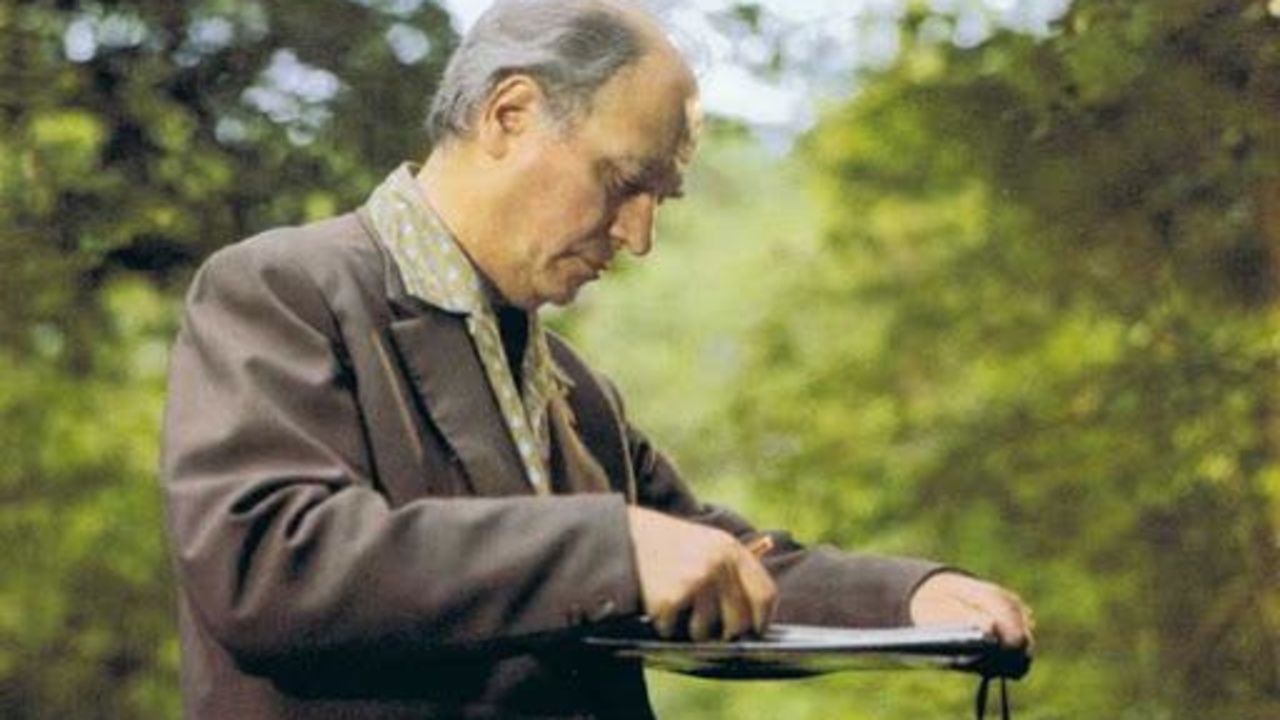
Bela Bartók listening to his wax-cylinder field recordings, collected all over the countryside of Eastern Europe, in countries that no longer exist, really, at least with the same borders. Anyway, Bartók and his pal Zoltan Kodály went around with their recording equipment (they also transcribed folk songs using standard Western notation, making performance notes as needed) like a couple of proto-Lomaxes, and we are all in their debt because they captured tons of stuff that few people cared all that much about at the time. And I am aware that he was young in this photo–young and so handsome!–whereas he was looking quite sick and decrepit when he wrote the Concerto for Orchestra, but hey, it’s my blog, and I’m an admitted flibbertigibbet.
What can you say about a woman brave enough to hang one-handed off the Eiffel Tower? IN SPIKE HEELS? People say the vertiginous scope of the background is mostly an optical illusion, but I call bullshit. Tina Turner was this brave and graceful every second of her life. You can’t persuade me otherwise.
The magnificent Tina Turner died today, although it feels impossible that such a dynamo could be stilled. Like Grace Bumbry, she was an alumna of Sumner High, on the Northside of St. Louis; back then, before the redlining and the strategic disinvestment, it was a jewel of the public school system, among many.
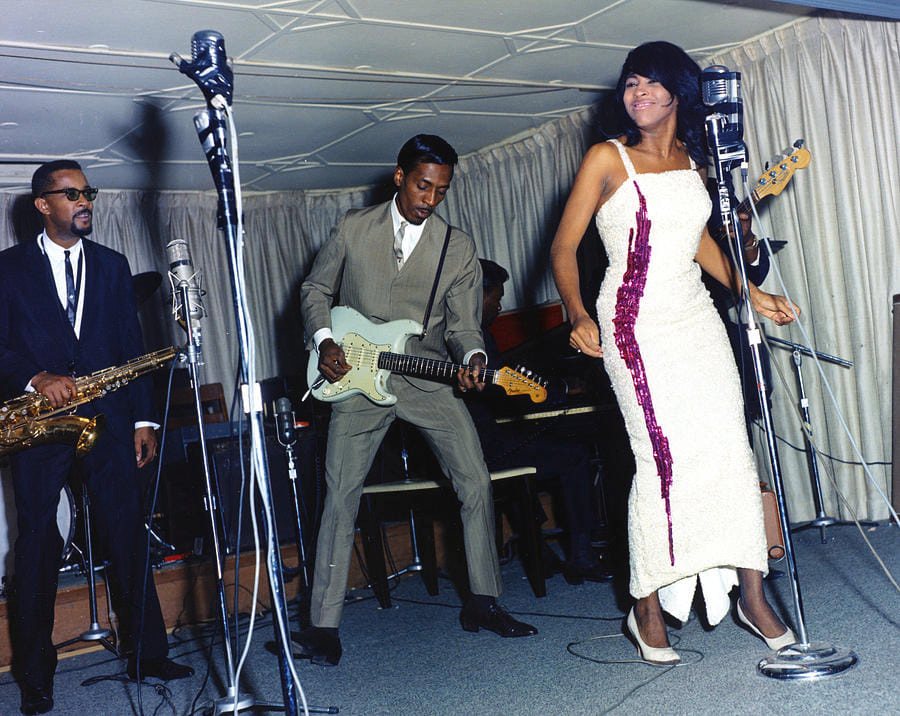
Tina Turner performing in St. Louis, at the Club Imperial, where she and Ike and the band honed their brilliance.
Way back in 2004 I wrote a review of an Ike Turner reissue that was actually an Ike and Tina record in all but name. In it I tried to describe what made her so electrifying to me from the first second I saw and heard her. If you don’t feel like reading, you can just watch this video from 1975, from The Midnight Special show.
Ike Turner His Woman, Her Man (Funky Delicacies)
It was Ike Turner’s curse and blessing that he hooked up with Anna Mae Bullock, a teenage girl from Nutbush, Tenn. The same might be said of her. She started out as a backup singer in Turner’s band, the Kings of Rhythm; was impregnated by one of said Kings; and then, with a snappy new name and a starring role in the revue, married Turner two years after they met. You’ve seen the movie, so you know how great that turned out. As a husband, Turner was monstrous; as a producer, songwriter, and multi-instrumentalist, he was sublime. If you’re one of those either/or types who believe geniuses have to be nice people, or at least not unrepentant dirtbags, remember that Pablo Picasso, Gustav Mahler, John Milton, and countless other cultural heavies all had their moments of misogyny, too. What do we gain by striking them from the canon?
Tina couldn’t help but outshine her mentor and tormentor. Still, even though she sings lead on every track of His Woman, Her Man, this is Ike Turner’s album, not Ike & Tina’s; if you don’t believe it, just look at the CD cover. Call it ungrateful, call it egomaniacal, but allowing Ike the frontman’s spot in this instance seems less unfair when you consider the couple’s careers: Ike is a god to nerdy collectors, but the hoi polloi know him only as the crazy coke fiend who smacked poor Tina around; his ex, on the other hand, she of the killer gams and the major motion pictures and the string of second-heyday hits in the ’80s, is a superstar. Who among us hasn’t whiled away a summer afternoon pretending to be Tina Turner, baring those famous golden thighs, shaking an imaginary shock of coppery hair, screaming and sighing and strutting and signifying like a sex-starved Pentecostal? Who else could sing like that, each phrase razor-blade bright and so sharp it doesn’t even hurt at first when it slices your heart in two?
But try to hear past Tina’s coruscating wail, the glamour that flares off every gritty syllable, and pause to savor Ike’s instrumental flourishes–the ARP synthesizer fed through a wah-wah pedal, the improbably funky “funk box” (an early drum machine), the oscillator, the countless crazy gadgets he collected at his Bolic Studio. His Woman, Her Man‘s 17 tracks were recorded there in 1970, when Ike, hoping to cultivate a bigger rock audience, began to experiment with what was then cutting-edge technology.
The results are strange but consistently compelling. Depending on your mood, you might crave the percolating country-soul of Creedence Clearwater Revival’s “Proud Mary (The Funky Version),” which Ike and Tina later rerecorded (the somewhat less funky version that anyone who’s ever listened to an oldies station knows by heart). Their first rendition thrums and pulses like the dirty river they’re celebrating, a long, sticky shudder of sound. Another cover, “I’ve Got My Mojo Working,” is as viciously sexy as anything the Stones ever recorded, and the percussion (it sounds like kerosene igniting) neatly punctuates Ike’s layers of brilliant guitar filth.
The weirdest cover, though, has to be Alice Cooper’s “Only Women Bleed.” In retrospect, the poignancy of this choice is almost unbearable (she did bleed, of course, and not just during her period); knowing that her abusive husband persuaded her to sing it, against her better judgment, makes it especially painful.
Fortunately, the mood lifts with the next track, “It’s Groovier Across the Line,” a bouncy sex romp that’s one among many great Ike compositions here. Dig the fried-out guitars on “Brain Game” or the squealing, almost unlistenable synths on “Baby Get It On,” the aural equivalent of crystal meth and undoubtedly the best song you’ve never heard. Every listen yields a new favorite, another if-only classic. His Woman, Her Man might not absolve Ike of his personal transgressions, but it secures his status as an icon.
Copyright 2004 by René Spencer Saller This review was originally published in the Illinois Times and later reprinted by the Association of Alternative Newsweeklies (along with my reviews of Wilco and Eminem, it won first place in the annual Association of Alternative Weeklies awards in 2005).
Olivier Messiaen, transcribing birdsong, which he incorporated in most of his compositions, especially in later decades.
The synesthete and mystic-slash-ecstatic composer and organist Olivier Messiaen (1908-1992) has long been a favorite of mine, but lately I find myself thinking a lot about his use of birdsong. He wasn’t the only composer to transcribe birdsong–Mozart and Beethoven did it, too–but no one listened to birdsong more closely or with greater devotion. According to some estimates, he incorporated the songs of more than 320 birds in his music. According to his colleague and sometime frenemy Pierre Boulez, “what he wrote was his imagination of birdsong.” Imagination aside, Messiaen did meticulous research on his beloved subjects and became something of an ornithological expert in France, and certainly one of the leading authorities on bird vocalizations. When he died, at 83, his widow, Yvonne Martenot, commissioned a bird sculpture for his headstone.
I learned a lot about Messiaen’s use of birdsong from this website, to which I’m sure I will return often.
And why have I been thinking about birdsong so much? It’s the Merlin Bird ID app from Cornell Ornithology lab, my new favorite addiction. So far in my backyard I have recorded a good couple dozen different species, and I’m learning to distinguish them without the Sound ID app being on, although I love to have it on anyway just in case it picks up something I miss. Messiaen lacked this app, but he more than made up for it in his listening and transcribing skills.
I could share any number of bird-related links, but I have chosen Catalogue d’oiseaux, composed between 1956 and 1958; he dedicated it to his second wife, former pupil, and forever muse, the brilliant Yvonne Loriod (1924-2010). Her sister, Jeanne, played the recently invented Ondes Martenot in Messiaen’s extraordinary Turangalîla Symphonie, the only symphony in his substantial catalogue.
Catalogue d’oiseaux contains his transcriptions of songs by more than 80 species of birds, all lovingly labeled in the score. The 13 movements feature birds from the eastern French Alps, then the southern Spanish border, then the northern coast. The composition, which takes about 2 hours and 45 minutes to perform in its entirety, is dedicated to Yvonne, like all of Messiaen’s major piano works since about 1942, when he met the former child prodigy in his harmony class, the first he had taught after being imprisoned in a Nazi concentration camp. Loriod impressed him from the start by playing his Eight Preludes from memory. (It wasn’t difficult for her in the slightest, thanks to her photographic memory. By 12 she had memorized all of Beethoven’s piano sonatas, as well as Mozart’s concertos. Two years later she had committed Bach’s Well-Tempered Clavier and all of Chopin and Schumann to memory.) The pupil and professor fell in love right away, but they couldn’t marry until 1961, two years after Messiaen’s first wife, the violinist and composer Claire Delbos, died as a result of cerebral atrophy, after nearly 20 years of suffering from total amnesia and other cognitive problems. Messiaen, a devout if somewhat unconventional Roman Catholic, had sole custody of their only son and wouldn’t consider divorcing her, even after falling in love with Loriod. He visited Delbos often, even though she never recognized him.
Loriod is fascinating in her own right. She was also a respected composer, although her works, unsurprisingly, were seldom performed, and she remains underprogrammed. She spent most of her life playing and promoting her husband’s music.
Yvonne Loriod and Olivier MessiaenOlivier and Yvonne, poring over a score, their love language.
The Composer Speaks
“I give bird songs to those who dwell in cities and have never heard them, make rhythms for those who know only military marches or jazz, and paint colors for those who see none.”
********************************* “It’s probable that in the artistic hierarchy birds are the greatest musicians existing on our planet.”
**********************************
“The birds are the opposite of time. They represent our longing for light, for stars, for rainbows, and for jubilant song.”
*********************************** A bird’s song is something extraordinary, an absolutely impenetrable chaos, a prodigious entanglement.”
*************************************** “[…] In order to translate these timbres, harmonic combinations are absolutely necessary. Even in very fast movements, where I reproduce bird songs either in the orchestra, or on the piano, each note is provided with a chord, not a traditional chord, but a complex of sounds destined to give the timbre of that note. There are as many invented chords as there are notes, which is to say for a bird piece comprising of one or two thousand notes, there are one or two thousand invented chords. It is an enormous task for the imagination….”
“…Birds always sing in a given fashion. They do not know the octave interval. Their melodic lines often recall the inflections of Gregorian chant. Their rhythms are of infinite complexity and variety, but always of perfect precision and clarity.”
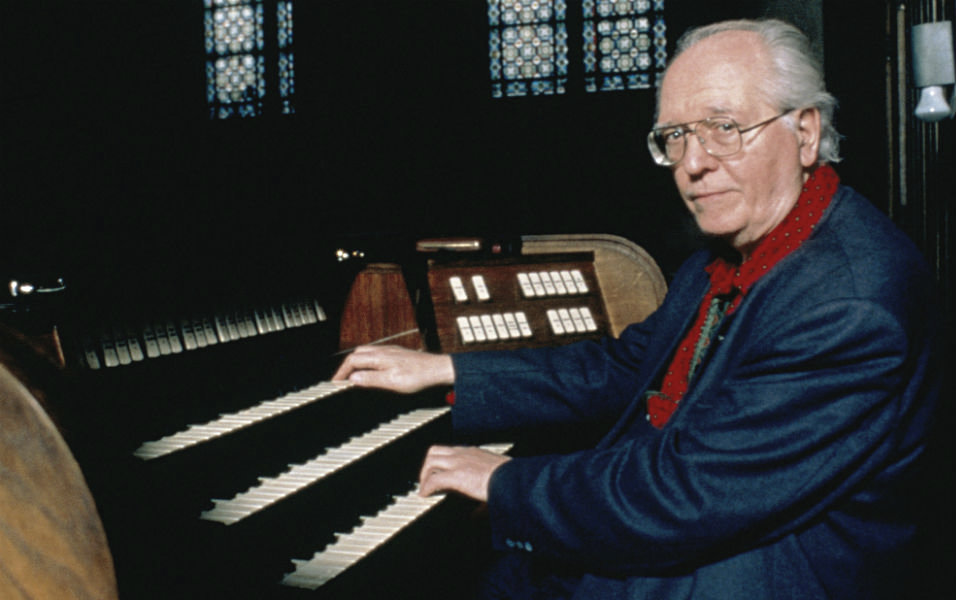
Messiaen at the organ. He would serve as organist at La Trinité, in Paris, for more than 60 years.
Author of SAINT OF THE NARROWS STREET, SHOOT THE MOONLIGHT OUT, CITY OF MARGINS, A FRIEND IS A GIFT YOU GIVE YOURSELF, THE LONELY WITNESS, EVERYTHING IS BROKEN, DEATH DON'T HAVE NO MERCY, and GRAVESEND

















 René Spencer Saller