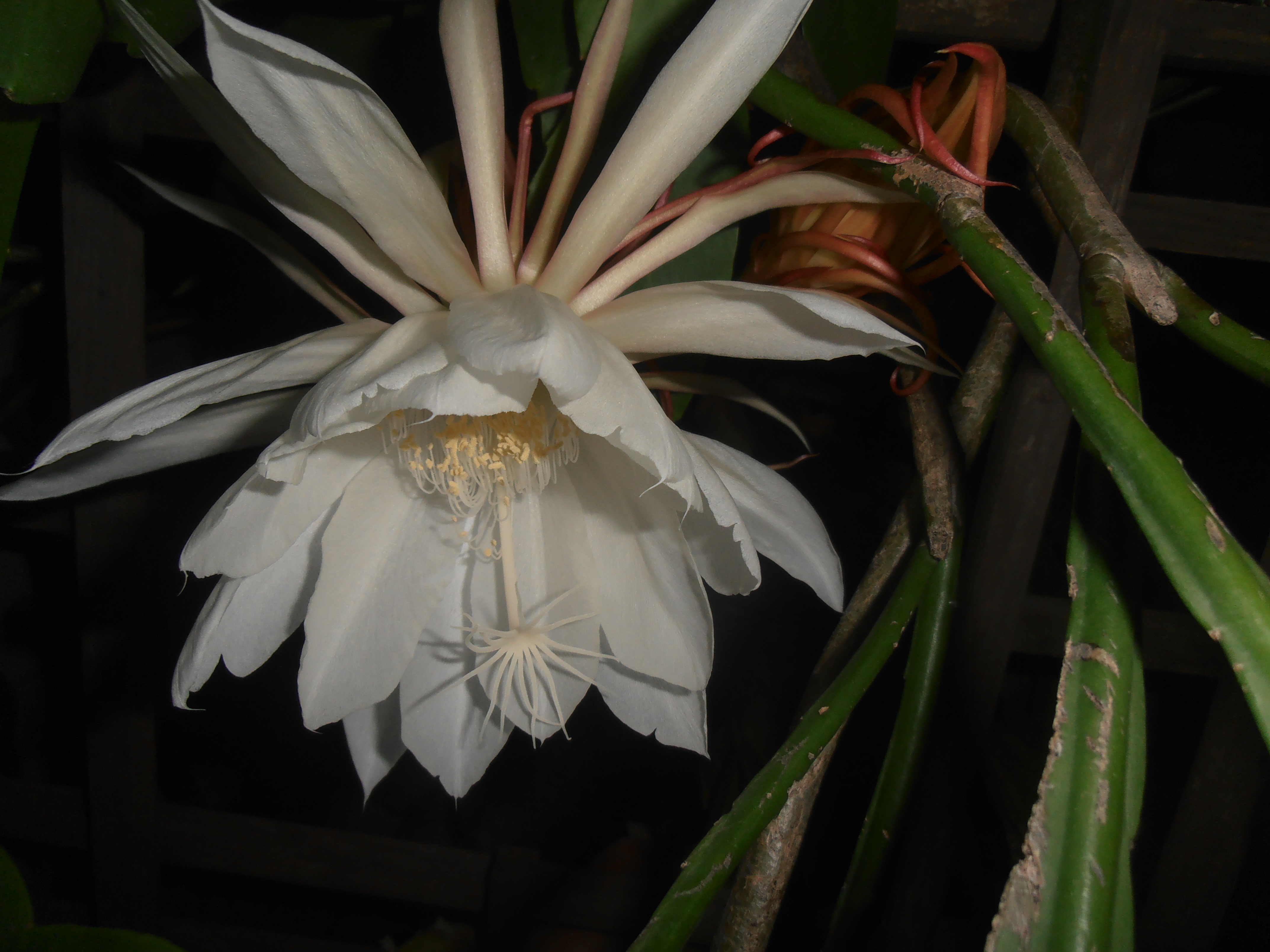
Under the moonlight, the cereus moonlight

I took this photo with my inexpensive digital camera (a 10-year-old Olympus that has been a true champ). I took it either the night of June 13 or the night of June 14; I got four big blooms in a 48-hour period, but I can’t keep the photos straight because the blossoms all look very similar).

I neglected to update my blog last week, even though I made a mental note that I could, say, celebrate the birthday of Richard Strauss (June 11) by posting a bunch of annotations from my vast backlog of notes that have been published but not online.

In my defense, I have been busy writing marketing client for a new client, one I value enormously and would like to retain, and I have also been doing other things, like studying French again on the free Mango app (free with my St. Louis Public Library card anyway–such a fantastic deal!), and reading books (I highly recommend the new Megan Abbott novel, Beware the Woman), learning to recognize the birdsong of various species in my backyard with the Merlin app, tending to our menagerie of geriatric companion animals (three cats in their mid to late teens, one dog who is estimated to be about 12), and, most relevant to this post, enjoying our small but fertile and fragrant garden.

Our night-blooming cereus is a reliable bloomer in the late spring and throughout the summer. Really, as soon as we put it outside on the patio, after its winter sabbatical indoors, which it seems to resent mightily, a sulking, drooping, morose succulent deprived of the only thing it really seems to care about, being outdoors. My mother-in-law was given this plant in the early ’80s, I believe, but the plant was already mature when she got it. She used to keep it on their brick patio on Westminster, but when they moved, they didn’t want to deal with it anymore (it’s extremely large and cumbersome and, if I’m being perfectly honest, not at all beautiful aside from the blooms, which last only one night and keep their own unpredictable blooming schedules).

That said, it’s hard to imagine a blossom more beautiful. Some people call it Queen of the Night, which I like because it reminds me of the famous Mozart aria, from The Magic Flute, but I haven’t adopted the nickname myself because night-blooming cereus is what I have known it, since I first encountered it on my in-laws’ patio back in the mid-90s.

I could include a lot more information about the n-b c, as my husband and I have taken to calling it, but instead I will just let you look at the photos. The petals remind me of swan feathers, elegantly curved and impossibly delicate. There’s that weird little sculptural stamen, like one of those Louise Bourgeois spiders, only small and pale. The bud, before it opens, looks like a frightening David Cronenberg creature, perhaps something out of eXistenZ. When more than two blossoms are opening at once–we had three on the night of June 14–the fragrance is almost overpowering. Imagine a gardenia on steroids. There’s a strong lemony floral top note, so dominant that it almost smells acrid, like mass-market kitchen cleaners, but this gradually fades to a much more pleasant, almost creamy classic white-petal scent.

By sunrise, the blossoms are spent and sad, resembling nothing so much as a used condom you might see on the street.

More classical music content coming soon, I promise.

On Birdsong and Messiaen

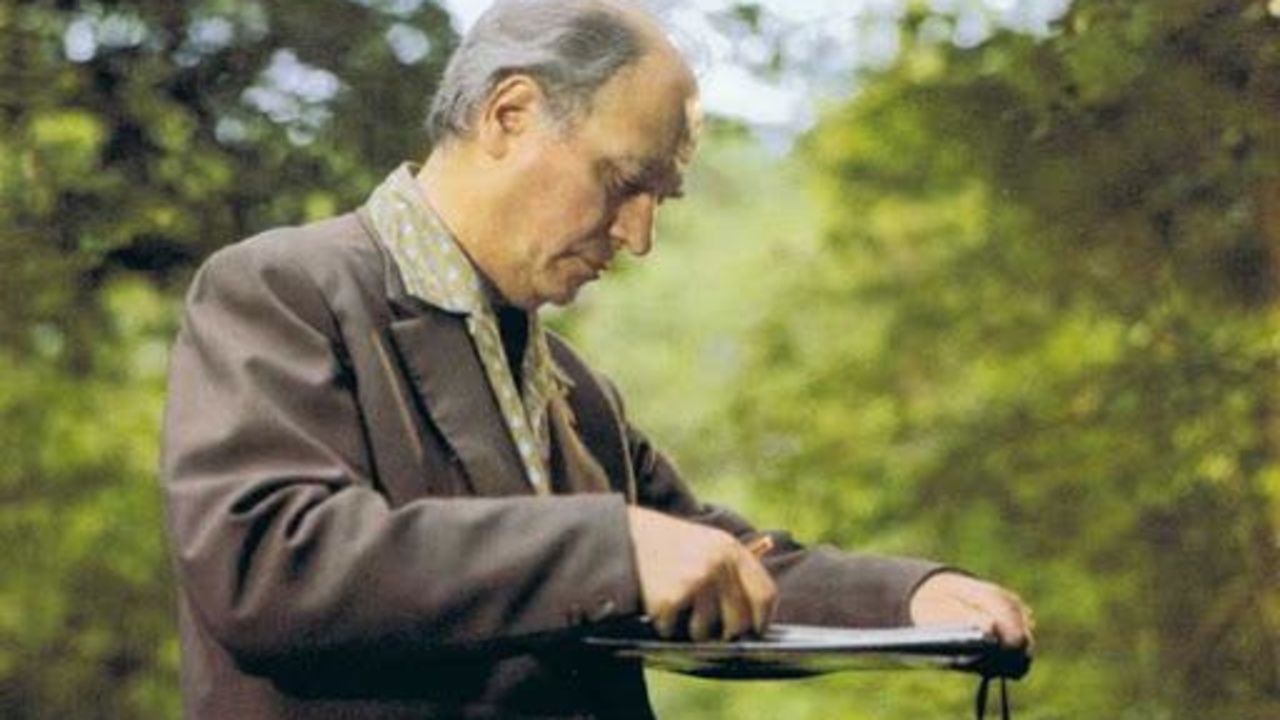
Olivier Messiaen, transcribing birdsong, which he incorporated in most of his compositions, especially in later decades.

The synesthete and mystic-slash-ecstatic composer and organist Olivier Messiaen (1908-1992) has long been a favorite of mine, but lately I find myself thinking a lot about his use of birdsong. He wasn’t the only composer to transcribe birdsong–Mozart and Beethoven did it, too–but no one listened to birdsong more closely or with greater devotion. According to some estimates, he incorporated the songs of more than 320 birds in his music. According to his colleague and sometime frenemy Pierre Boulez, “what he wrote was his imagination of birdsong.” Imagination aside, Messiaen did meticulous research on his beloved subjects and became something of an ornithological expert in France, and certainly one of the leading authorities on bird vocalizations. When he died, at 83, his widow, Yvonne Martenot, commissioned a bird sculpture for his headstone.

I learned a lot about Messiaen’s use of birdsong from this website, to which I’m sure I will return often.

And why have I been thinking about birdsong so much? It’s the Merlin Bird ID app from Cornell Ornithology lab, my new favorite addiction. So far in my backyard I have recorded a good couple dozen different species, and I’m learning to distinguish them without the Sound ID app being on, although I love to have it on anyway just in case it picks up something I miss. Messiaen lacked this app, but he more than made up for it in his listening and transcribing skills.

I could share any number of bird-related links, but I have chosen Catalogue d’oiseaux, composed between 1956 and 1958; he dedicated it to his second wife, former pupil, and forever muse, the brilliant Yvonne Loriod (1924-2010). Her sister, Jeanne, played the recently invented Ondes Martenot in Messiaen’s extraordinary Turangalîla Symphonie, the only symphony in his substantial catalogue.

Catalogue d’oiseaux contains his transcriptions of songs by more than 80 species of birds, all lovingly labeled in the score. The 13 movements feature birds from the eastern French Alps, then the southern Spanish border, then the northern coast. The composition, which takes about 2 hours and 45 minutes to perform in its entirety, is dedicated to Yvonne, like all of Messiaen’s major piano works since about 1942, when he met the former child prodigy in his harmony class, the first he had taught after being imprisoned in a Nazi concentration camp. Loriod impressed him from the start by playing his Eight Preludes from memory. (It wasn’t difficult for her in the slightest, thanks to her photographic memory. By 12 she had memorized all of Beethoven’s piano sonatas, as well as Mozart’s concertos. Two years later she had committed Bach’s Well-Tempered Clavier and all of Chopin and Schumann to memory.) The pupil and professor fell in love right away, but they couldn’t marry until 1961, two years after Messiaen’s first wife, the violinist and composer Claire Delbos, died as a result of cerebral atrophy, after nearly 20 years of suffering from total amnesia and other cognitive problems. Messiaen, a devout if somewhat unconventional Roman Catholic, had sole custody of their only son and wouldn’t consider divorcing her, even after falling in love with Loriod. He visited Delbos often, even though she never recognized him.

Loriod is fascinating in her own right. She was also a respected composer, although her works, unsurprisingly, were seldom performed, and she remains underprogrammed. She spent most of her life playing and promoting her husband’s music.

Yvonne Loriod and Olivier Messiaen
Olivier and Yvonne, poring over a score, their love language.

The Composer Speaks

“I give bird songs to those who dwell in cities and have never heard them, make rhythms for those who know only military marches or jazz, and paint colors for those who see none.”

*********************************
“It’s probable that in the artistic hierarchy birds are the greatest musicians existing on our planet.”

**********************************

“The birds are the opposite of time. They represent our longing for light, for stars, for rainbows, and for jubilant song.”

***********************************
A bird’s song is something extraordinary, an absolutely impenetrable chaos, a prodigious entanglement.” 

***************************************
“[…] In order to translate these timbres, harmonic combinations are absolutely necessary. Even in very fast movements, where I reproduce bird songs either in the orchestra, or on the piano, each note is provided with a chord, not a traditional chord, but a complex of sounds destined to give the timbre of that note. There are as many invented chords as there are notes, which is to say for a bird piece comprising of one or two thousand notes, there are one or two thousand invented chords. It is an enormous task for the imagination….”

“…Birds always sing in a given fashion.  They do not know the octave interval. Their melodic lines often recall the inflections of Gregorian chant. Their rhythms are of infinite complexity and variety, but always of perfect precision and clarity.”

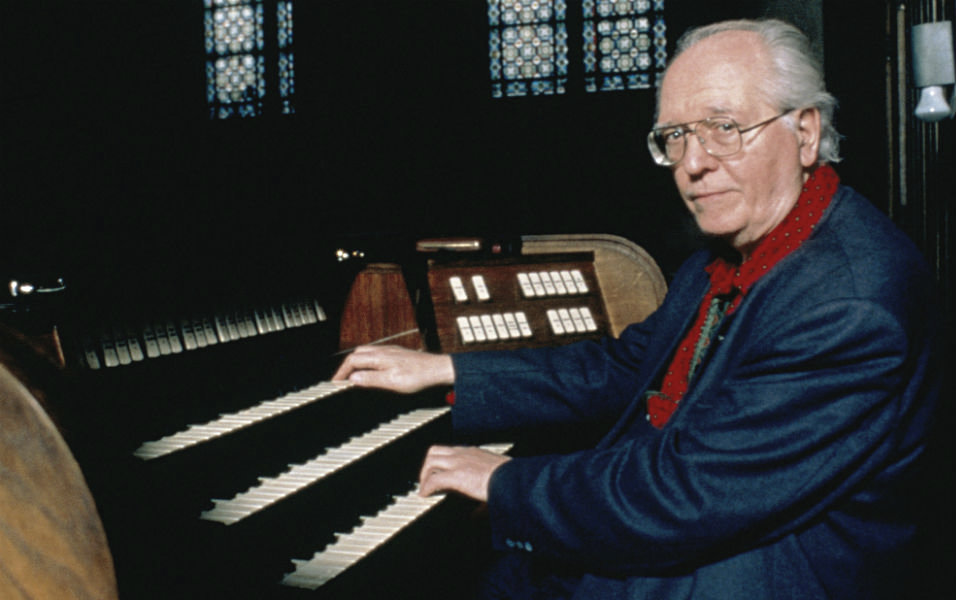
Messiaen at the organ. He would serve as organist at La Trinité, in Paris, for more than 60 years.