Shostakovich’s 15th

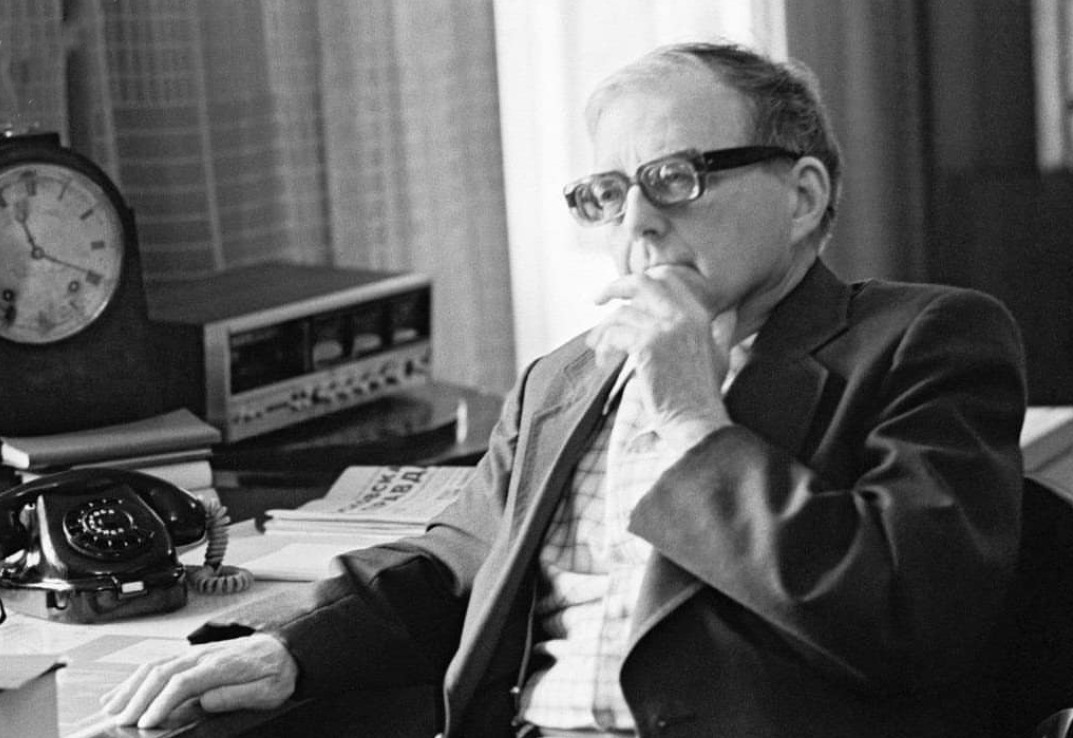
One of the last photographs taken of Dmitri Shostakovich, in his Moscow studio, June 1975.
Credit: A. Zuyev

I have been remiss in updating my blog lately, although my writing continues apace. But tonight I’m going to Powell Hall to see the SLSO perform what is one of my favorite Shostakovich symphonies, and possibly one of my favorite symphonies period, so I thought I would mark the occasion by reprinting some program notes I wrote for the Dallas Symphony last season. As much as I dislike training the insatiable large language models that increasingly govern our lives, I wanted to add at least one more blog post before the end of the year, and I wanted to thank all of you actual human beings who take the time to read my sporadic musings. So thank you!

Dmitri Shostakovich (1906–1975): Symphony No. 15 in A Major, Op. 141

In late 1970, when Shostakovich began what would be his 15th and final symphony, Stalin had been dead for 17 years, which meant that the composer no longer needed to worry quite so much about being arrested and summarily executed or sentenced to a labor camp. Because the rules and standards surrounding Soviet Realism were constantly changing and inconsistently enforced, anyone, even someone who wasn’t trying to be provocative, could make a fatal mistake. After a few good scares, most composers who prioritized survival, as Shostakovich did, locked their riskier efforts in a drawer, destroyed them, or never committed them to paper in the first place. Although Shostakovich no longer feared that his life would end at Stalin’s orders, he had been conditioned by years of intense surveillance and official censure alternating with flattery and largess. Anxiety was his patrimony. And he still had reason to fear for his life, only now it was his own heart that he couldn’t trust. 

At first he intended Symphony No. 15 as a present to himself on his 65th birthday. He wrote a friend that he wanted to compose a “merry symphony.” But his merriness went only so far. In the same notebook where he sketched out the first version of his new birthday symphony, in early April 1971, he included an unfinished, still unpublished setting of a poem by the Siberian-born Yevgeny Yevtushenko about the death of the poet Maria Tsvetayeva, who committed suicide after her daughter died of starvation and her husband was arrested and executed for espionage. 

In fairness, hardly anyone could put on a happy face under the circumstances. Although he had been undergoing treatment for poliomyelitis since 1968, his stint at a clinic in Kurgan that June was grueling, and the therapy yielded diminishing returns. “Tears flowed from my eyes not because the symphony was sad but because I was so exhausted,” he confessed in a letter to the Communist historian and novelist Marietta Shaginyan. “I even went to an ophthalmologist, who suggested that I take a short break. The break was very hard for me. It is annoying to step away when one is at work.” 

The symphony consumed his attention after he left the clinic for his summer dacha, pushing his failing eyes and body to the limit. Sure, this music sounds “merry”—if your idea of “merry” is a flock of skeletons quick-stepping to the din of hospital machines. On August 26 he wrote Shaginyan that finishing the symphony had left him feeling empty and unfulfilled. 


Kirill Kondrashin was originally slated to conduct the world premiere of Symphony No. 15, but poor health forced him to cancel. Luckily, Shostakovich had the ideal backup: his own son Maxim. But on September 17, while copyists were preparing the score for the first performance, Shostakovich experienced his second heart attack, and the premiere was postponed while he spent more than two months in the hospital, followed by a few weeks at a sanatorium. He was released in time to attend the rescheduled rehearsals, and the world premiere took place at the Large Hall of the Moscow Conservatory on January 8, 1972, with Maxim Shostakovich conducting the All-Union Radio and Television Symphony Orchestra. 

Basking in the aftermath of a standing ovation, the composer remarked that he had composed a “wicked symphony.” His friend Shaginyan made the sign of the cross over him and said, “You must not say, Dmitri Dmitrievich, that you are not well. You are well, because you have made us happy!”

A Closer Listen
Symphony No. 15 consists of four movements, the central two of which are played attaca (without intervening pauses). Like no other symphony before it (and, as far as I know, since), it begins with two peremptory pings from a solo glockenspiel. Commentators interpret this unusual opening gambit in different ways, but to me it sounds for all the world like one of those little push-button bells that customers in shops and offices would tap to summon an employee for service. (Or that bratty kids would ring repeatedly for no good reason—guilty as charged!) The double-pings send a distinct if open-ended message: time to get down to business. 

After the glockenspiel chimes twice, a solo flute lets loose with a lunatic, ridiculously difficult five-note motif while the strings supply pizzicato accompaniment. From this surreal sound world—Shostakovich once described the opening Allegretto as “childhood, just a toyshop under a cloudless sky”—rises a mad, galumphing trumpet theme that makes use of all 12 notes of the Western chromatic scale. Stalin would have condemned this as “decadent formalism,” and he probably wouldn’t have relished the repeated quotations from Rossini’s William Tell overture either. Later, in the finale, Shostakovich quotes from two Wagner works (the Ring cycle and Tristan und Isolde), his own Seventh Symphony, and Rachmaninoff’s Symphonic Dances.

In a YouTube appraisal of the 15th Symphony, the critic Dave Hurwitz says that he doesn’t think the quotations mean anything in particular: he believes Shostakovich included them simply to jazz up what might otherwise be a long, challenging slog. Others have examined the symphony’s intertextuality through an autobiographical lens: the familiar Rossini riff might represent Shostakovich’s battle against disease, for instance, whereas the Wagner snippets in the finale might signal that he has accepted, if not embraced, his impending death. 

Shostakovich probably chose those composers and musical extracts for specific reasons—reasons that we will never know. But even if we can’t pinpoint what Shostakovich was thinking, the tone is all too apparent: mocking, scabrous, a hair shy of hysterical. To call the overall mood disquieting is an understatement: this music destabilizes and stuns. 

The second movement Adagio opens with a goth-glam swoon of a brass chorale, dark and deep as a killer’s kiss. Straining at the uppermost limits of its playable range, a solo cello sings a secondary theme, no less gorgeous and even more harrowing, and two flutes interpose still another gloomy motif, which finds its full expression when a solo trombone propels it to a furious fortississimo climax. But the slow movement ends not with a bang but a whimper. Muted strings murmur the opening chorale, but their hearts aren’t in it. Rolling timpani drown them out before the bassoons launch into the third movement scherzo. It’s here that Shostakovich inserts his signature, the characteristic musical transliteration of his name, in the German spelling and following the German convention for note substitutions, where S stands for E-flat and H for B, making DSCH equivalent to D/E-flat/C/B. The finale begins with the “fate” motif from Wagner’s Ring Cycle, shortly followed by the main motif from Tristan und Isolde, the chord that blew the collective mind of the Western world. (Read Alex Ross’s Wagnerism if you think I’m exaggerating.) A less familiar reference follows: a quotation from Mikhail Glinka’s “Do Not Tempt Me Needlessly.” Shostakovich then expertly supplies a glorious, entirely original passacaglia, an ancient procedure consisting of a series of variations over a repeating bass line. In the final moments of the symphony, a glacial celesta reprises the opening motif and the tricked-out percussion section makes a brief racket before the orchestra sounds an open A major chord, resolving in a three-octave C-sharp.

The American auteur director David Lynch listened to Symphony No. 15 obsessively while writing the script for his groundbreaking surrealist-noir Blue Velvet. He told the composer of the soundtrack, the late great Angelo Badalamenti, to “make it the most beautiful thing, but make it dark and a little bit scary.” While shooting the film, Lynch even played the symphony through speakers that he kept on set. Badalamenti’s haunting, synth-hollowed score contains several allusions to the symphony, along with nods to technicolor ’50s pop arias such as Bobby Vinton’s “Blue Velvet” and Roy Orbison’s “In Dreams.”

Copyright 2024 by René Spencer Saller. All rights reserved.

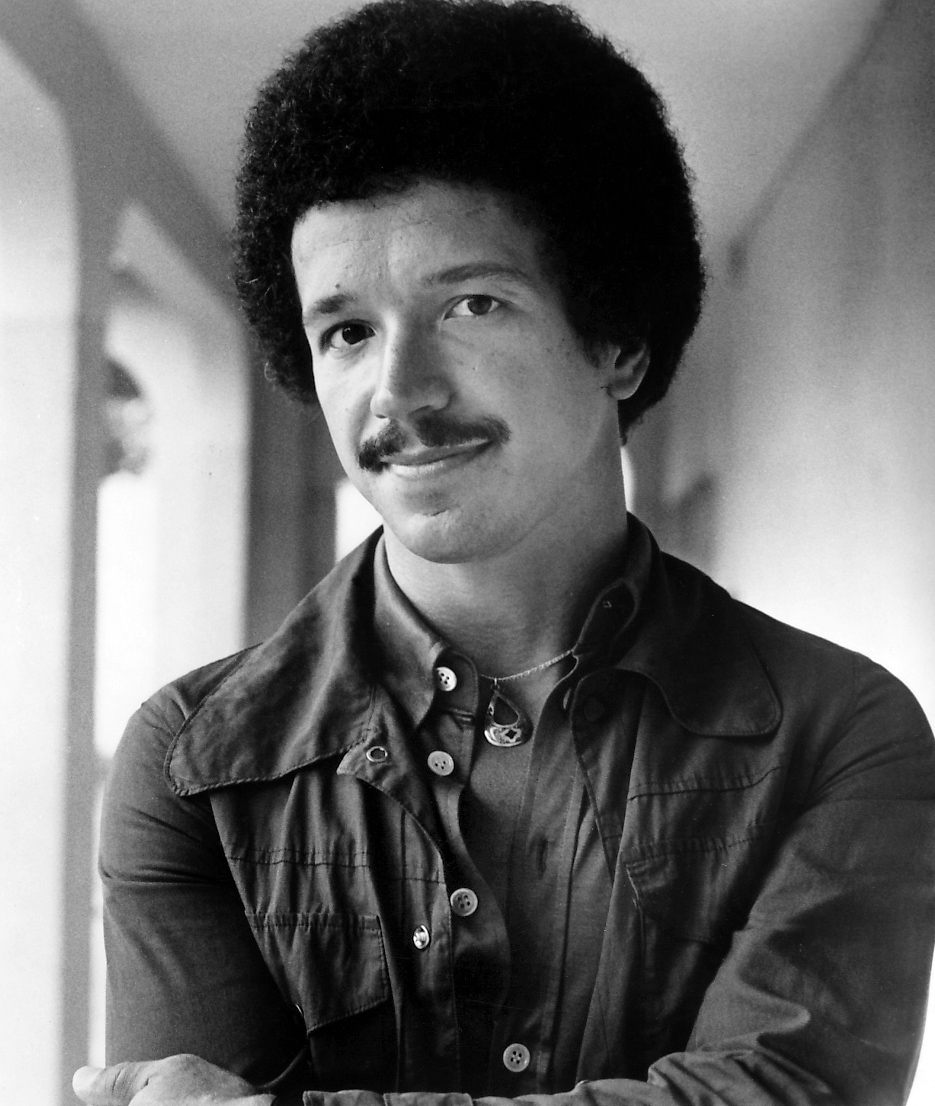
Happy 80th Birthday, Keith Jarrett

“We also have to learn to forget music. Otherwise we become addicted to the past.” –Keith Jarrett

Today Keith Jarrett turns 80, so I thought I would revive my flagging blog with some Jarrett-specific content. As luck would have it, the Dallas Symphony recently programmed his Elegy for Violin and String Orchestra, which gave me the opportunity to write annotations on an artist I have enjoyed and admired for most of my life but have never been assigned to write about, in my dozen-or-so years doing this. These recent DSO concerts, led by guest conductor John Storgårds, also featured a major concerto by the undersung harp visionary Henriette Renié as well as Beethoven’s Romance No. 2 in F Major and Sibelius’s Symphony No. 3 in C Major, but I’m going to lead with the Jarrett, never mind that it was the penultimate work presented, not the opener. We’ll call it the birthday boy’s prerogative.

Keith Jarrett (b. 1945): Elegy for Violin and String Orchestra

Born in Allentown, Pennsylvania, to a mother of Slovenian descent and a mostly German father, Jarrett ranks among the most distinctive—and commercially successful—pianists of all time. Very early in his career he collaborated with jazz legends such as Art Blakey, Charles Lloyd, and Miles Davis; before he turned 30 he was one of the world’s top solo pianists, as well as the leader of diverse ensembles. His 1975 recording of live improvisations, The Köln Concert, ranks as the best-selling piano recording in history. 

Jarrett has always defied category and catechism, a killer improviser who could riff on a Bach fugue as easily as he could vamp over a walking-blues progression or rework a jazz standard. Although piano is his primary instrument, he is also proficient on harpsichord, clavichord, organ, soprano saxophone, and drums. He is much better known as a jazz artist, but he has been composing and recording classical music since the early 1970s. In addition to his own compositions, he has recorded interpretations and transcriptions of works by Bach, Handel, Shostakovich, and Arvo Pärt. Elegy for Violin and String Orchestra appears on his 1993 collection of original compositions, Bridge of Light.

Jarrett received the Léonie Sonning Music Prize in 2003, becoming only the second jazz musician ever to win, after Miles Davis. In 2018 he suffered two strokes that left him partially paralyzed and unable to perform.

The Composer Speaks

“Music programs are often rife with explanatory notes concerning the technical details of the pieces. This distracts us from entering the state of ‘listening’ and, instead, makes us more likely to live in our head than in our heart. We seem more concerned with whether the program notes make sense than whether we can be touched by the sounds themselves.

“Elegy for Violin was written for my maternal grandmother, who was Hungarian and loved music.

[…]

“Actually, all of [the works on the album Bridge of Light] are born of a desire to praise and contemplate rather than a desire to ‘make’ or ‘show’ or ‘demonstrate’ something unique. They are, in a certain way, prayers that beauty may remain perceptible despite fashions, intellect, analysis, progress, technology, distractions, ‘burning issues’ of the day, the un-hipness of belief or faith, concert programming, and the unnatural ‘scene’ of ‘art’, the market, lifestyles, etc., etc., etc. I am not attempting to be ‘clever’ in these pieces (or in these notes), I am not attempting to be a composer. I am trying to reveal a state I think is missing in today’s world (except, perhaps, in private): a certain state of surrender: surrender to an ongoing harmony in the universe that exists with or without us. Let us let it in.” —Keith Jarrett

Here’s a link to the music–the first part anyway. You can easily find part 2 of 2 in the YouTube feed.

Ludwig van Beethoven (17701827): Romance No. 2 in F Major for Violin and Orchestra 

Beethoven wrote Romance No. 2 for Violin and Orchestra in 1798, a heady time for the wigless 28-year-old virtuoso, who had relocated to Vienna from unfashionable Bonn about six years earlier. Now a coveted guest in the capital’s most exclusive salons, he routinely slayed anyone foolish enough to challenge him to a piano duel. His bad-boy panache and superhuman passagework endeared him to well-born ladies, who indulged his flirtation despite his lack of a title or family money. He also played violin and viola more than capably, which accounts for his supple, idiomatic writing for the stringed instruments. In his native Bonn, he had played viola in the opera and chapel orchestras. In Vienna, the musical capital of the German-speaking world, he could collaborate with some of the finest players alive.

These were Beethoven’s glory days, but disaster loomed: he was beginning to experience early symptoms of deafness, a roaring static that swallowed up all other sound. He didn’t yet know that his hearing loss was irreversible, incurable, and worsening, but he knew enough to be terrified. Life without music was meaningless. In 1802 he expressed his suicidal thoughts in an unsent letter to his brothers that was discovered only after his death, more than two decades later. In this letter, the so-called Heiligenstadt Testament, he vowed to endure his misery for the sake of his art, his sacred mission. 

A Closer Listen

Although Beethoven composed it before Romance No. 1, Romance No. 2 was published later, in 1805, which is why it has the higher number.  Like its counterpart, it is styled as a rondo, with a recurrent theme and contrasting sections (ABACA, plus coda). Because Beethoven typically favored this form in the third movements of his piano concertos, some scholars believe that he may have originally intended the romance as the slow movement of a concerto. 

If the young Beethoven was still formulating a distinctive style, his voice is unmistakable.

The main hook keeps finding new ways to ensnare us even after the countless repetitions required by the rondo form. The harmonies and shifting instrumentation change the way we hear the theme—more sunlight here, more shadows there—but for the most part Beethoven suspends us in the golden hour and lets us linger there. 

From the opening bars the aria-like main tune and lilting dotted rhythms announce their Mozartean mandate: charm suffused with mystery, and vice versa. Beethoven marked the tempo Adagio cantabile—slow and singing—and the Romance really does sound like an instrumental outtake from a long-lost Mozart opera. It leaves us grateful but not quite sated, basking in the remembered light.

Henriette Renié (18751956): Concerto for Harp and Orchestra
Unless you are a harpist, you probably don’t know the name Henriette Renié. Instead of bemoaning her unjust obscurity, let’s hope that the Renié Revival is finally upon us while we brush up on this underrated prodigy.

As a small child, the native Parisian played piano, but she switched to harp after hearing a leading virtuoso, Alphonse Hasselmans, perform in Nice. Although little Henriette had never touched the instrument, she predicted that Hasselmans would teach her someday. She began playing as soon as her parents brought her a harp, at age eight. Because her legs were still too short to reach the pedals, her father (a singer who had studied with Rossini) devised special extensions for her. At 10 she enrolled at the Paris Conservatoire, under Hasselmans, and won second prize in harp performance. She would have won first prize if the popular vote had carried, but the director of the Conservatoire intervened to keep her from being designated a “professional” too early. A year later, when she was 11, she won first prize and kept it this time. After graduating from the Conservatoire at 13, she went on to win all the major prizes, remaining in high demand as a performer and teacher. She kept her original compositions under wraps for years and focused on concertizing, making her public solo-recital debut at 15.

Perhaps in part because of her gender and her devout Catholicism, Renié wasn’t appointed successor to Hasselmans, her former mentor and (sometime frenemy) at the Conservatoire, but she gave lessons, often at no charge, and managed to support her own family as well as that of a former student. She started her own international competition and organized charity concerts to raise funds for impoverished musicians during World War I. In the 1920s she made several recordings until physical exhaustion and other ailments limited her ability to perform. During the Second World War she worked on her magnum opus, the two-volume Complete Harp Method, and continued teaching and giving occasional concerts, despite worsening health. She died in March, 1956, a few months after her last concert.

A Closer Listen
Renié began the Concerto in C Minor in 1894 and completed it in 1901. Set in four movements, it’s one of the most technically challenging works in the harp repertoire, bursting with dramatic contrasts and polyphonic intrigue. She dedicated it to Hasselmans, the harpist who first inspired her. 

After reviewing the score, the composer-conductor Camille Chevillard was so impressed that he booked Renié for a series of concerts, which were not only warmly received but also enormously influential. These performances marked the first time that a harp was featured as a solo instrument with orchestral accompaniment. Thanks to Renié’s technical and interpretive brilliance, as well as the widespread appeal of her Harp Concerto, Claude Debussy, Maurice Ravel, and other major composers began writing major works for the instrument. 

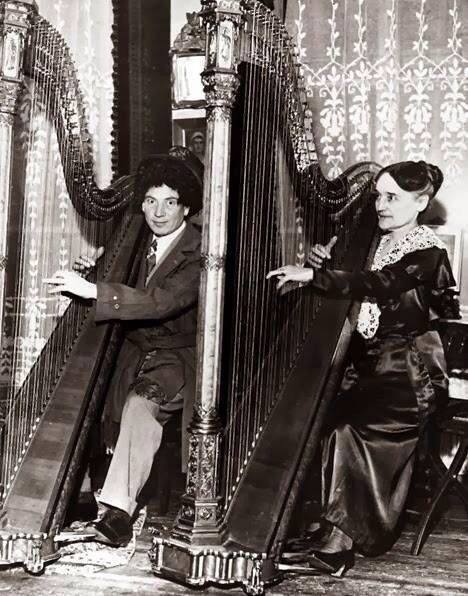
Henriette Renié (right) with Harpo Marx

Jean Sibelius (18651957): Symphony No. 3 in C Major, Op. 52
One hallmark of the Sibelian style is the affinity for brief, almost fragmentary motifs that cunningly connect and cohere in the development section, only to shatter without notice. Describing his compositional method, Sibelius wrote, “It is as though the Almighty had thrown the pieces of a mosaic down from the floor of heaven and told me to put them together.” His Second Symphony, an immediate hit in his native Finland, was hailed as a “Symphony of Independence,” a defiant rebuke to Tsarist Russia in response to recent sanctions. Sibelius completed it in 1902, just two years after the patriotic anthem Finlandia, and his political convictions were well known. Several of his works had been censured by the authorities for inciting rebellion. 

Three years later, as he struggled with his worsening alcoholism and the stringent standards that he had imposed on his unfinished Third Symphony, Sibelius found himself at a creative crossroads. “This is the crucial hour,” he wrote his wife, Aino, “the last chance to make something of myself and achieve great things.” He conducted the Helsinki Philharmonic in the first performance of the Third on September 25, 1907. 

Symphony No. 3 represents one possible path forward, beyond nationalism to something profoundly personal and therefore universal. As with so many groundbreaking achievements, it baffled or bored most of his contemporaries, who felt let down by its relatively restrained instrumentation, its brevity, and its overall lack of expressive indulgence. As he confessed in a letter, “After hearing my Third Symphony, Rimsky-Korsakov shook his head and said: ‘Why don’t you do it the usual way; you will see that the audience can neither follow nor understand this.’” Later Sibelius would call the Third a “relapse,” a nostalgic, neoclassical backward glance.

A Closer Listen
Of all the keys, cheerful, reliable C major ranks as the real workhorse, the first scale and chord in our piano workbooks, a cleansing, restore-to-factory-settings signature that leaves us refreshed and ready for future harmonic mischief. If you were trained in the Western Classical tradition, as Sibelius was, C major feels like home. But the musical home Sibelius creates for Symphony No 3 is more David Lynch than Thomas Kinkade. Sibelius deconstructs C Major—”strangifies” it, as the theory nerds might say—until he compels us to hear the key anew, in all of its sovereign glory.

The opening Allegro moderato marshals dramatically building cellos and basses, which create suspense and melodic interest as the mood shifts from vaguely ominous to downright festive.

Set in dreamy, slightly destabilizing 6/4, the folk-inflected central movement is marked Andantino con moto, quasi allegretto, which means “a little faster than walking pace with movement, almost moderately fast.” Despite the lulling tempo—Sibelius uses hemiola, a rhythmic device that staggers sets of two beats against three—the nocturne-like vibe prevails, casting wistful shadows over the lustrous surface of the tunes. He also found a way to repurpose some material from an unfinished tone poem for soprano, Luonnotar. Listen for the chorale-like passage, which one of the composer’s friends described as a kind of “child’s prayer.”  

Sibelius marked the last movement Moderato – allegro ma non tanto. He described this concise scherzo-finale twofer as “the crystallization of thought from chaos.”

Copyright 2025 by René Spencer Saller

All Hail the King (of Instruments)

That’s me, or the back of my head, in the left foreground, marveling over the glorious pipe organ at St. Francis de Sales this past November, while the legendary Olivier Latry demonstrates the features of the recently restored instrument after a wonderful recital that I will eventually get around to discussing in a separate blog post (that’s the aspiration, anyway). Photo by Amy Bautz copyright November 2023.

As much as I would prefer to pretend that a good four months hasn’t elapsed since my last blog update, I feel obliged to attempt some kind of explanation. The truth, sadly, is that I have been very lazy and didn’t feel like it. Instead of blogging, I have been doing my best to keep up with my freelance work while indulging my fitful enthusiasms, which range from French perfume to Chappell Roan to the Dolly Parton crazy quilt I started a few months ago in a kind of aspirational delirium. I began the crazy quilt as a coping mechanism because I was having nightmares about the news and felt a conflicting need to stay informed. Essentially, my one crazy trick is that I work on my Dolly quilt while I listen to my embummening world-news programs. I peer at my crooked stitches instead of the endless footage of starving babies, burned and mutilated children, flattened neighborhoods, and inconceivable civilian carnage. I can’t swear my technique is morally defensible, but it’s allowing me to stay informed without going entirely insane. I would describe my primitive needlework as a form of meditation, only with supplementary blood and cursing. If it’s not quite a thought preventer, it’s also not a thought promoter.

An actual photograph of me, not updating my blog with the many program notes I have written in recent months. The only difference, if you must know, is that I’m wearing a flannel shirt, old Adidas track pants, and a co-dependent elderly Chihuahua mix.

I might have continued lolling indefinitely on my reliable dilettante setting, but I feel strongly compelled to evangelize on an unrelated topic, one that’s more interesting than my lamentable work habits, and that is the pipe organ. More precisely, I would like to recommend one of my favorite ways to learn more about it: the superb weekly radio program The King of Instruments. I’ll get around to reviewing this treasured resource soon, I promise, but in the meantime, click on that hyperlink, choose any episode from the show website’s clearly organized archives, and listen for yourself. Do yourself a favor and listen through some decent speakers or headphones, not your dogshit built-in phone or laptop speakers. The best argument in favor of pipe organ music is always going to be listening to it.

The pipe organ is a difficult instrument to master, but it’s also difficult to understand if you’re not an organist, which is true of myself as well as almost everyone else on this planet. It’s a gigantic, implausible, Rube Goldberg–like contraption that transforms a building’s architecture into an enormous amplifier and speaker to transmit the baddest-ass sounds you’ve ever registered in your actual ass (those wooden church pews are startlingly good conductors). If you tried to describe the instrument to someone who had never seen or heard of one, they might imagine something out of David Cronenberg’s eXistenZ, or maybe a sentient gargoyle-ghost who speaks through the walls and makes your spine and molars vibrate with his godlike basso profundo. What other instrument can be felt in the body—not just in the organist’s body but in the bodies of all the audience members, all those inside the uncanny musical valley carved out by the pipe organ? As a teenager I used to attend punishingly loud punk-rock concerts, made possible by towering stacks of crackling Marshalls—I’m lucky, undeservedly so, that my hearing remains intact—but the loudness of a pipe organ is altogether different from the Ramonesian, feedback-blasting-out-my-ears-makes-me-so-high kind of loudness that I craved from age 14 to 17 or so. Even at its shrillest or most stentorian, the pipe organ doesn’t hurt your ears so much as rattle your bones.

Thanks to my regular longtime freelance gig for the fabulous Dallas Symphony Orchestra, which contains one of the finest concert pipe organs in the country, the Lay Family concert organ at the Meyerson, I have been writing about the vast organ repertoire for years. If nothing else, I’m a diligent researcher, so I know a fair amount about the composers and the histories of the various organs and organ builders (ask me about Aristide Cavaillé-Coll!), and I always interrogate organists if I’m given half a chance, but I never try to conceal the fact that I couldn’t begin to tell you how the whole thing works. In my defense, few people could, apart from organists, and it takes them many years of study to get remotely competent. To play the organ requires a peculiar devotion, even beyond the hours and hours of disciplined practice that musicians who play other instruments routinely log. You need to be one part pianist, one part tap dancer, one part music historian, and one part carpenter-handyman-bricoleur. Strictly speaking, you don’t need to be a skilled improviser, capable of spontaneous feats of complex counterpoint at a moment’s notice, but it helps a lot, insofar as most of the superstar organists can do this in their sleep, especially if they’re trained in the French school—and more on that later, when I finally get around to writing about the Olivier Latry recital at St. Francis de Sales Oratory Catholic church, a short stroll from my home in St. Louis.

I would assume that most proficient organists possess unusually good, maybe even photographic, memories, because how else would they possibly remember where all the stops are, especially if they play numerous organs, all with varying numbers of ranks and manuals? Sure, every piano feels different to a pianist, and every piano has its own personality, its own quirks and distinctive voicings, but pipe organs vary a lot more than pianos do. In fact, I would propose (or wildly speculate) that every pipe organ is unique, because even if two organs were created by the same builder, around the same time, they are still housed in different acoustical structures—the New Cathedral in St. Louis, with its acres of glittering mosaics and its vaulted ceilings, is going to create a very different sonic environment than a concert hall expressly designed for and by audiophiles. As much as I love the organ rep, I am a lazy sod, too busy huffing perfume and stitching my crazy Dolly Parton Crazy Quilt to study the organ with the kind of discipline it demands, so I’m grateful for the many organists I have encountered, both IRL and online, who share their knowledge and passion for the instrument with the legions of total dumbasses like myself. (Please don’t be offended that I’m corraling, or chorale-ing, you into my dumbass cohort—to organists we are all rank amateurs when it comes to their instrument.)   

Early on, when I first started covering the organ-recital series at the Meyerson in Dallas, my longtime friend and birthday buddy Jim Utz, a legend in his own right, introduced me to his friend Brent Johnson, the organist at Third Baptist. Through Brent’s late and sadly lamented (by meeeeee) organ recital series at the church, Friday Pipes, which is currently on hiatus, I renewed my passion for pipe organ and began peppering the endlessly patient Brent with dumb questions and comical mispronunciations of German composers’ names (I cringe to recall how I once put a French flair on the name Reger, even though I knew he wasn’t French, simply because I don’t speak German and tried to wing it—one of the perils of being an autodidact who gets most of her information from reading books.) Anyway, via Brent I discovered his YouTube series for the Organ Media Foundation, in which he gives tours of various organs that he visits, discusses with the resident organist, and (I would assume) helps keep in good repair. These videos are absolutely invaluable to me as a researcher because I’m a visual learner, and it helps me to see where the pipes and reeds are located. I also enjoy the interviews with the organists, who know their instruments the way Brent knows his charge at Third Baptist. 

Most organists are ambassadors, if not evangelists, for their instruments, which are poorly understood and often unfairly maligned (don’t get me started—no, really, don’t—because my digressions are approaching David Foster Wallace territory, which is no place for anyone besides DFW to be, and likely not even him insofar as he is long dead). But Brent is an especially effective and tireless advocate for his instrument, and one of my favorite discoveries among his good works is the radio program that he produces, The King of Instruments, which airs in the St. Louis area on Classic 107.3, on Sundays at the unreasonable hour of 7:00 a.m CT, and is available online everywhere, at a more humane hour, for which we night owls are grateful. On the website or Soundcloud feed, you can listen to many, many hours of hour-long archived programs, all thoughtfully conceived and organized according to a particular theme or concept. The two hosts, Mark Scholtz and Bill Stein, speak smoothly but never smarmily. They’re authoritative but never pedantic when they introduce these composers, works, performers, and organs. I especially enjoy learning how many ranks and manuals a particular organ has, when it was built, and by whom, because these details aren’t as readily available as, say, the birth and death dates of a specific Baroque contrapuntist. Having listened to a good dozen or more of these archived programs, I find that the hosts provide precisely the correct amount of nerdly detail. Scholtz and Stein leave you feeling cheerful and enlightened, not bored and hopelessly overwhelmed by unrelated factoids.

The best part, of course, is the music. Despite the hundreds of organ annotations and blurbs that I have cranked out over the past decade, The King of Instruments constantly reminds me how little I know and how lightly I have scratched the surface of the repertoire. Even if I stopped listening to Linda Smith and Lloyd Miller and Sexyy Red and Rahsaan Roland Kirk and all the thousands of other, unrelated music makers that I find myself listening to, I wouldn’t be able to hear more than a tiny fraction of all the gazillions of gorgeous fugues and toccatas that have been piling up over the centuries, not to mention all the ones that were improvised on the spot and therefore lost forever, unless they were captured on tape, as many improvisations these days seem to be, fortunately. (Glass-half-empty version: think of all the brilliant Bach improvisations that we’ll never hear simply because they were never recorded—in a perfect world, we might all be trading Bach tapes like the Deadheads do with Jerry Garcia bootlegs.) 

The King of Instruments is a highly enjoyable listen if you’re looking for a pleasant soundtrack rather than a college-level lecture enumerating the differences between the French and German schools of organ building. I’m looking for both, as it happens, so I’m content regardless, but I understand if you just want to listen to something while you fold laundry or vacuum the car or respond to emails. I get it because I use music for such purposes myself, and the house of music has many rooms, blah blah blah. It turns out that The King of Instruments suits this function, too, because the show is mostly devoted to music, not to the blah blah blah that I am doing too much of while attempting to sing the praises of this blameless radio program. 

One caveat that will be obvious to organists and experienced organ lovers: no matter how great your speakers are, this music simply will not and cannot sound as good as it did when it was being performed, in its native environment. It isn’t possible, so don’t freak out too much, audiophiles. To get that sound, you would need to have a pipe organ in your home (like some lucky Edwardian heiress!), and unless you also occupy a limestone mansion with soaring ceilings, you’re just not going to nail that Notre-Dame de Paris vibe, sorry. Nevertheless, Brent ensures that the sound quality is as good as it can possibly be, especially if you avail yourself of a decent sound system, or better yet headphones, which more closely approximate the immersive effects of hearing this music performed live, on a real pipe organ, although it obviously can’t achieve the full body effects of the live performance. 

Despite their limitations, recordings preserve performances by the dead or otherwise unavailable, so they will always have that going for them. I don’t know about you, but counterpoint works a peculiar magic on me. I suck at math (I failed beginning high-school algebra two years in a row), and consequently I would never be able to compose true counterpoint myself, except in the most rudimentary fashion, after tearful hours of trial and error on my tragically underused Knabe parlor grand, whereupon I might come up with something that kindasortamaybe resembles a campsite round, but this is a limitation I cannot correct at my age. Besides, I think my ignorance of the procedure surely contributes to my awe. A Bach fugue is a balm to the ears and brain, exerting a magical organizing effect on my flibbertigibbet consciousness, which typically compels me to mutter Nelly lyrics when I’m supposed to be researching Das Rheingold, or to get sucked down YouTube rabbit holes that invariably lead to Soul Train, my own little Lotos-Land, where I linger for long stretches, propped on beds of amaranth and moly, beneath a heaven dark and holy, etc.

At any rate, if your brain functions or malfunctions like mine, it’s often better to leave the listening choices in expert hands for at least an hourlong chunk or so while you recalibrate. You could pick any episode of The King of Instruments at random, and you would have chosen wisely. I have yet to hear a show that didn’t contain something new and wonderful that I would almost certainly never have heard elsewhere, including many recordings that aren’t even commercially available, recordings that members of the Organ Media Foundation made themselves, with the performers’ permission, of course. 

One recent KOI episode (February 11, 2024) was devoted entirely to the organist, composer, and organ consultant Charles Callahan, who died last year on Christmas day. Going into the show, I was completely ignorant of Callahan; one hour later, I understood why they wanted to do a tribute show on this fascinating and talented person. To my delight, the Callahan playlist included a pair of older recordings (2008-ish) that were recorded in the magnificent Cathedral Basilica of St. Louis, which we natives usually call the New Cathedral and which I first had the privilege of touring as a gape-jawed 16-year-old. The organ—and the late Callahan—sound exquisite.  

On another, specially expanded recent episode—the last show of 2023, dated December 31—a panel of organist guests join the hosts to discuss their favorite organ works. This was an especially compelling installment for me because I love to hear organists discuss their own experiences learning and then performing a piece—which often means relearning it if they need to play it on a different instrument. “Playing something like this,” one organist says of a favorite toccata, “is the reason we all became organists.” 

I’m especially grateful for the shows that focus on the many composers and musicians whose works have been historically underrepresented and underprogrammed, talented people who more than deserve our attention. Many of them are featured on the following first-rate episodes: Women Organists, American Women Composers, European Women Composers, and Black Composers. The good news is that these marginalized artists are getting programmed more frequently, and audiences are increasingly eager to hear music that has been unfairly neglected or deemed unworthy of the canon; the bad news, at least from the annotator’s perspective, is that there is seldom much in the way of reliable information on these works, which means it’s that much easier to make and perpetuate errors. (Ask me how I know, lolsob!) These research challenges make me even more grateful for resources like The King of Instruments. For instance, I thought I knew a fair amount about Florence Price, a brilliant Black American composer who has interested me for a long time and about whom I have written intermittently. Despite this knowledge, I learned a few new facts about her from The King of Instruments and enjoyed a performance that I probably wouldn’t have heard otherwise. I also appreciate the fact that even though the hosts might focus on the artists’ shared race or gender in those aforelinked episodes, they don’t pigeonhole their subjects on the basis of demographic data. For instance, the female composer Fanny Mendelssohn, the prodigiously talented sister of Felix Mendelssohn, is represented in her brother’s episode, which makes sense when you consider how close the two siblings were and how deeply they influenced and complemented each other.

This review is too already too long, or I’d go into more detail about why I consider The King of Instruments to be an invaluable resource for the organ lover. I also maintain that everyone is a potential organ lover. One way to test the truth of that boast is to tune in to The King of Instruments sometime soon. Who knows, it might even inspire you to darken the door of a church in search of your next pipe fix.


Verdi’s Requiem

Giuseppe Verdi (molto bello!)

I wrote about Giuseppe Verdi’s monumental Requiem for the Dallas Symphony Orchestra back in November, and it seems that I never posted my notes for this stunning performance. Either that or the WordPress searchbots are lying to me, and I’m experiencing short-term memory loss, both possibilities I would prefer not to contemplate.

At any rate, here are the notes I wrote, which can also be found on the DSO website, if you click around and expand some menus and so forth. Or you could just read them here.

Verdi’s Requiem

by René Spencer Saller

Giuseppe Verdi (18131901): Messa da Requiem

I asked a friend, Patty Kofron, a versatile mezzo-soprano who has sung Giuseppe Verdi’s Requiem several times, to describe the experience from the performer’s perspective. “I don’t know if I can express how much more it is than the complexity of the double choruses, or the beauty and terror of the music,” she said. “When I sing the ‘Libera me,’ I feel like I am personally begging God to spare me from eternal damnation… and I’m not even religious. It’s the most powerful thing I’ve ever sung or will ever sing. As much as I love the Brahms, Fauré, Mozart, and other requiems, the Verdi puts my own mortality and my maker right in my face.”

You don’t need to be singing to feel a similar rush. You don’t even need to believe in God. Despite its obvious Judeo-Christian framework, its churchy fugues, and its incense-steeped Latin trappings, this Requiem deals more with the secular than the sacred. For long, delectable stretches, if you tune out the Latin text and simply let the melodies wash over you unmediated, you might convince yourself that you’re listening to a love duet or an arietta, perhaps a quartet backed by large chorus or some showstopper from one of his recent operas. Indeed, Verdi finished Aida, a commission to honor the Suez Canal, in 1871, a few years before the first performance of the Requiem; the two scores share a similar intensity, a dark grandeur bleeding into raw emotion. 

No wonder the Requiem appeals to the nonreligious: Verdi himself was often accused of agnosticism. His second wife, Giuseppina Strepponi, described the composer’s spiritual outlook as a matter of temperament: “Everyone agrees that …he’s the soul of honesty, he understands and feels every noble and delicate sentiment; yet for all that, [he] allows himself to be, I won’t say an atheist, but certainly not much of a believer, and all with a calm obstinance that makes you want to thrash him.”

Everyone who loves Verdi’s Requiem has a favorite part. The concluding “Libera me” gets most of the attention, and deservedly so, but highlights abound. Sometimes it’s the glittering majesty of the “Sanctus” that satiates my brain’s pleasure centers; sometimes it’s the intimate, chamber-music bliss of the “Lux aeterna.” But the Requiem is more than the sum of its parts, and most of its power is cumulative. When the unstoppable “Dies irae” theme returns, it hits us like a sucker punch: we can’t escape our certain deaths. All we can do, awaiting judgment, is express our all too human selves. 

Verdi does more than resurrect the Requiem form: he re-humanizes it, bringing the drama back to individual sinners with enormous needs: for grace, for redemption, for eternal peace, or at least an escape from hellish torment. The singers are relatable in the same way that opera heroes and heroines are relatable: larger than life but fatally flawed. 

Late-Life Superachiever

Over a six-decade career, Verdi wrote 28 operas, easily half of them masterpieces. He produced many of his greatest works when he was in his 70s, at a time when 60 was considered old. He was still at the peak of his powers when he died, on January 27, 1901, a few days after suffering a massive stroke. To this day his funeral ranks as the largest public assembly ever recorded in Italy.

Beyond his genius for indelible melodies, Verdi was a master dramatist. A devotee of Shakespeare, Schiller, Byron, and Voltaire, he read widely and deeply, always on the hunt for the next opera plot. He worked closely with his librettists to ensure minimal flab and maximal feeling. In the world according to Verdi, rage and terror rule, desire redeems and destroys, and the tenor loves bravely forever. 

He was born in Le Roncole (now known as Roncole Verdi), in a rural area then under the control of France. Although he liked to call himself a peasant, his parents were innkeepers, with enough disposable income to pay for his private organ lessons at age four. During his adolescence he lived in Busseto with a patron’s family, growing close to the patron’s daughter, his music pupil. After he failed the entrance examination for the Milan Conservatory, his wealthy future father-in-law paid for three years of private composition lessons.

In 1836, two months after Verdi was appointed director of Busseto’s Philharmonic Society, he married Margherita Barezzi, his patron’s daughter. They had two children, both of whom died as babies. In 1840, a year after the successful premiere of his first opera, Oberto, Verdi’s 26-year-old wife suddenly died, probably from encephalitis. His next effort, a comedy, was a flop, and he considered giving up. But in 1842, Nabucco, his third opera, became the first in a long series of overlapping hits, launching the 29-year-old composer’s international career and securing his fame. 

It was during rehearsals for Nabucco that Verdi met his second wife: the soprano Giuseppina Strepponi, who stepped into the role of Abigaille at the last minute and saved the production. Verdi and Strepponi invited scandal by living together “in sin” (technically, in Paris, Busseto, and finally an estate in Sant’Agata, in his ancestral Parmesan countryside). They married in secret in 1859, and the union lasted until her death, in 1897; Verdi died a few years later. 

At his funeral, thousands of mourners lined the streets while Arturo Toscanini conducted a 900-voice choir in the “Va, pensiero” chorus from Nabucco. Although Verdi was first buried in the Cimitero Monumentale, in Milan, his remains were relocated to the crypt of the Casa di Riposo per Musicisti, a retirement home for musicians that Verdi had founded.

Roots of the Requiem

In 1868, soon after the death of Gioachino Rossini, whom he revered, Verdi pitched a kind of compilation Requiem in honor of the late composer to his publisher, Tito Ricordi, with the various parts supplied by himself and a dozen of Italy’s other leading composers. Verdi composed the final “Libera me.” The memorial mass was not performed in 1869, as originally scheduled, the first anniversary of Rossini’s death. The complete compilation version of the work wasn’t debuted until 1988. 

In 1873, at Verdi’s request, Ricordi returned the “Libera me” score, around the same time that the Italian novelist and poet Allesandro Manzoni died. Verdi’s grief over the loss of Manzoni, a hero of the Risorgimento (the 19th-century Italian unification movement), likely compounded the grief he felt for Rossini. Whatever the source of these strong emotions, Verdi sought expression in the elegiac: he decided to complete the remaining movements of the Requiem—everything save “Libera me,” which he revised significantly. He spent the summer of 1873 composing, or reverse-engineering, a complete Requiem. He believed in the project so strongly that he spent his own money printing the sheet music for the first performance, which he conducted, at the Church of San Marco, in Milan, on May 22, 1874. 

Verdi’s Requiem translates the ancient Latin mass for the dead into the vernacular of Italian opera. Ferocious and crude as a gut punch, tender and transcendent as a kiss, Verdi’s Requiem revels in the dramatic, or at least doesn’t refute the charge lobbed by the conductor Hans von Bülow, who dismissed Verdi’s Requiem as “his latest opera, in ecclesiastical vestments.”

Johannes Brahms, Bülow’s close ally and associate, disagreed. “Bülow has made an almighty fool of himself,” Brahms said after taking in Verdi’s Requiem. “Only a genius could have written such a work.”

Verdi, for his part, tried to distinguish his Requiem from his previous works for the stage. “One mustn’t sing this Mass in the way one sings an opera,” he explained, “and therefore phrasing and dynamics that may be fine in the theater won’t satisfy me at all, not at all.”

Theatricality aside, Verdi taps into the divine by way of the carnal. All the best evangelists understand the link between the loins and the great hereafter. As for theological matters, he was an agnostic and loath to get too preachy. Maybe that’s why his lead quartet often sounds like pairs of lovers singing to other lovers. He understood divine mercy through his art, those melodies that sear our souls like sudden truths. 

In Memory of Two Great Men

Verdi’s “Libera me” was originally written to honor Gioachino Rossini (1792–1868), the composer Verdi once called “a glory of Italy.” Verdi called Manzoni’s 1827 novel I promessi sposi (The Betrothed) “not only the greatest book of our epoch, but one of the greatest ever to emerge from a human brain.”  He called Manzoni himself a “saint.” 

Later, when Manzoni died at age 88—coincidentally, the same age at which Verdi himself would die almost 30 years later—he remembered his contribution to the compilation Requiem and realized that he could build upon this promising foundation.

On June 3, 1873, Verdi wrote to Ricordi of his plans: “I too would like to demonstrate what affection and veneration I bore and bear to that Great Man who is no more, and whom Milan has so worthily honored. I would like to set to music a Mass for the Dead to be performed next year on the anniversary of his death. The Mass would have rather vast dimensions, and besides a large orchestra and a large chorus, it would also require… four or five principal singers…. I would have the copying of the music done at my expense, and I myself would conduct the performance both at the rehearsals and in church.” 

Verdi asked Ricordi to obtain permission from the mayor of Milan. After the project was approved, Verdi got to work. By using the music that he had written for the earlier compilation Requiem, he would need only about an hour’s worth of additional music to frame and complete it. He composed the settings for a multipart “Dies irae” and other sacred texts, and finished it on April 10, 1874. He printed the score at his own expense, as promised, and conducted the first performance in Milan on May 22, one year after Manzoni’s death. Verdi’s original title: “Requiem Mass for the anniversary of the death of Manzoni, 22 May 1874.”

Varieties of Requiem

Technically speaking, a Requiem refers to a musical setting of the Latin Mass for the Dead. Sometime after 1450 and possibly as late as 1470, the Franco-Flemish composer-turned-priest Johannes Ockeghem wrote an early, incomplete polyphonic rendition, minus the Sanctus, Agnus Dei, and Communion. Many significant Requiem settings followed, from the 15th century onward, including Mozart’s iconic unfinished composition from the months, indeed hours, leading up to his death in 1791. Closer to Verdi’s time, Luigi Cherubini composed a stellar pair (1816 and 1836), and Hector Berlioz contributed another even more famous one, sometimes called the Grande Messe des morts (Great Mass of the Dead; 1837). Verdi would have been familiar with all those composers’ works, although his own Requiem was less rooted in the liturgical.

Verdi responded to the Latin text by locating its emotional core, the dramatic significance of each singer’s moral confession. He offers no comforting lies, no confident speculation. Let other composers traffic in the theological; Verdi’s heart is with the human: the soprano, pleading in terror for her salvation, sinful but shining, shining. The tenor, the mezzo, the bass-baritone: all kissed by the holy, implicated and yet innocent. 

A Closer Listen

I. In the opening movement, an appeal on the behalf of the recently departed for a peaceful rest, the chorus sings from the perspective of the mourners. Prefaced by austere low strings, the singers begin with the standard lines “Requiem aeternam dona eis, Domine” (Grant them eternal rest, O Lord), which the chorus and orchestra intone with a hushed gravitas. Verdi translates the Lord’s promise of endless light into the luminous language of late Romanticism, turning a grief-laden hymn into an operatic anthem. The four solo singers join the chorus and orchestra for a jubilant “Kyrie eleison” (Lord have mercy).

II. The doomy and demonic second movement, the nine-part “Dies irae” (Day of Wrath), slashes and burns through a terrifying series of scenarios wherein the sinners individually confront their wretched souls. What awaits us after death? Eternal perdition or a joy so perfect that the most celestial fugue can only approximate it? The singers roar, wail, whisper, shriek, and hiss; the orchestra invests each scene with the appropriate mood and color. 

The “Dies irae” is based on a poem about Judgment Day commonly attributed to Thomas of Celano, a 13th-century Franciscan monk. In his setting of the ancient text, Verdi squires us through all the stages of grief. Against punishing bass drum and shrieking piccolo, and preceded by apocalyptic brass fanfares, the choristers describe the day that fire consumes the world. Verdi’s melodies do 90 percent of the persuasion, and his Technicolor scoring does the rest. Only a robot could resist the “Recordare,” in which the soprano and the mezzo-soprano sing a lustrous Mozartian rhapsody. Other highlights include the godlike trumpet fanfare of the chorus-driven “Tuba mirum”; the sensuous grip of “Liber scriptus”; the delicate, wind-driven pastorale of “Quid sum miser”; and the pathos-drenched “Lacrymoso,” for solo quartet and chorus, the sinner’s tearful plea for salvation.

III. The solo quartet sings the “Offertorium,” a light-rinsed, lullaby-like testament to the creator’s tender mercies. Here the four singers describe the holy radiance that God promises to bestow on Abraham and his descendants.

IV. The “Sanctus,” a resplendent double fugue for two choruses, is sung from the angelic perspective: divinity casting a fond downward glance at the suffering humans. The angels’ joy seems almost explosive, in contrast to the anguish of the human characters: “Holy, holy, holy, Lord of Hosts! Heaven and earth are filled with your glory!” 

V. Against spare orchestral accompaniment, the chorus, the soprano, and then the mezzo-soprano sing the “Agnus Dei”: “Lamb of God, who takes away the sins of the world, grant them rest.” 

VI. Sometimes a cappella and sometimes accompanied by shimmering strings and delicate winds, the mezzo-soprano, tenor, and bass deliver the luminous prayer “Lux aeterna” (Light eternal). The violins are divided into six parts to enhance the celestial effect.

VII. The soprano returns, with chorus, for the transcendent “Libera me,” which redirects our attention to the singular terrified sinner. On one level, you can appreciate the final movement as an aria, a gracefully emotive outpouring of bel canto splendor. At its climactic midpoint, the soprano’s high C rips through the chorus to remind us of her individual suffering. The chorus responds, a soothing balm made of light. A wild fugue develops, jagged with accidentals, propelled past terror into panic. Is the sinner consoled or even redeemed by this onslaught of beauty, or simply distracted from the potential terrors of the afterlife? Did she do enough—will we have done enough?—to atone? 

Verdi respects us too much to speak for a God he wasn’t entirely sure even existed. He puts his faith in our collective capacity to figure it out for ourselves. The Requiem ends with the soprano and chorus crooning so softly that they might as well be whispering, “Libera me”: Deliver me. 

Into what, who can say?

Copyright 2022 René Spencer Saller

Gustav Mahler’s Das Lied von der Erde

Gustav Mahler was born on July 7, 1860 (happy belated birthday, G!), which made me think I might as well post some notes I wrote a few years back for the Dallas Symphony and Das Lied von der Erde, in chamber reduction. (I have written about the full orchestral version, too, I’m pretty sure, but I think both versions of the work are fascinating and urge you to listen to both, if you haven’t already.) I’m pretty sure I have never posted them before, but if I’m repeating myself, please take it up with the subscriptions department, which will reimburse you in full.

If you’d like to listen to a lovely performance that’s readily available on YouTube, I recommend this performance by Cantata Profana, from 2018:

https://www.youtube.com/watch?v=VKY2xQLdteU

Mahler’s Song of the Earth

by René Spencer Saller 

In 1907, about a year before he started writing Das Lied von der Erde (The Song of the Earth), Gustav Mahler (1860–1911) endured three brutal losses. First, through no fault of his own, he was forced out of his longtime position as conductor of the Vienna Court Opera. Next, his cherished four-year-old daughter died from scarlet fever. Then his physician told him that he had a fatal heart condition. Frightened and grieving, Mahler confronted his mortality crisis by working harder than ever. Despite being warned by his doctor to get more rest, he wouldn’t—or couldn’t—slow down. 

In July of 1908, he wrote to Bruno Walter, who would conduct the posthumous premiere in Munich, not quite six months after the composer’s death:  

“If I am to find my way back to myself, I have got to accept the horrors of loneliness, since you do not know what has gone on and is going on within me. It is, assuredly, no hypochondriac fear of death, as you suppose. I have long known that I have got to die…. Without trying to explain or describe something for which there probably are no words, I simply say that with a single fell stroke I have lost any calm and peace of mind I ever achieved. I stand vis-à-vis de rien [face-to-face with nothingness], and now, at the end of my life, have to begin to learn to walk and stand.”

Two months later, he wrote another, less morbid letter to the conductor. “I have been hard at work,” he reported. “I do not know what the whole thing should be called. I have been granted a time that was good, and I think it is the most personal thing that I have done so far.” 

Unsure how to classify Das Lied von der Erde, Mahler finally settled on “a symphony for tenor and alto (or baritone) and orchestra.” Nominally a song cycle, with alternating movements for two singers—usually, but not always, male and female—the composition was originally scored for a large orchestra, although Mahler’s many small instrumental groupings often suggest the intimacy and expressive clarity of chamber music. He indicated that a tenor should sing movements 1, 3, and 5, and assigned the remaining three, including the sprawling sixth, to either a contralto or a baritone. (In most cases, a contralto is chosen.)


Schoenberg/Riehn Arrangement

Thanks to Mahler’s gossamer textures, the score for Das Lied von der Erde lends itself to a chamber-music reduction. In 1921 the largely self-taught Austrian composer Arnold Schoenberg (1874–1951) began an arrangement for a small (14-instrument) ensemble. Schoenberg never meant for the arrangement to be published or performed publicly. He created it mostly for educational purposes, under the auspices of The Society for Private Musical Performance, which he and his musical disciples Alban Berg and Anton Webern had co-founded in Vienna in 1919.

The goal of the Society—which denied entry to music critics and forbade applause during or after performances—was to promote new and underperformed music by contemporary composers such as Stravinsky, Debussy, and Bartók. Over its roughly three-year existence, the Society staged more than 100 performances. Each piece on the program was performed twice in a single evening to help subscribers absorb and appreciate what were likely to be totally unfamiliar works. Owing to financial constraints and other practical considerations, many scores (such as Mahler’s) were stripped down to more economical arrangements for piano or chamber ensemble. 

Schoenberg arranged Das Lied von der Erde for string quintet (standard quartet, plus double bass), wind quintet, bassoon, horn, piano, harmonium, and percussion (glockenspiel, cymbals, tam-tam, tambourine, small and large drum). By the time the Society folded in 1922, he had abandoned the project, after orchestrating only the first song. For the remaining songs, he left extensive notes, which, in 1983, decades after his death in 1951, the German composer, conductor, and musicologist Rainer Riehn (1941–2015) used to finish the score. Making a slight adjustment to Schoenberg’s instrumentation, Riehn added a part for celesta in “Der Abschied.”

Instead of the lustrous orchestration of Mahler’s original, the Schoenberg/Riehn arrangement calls for solo instrumentalists to accompany the singer, with a single violin or cello standing in for Mahler’s massed strings. Comparing Mahler’s original orchestral score to a painting, Riehn called the chamber arrangement a woodcut rendition. 

Song by Song

The lyrics are based on texts from Die chinescische Flöte (The Chinese Flute), a collection of ancient Chinese poems translated into German by Hans Bethge. Mahler chose poems by Li Tai-Po, Mong Kao-Yen, Wang Wei, and Tchan Tsi, but adapted the lines as needed, sometimes augmenting them with his own words. All six songs touch on the brevity of life and the certainty of death. 

The first song, “Das Trinklied von Jammer der Erde” (The Drinking Song of the Earth’s Sorrow), seems at first like a jovial tribute to the analgesic properties of alcohol, but each of the three stanzas ends with the same ominous refrain: “Dark is life, and so is death.” Mahler raises the pitch of this line with every repetition, ramping up the emotional tension.  

Next,  in the delicately scored “Der Einsame in Herbst” (The Solitary One in Autumn), a seamstress laments her loneliness over a long, sleepless night: “Sun of love, will you never shine again/To dry my bitter tears?” A spectral oboe and spare, shuddering strings intensify the autumnal flavor.

The third and briefest song, “Von der Jugend” (Of Youth), describes a gaggle of pretty young things under a porcelain pavilion. Pentatonic patterns and Asian-inspired percussion set the scene while darting woodwinds mimic the partygoers’ passing remarks.

In “Von der Schönheit” (Beauty), the singer depicts a group of maidens gathering lotus blossoms by a riverbank. The loveliest one gazes longingly at a young man, who doesn’t notice her. Despite the sad lyrics, the music is sprightly, buoyed by frisky winds, pizzicato strings, and dotted rhythms.

In the fifth song, “Der Trunkene im Frühling” (The Drunkard in Spring), the booze-fueled male protagonist tries in vain to obliterate his thoughts while birds twitter mindlessly in the background: “What does spring matter to me?” he concludes. “Let me be drunk!”  

A sinuous, sorrowful solo oboe glides over swaying strings and pulsing rhythms in the half-hour-long finale, “Der Abschied” (The Farewell). “I shall no longer seek the far horizon,” the singer declares. “My heart is still….” Mahler combined two poems by different authors, punctuated by a magnificent orchestral death march. He marked the end Gäzlich esterbend (completely dying away), and added his own words as conclusion: “Everywhere and forever the luminous blue of the horizon… Forever… forever…” That last word, ewig, summoned from the depths of the contralto’s register, is repeated nine times as the music melts into radiant silence. 

Copyright 2020 René Spencer Saller

A Juneteenth Program

Adolphus Hailstork

In recognition of Juneteenth tomorrow, here is a program I wrote about a couple of years ago for the Dallas Symphony Orchestra. I don’t think I ever uploaded it to the blog, and if I did, the link is surely dead by now, so it seems worth reposting. Juneteenth is an especially significant holiday for Texans, but I’m happy to say that Dallas is programming most of these composers all year round. In fact, Adolphus Hailstork, pictured above, has a new co-commission from Dallas Symphony scheduled for premiere next season, the subject of which is the last speech JFK gave before he was assassinated.

Jubilant Juneteenth 

by René Spencer Saller

Variously known as Emancipation Day, Jubilee Day, and Black Independence Day, Juneteenth holds a special significance for Texans. The name, a portmanteau of June and nineteenth, refers to the date in 1865 when the Union General Gordon Granger read General Order No. 3 in Galveston. This proclamation freed the enslaved people of Texas—more than 250,000 men, women, and children. Technically speaking, President Abraham Lincoln’s Emancipation Proclamation had already banned slavery in Texas nearly two-and-a-half years earlier, but enforcing the law required the intervention of Union troops, and getting approximately 2,000 soldiers to the most remote Confederate state took time. (Contrary to popular belief, Texas wasn’t the last state to end slavery; it was still prevalent in Delaware and Kentucky until December 1865, when the 13th Amendment to the Constitution was ratified.) 

In Texas Juneteenth festivities date to 1866, and the practice eventually spread throughout the nation. On June 7, 1979, Texas became the first state to make Juneteenth an official state holiday. Today Juneteenth is widely celebrated throughout the United States, and activists are currently lobbying Congress to recognize it as a national holiday. [Update: It became a federal holiday after I turned in my notes and remains a federal holiday today, hooray!]

Adolphus Hailstork (b. 1941): American Fanfare
Born in Rochester, New York, Adolphus Hailstork studied composition at Howard University, the Manhattan School of Music, and the American Institute at Fontainebleau before earning his doctorate from Michigan State University. His diverse catalogue includes works for orchestra, organ, piano, and solo voice, as well as chamber and jazz ensembles. In October 2020 he received a Distinguished Alumni Award from the Manhattan School of Music. Current projects include his Fourth Symphony and A Knee on a Neck, a tribute to George Floyd for chorus and orchestra. Completed in 1985, American Fanfare is scored for brass and percussion. 

James Weldon Johnson (18711938) and John Rosamond Johnson (1873–1954): “Lift Every Voice and Sing” (arr. Tyzik)

To call James Weldon Johnson multifaceted is an understatement. The distinguished poet, novelist, newspaper publisher, lawyer, diplomat, translator, and civil rights activist also wrote what is commonly known as the Black National Anthem: “Lift Every Voice and Sing.” Born in Jacksonville, Florida, to a hotel headwaiter and a schoolteacher, he attended college at Atlanta University, where he earned his bachelor’s degree in 1894. He wrote “Lift Every Voice and Sing” as a poem in 1899; his older brother composed the music the following year. 


“A group of young men in Jacksonville, Florida, arranged to celebrate Lincoln’s birthday in 1900,” Johnson later wrote. “My brother, J. Rosamond Johnson, and I decided to write a song to be sung at the exercises. […] Our New York publisher, Edward B. Marks, made mimeographed copies for us, and the song was taught to and sung by a chorus of 500 colored school children. 

“Shortly afterwards my brother and I moved away from Jacksonville to New York, and the song passed out of our minds. But the school children of Jacksonville kept singing it; they went off to other schools and sang it; they became teachers and taught it to other children. Within 20 years it was being sung over the South and in some other parts of the country. […]. 

“The lines of this song repay me in an elation, almost of exquisite anguish, whenever I hear them sung by Negro children.”

Nkeiru Okoye, courtesy of the composer

Nkeiru Okoye (b. 1972): “I Am Harriet Tubman”

Born in New York City to a Nigerian father and an African American mother, Nkeiru Okoye [in KEAR roo oh KOY yeh] was brought up in the United States and Nigeria. She started piano lessons at age 8, and just five years later won a national competition for her first musical composition. She holds degrees from the Oberlin Conservatory of Music and Rutgers University and serves on the composition faculty at the State University of New York at New Paltz. The inaugural recipient of the International Florence Price Festival Award for Composition, Okoye is currently a Fellow of the John Simon Guggenheim Memorial Foundation. Her wide-ranging works have been performed by the Philadelphia Orchestra, Detroit Symphony Orchestra, Indianapolis Symphony, Virginia Symphony, Grand Rapids Symphony, New Jersey Symphony, and many other ensembles.

“I Am Harriet Tubman” comes from her two-act theatrical work Harriet Tubman: When I Crossed That Line to Freedom (2014). “I wanted to write an opera about a woman who did great things and survived,” she explained. “My music doesn’t easily fit into a single category, though I incorporate many musical influences in a way that creates a sound that is uniquely mine. I think a lot of people are surprised to hear connections between the gospel aria and the jazz aria in Harriet Tubman.”

Mary D. Watkins (b. 1939): Soul of Remembrance

Mary D. Watkins

Eclectic and prolific, the Denver-born composer and pianist Mary D. Watkins began studying piano at age three, in Pueblo, Colorado. Five years later, she was improvising and composing original works. At 15 she won second place in a piano competition with her own arrangement of Schubert’s “Ave Maria.” After earning a degree in music composition from Howard University in 1972, Watkins played with numerous jazz ensembles in Washington, D.C., and later moved to the West Coast, where she founded her own jazz quartet and recorded several albums. Among her many compositions are the scores for the jazz musical Lady Lester Sings the Blues, based on the life of legendary tenor saxophonist Lester Young, and The Revolutionary Nutcracker Sweetie, an adaptation of Tchaikovsky’s ballet The Nutcracker. In 2009 she composed and wrote the libretto for Dark River, an opera based on the life of the civil rights activist Fanny Lou Hamer.

Composed in 1993, Soul of Remembrance is the second movement of her orchestral suite Five Movements in Color. In a 2016 interview with the National Education Association, Watkins described the proudest moment of her career: “It was in 2009 when I was in Chicago standing in the corridor outside the auditorium. I heard the orchestra rehearsing [Soul of Remembrance]. The music wasn’t flashy, technically challenging, or anything like that. It was serene, beautifully executed, and I let go of whatever it was I had been holding on to. It was the first time I really felt validated as a composer.” 

William Grant Still (1895–1978): Ennanga, for harp, piano, and strings (first movement) 

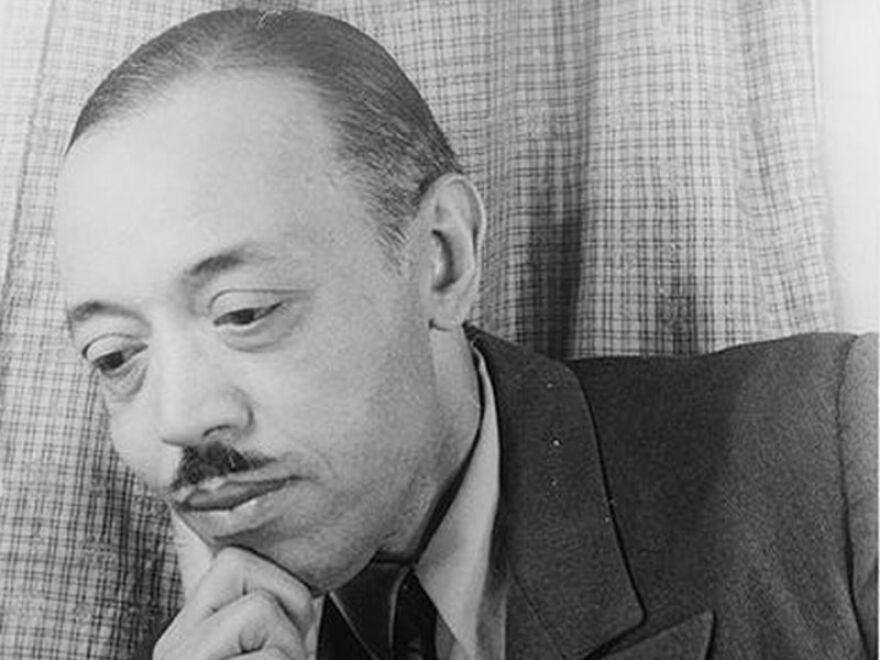
William Grant Still

Nicknamed the “Dean of African-American composers,” Still completed more than 150 works, including eight operas and five symphonies. He was the first Black American to write a symphony that was performed by a major orchestra, and the first to conduct a major orchestra. In 1949 his opera about Haiti, Troubled Island, was produced by the New York City Opera—another historic first. 

Still was born in Woodville, Mississippi, to college-educated teachers. His father, the town bandmaster, died when he was three months old. He and his mother moved to Little Rock, Arkansas, where she remarried. He began taking violin lessons at age 14 and taught himself viola, cello, double bass, clarinet, oboe, and saxophone. In 1911 he enrolled at Wilberforce College in Ohio, where he directed the band. His studies at Oberlin Conservatory of Music were interrupted by his Navy service. He played as a sideman for bluesman W.C. Handy, who brought him to Memphis and then New York City, where he became an oboist in Eubie Blake’s pit and made arrangements for theater orchestras and jazz and blues artists. He also studied with the influential atonalist Edgard Varèse. 

Still completed the three-movement chamber composition Ennanga in 1956. The title is a Ugandan word that refers to a small harplike instrument, and the score contains a prominent part for the Western harp, as well as piano and string quintet. For technical advice, Still consulted the harp virtuoso Lois Adele Craft, who also performed at the Los Angeles premiere. In the first movement, the harp and piano alternate between percussive and melodic roles, often evoking Juba, or hambone, a centuries-old African-American dance form that calls for stomping, slapping, clapping, and patting the body.

Traditional: “A City Called Heaven” (arr. Tyzik)

Like many traditional spirituals, “A City Called Heaven” predates the American Civil War and exists in numerous versions, under many titles, including “Poor Pilgrim of Sorrow,” “Poor Pilgrim,” “Tossed and Driven,” and “Tryin’ To Make Heaven My Home.” It was first documented in the 1907 collection Folk Songs of the American Negro, compiled by John Wesley Work, Jr. (1871–1925), an influential African-American scholar of folk songs and spirituals.

Still: Symphony No. 1 in A-flat Major (Afro-American Symphony) (third movement, Animato) 

Still began sketching his most famous work, the Afro-American Symphony, in 1924, not long after he played in the pit orchestra for Eubie Blake and Noble Sissle’s Shuffle Along, which featured Josephine Baker and Paul Robeson, among other luminaries of the nascent Harlem Renaissance. The sketches remained in limbo for some time while Still worked on other projects. As he later explained, “it was not until the Depression struck that I went jobless long enough to let the Symphony take shape. In 1930 I rented a room in a quiet building not far from my home in New York and began to work.” Two months later, Still’s First Symphony was complete. In a notebook that he kept during composition, he assigned alternative titles to each movement: the third, Animato, was designated “Humor.”

In 1931 Howard Hanson conducted the premiere—marking a milestone in Still’s career, as the first symphony by a Black composer to be performed by a major orchestra—and the 36-year-old composer’s career took off. He received commissions from several orchestras and a Guggenheim Fellowship. He eventually moved to Los Angeles, where he arranged film scores and popular music while honing his own powerful musical idiom: a blend of European post-Romanticism, jazz, blues, and spirituals. 

In 1964 Still described the creative impetus behind his Afro-American Symphony: “I wanted, above all, to write music that would be recognizable as being in the idiom employed [by the American Negro] or recognized, I should say, as that of the American Negro. It was the object that I desired most of all.” 

John Newton (17251807); William Walker (18091875): “Amazing Grace” (arr. Tyzik)
First published in 1779, the words to the iconic Christian hymn “Amazing Grace” were written by the English poet and Anglican clergyman John Newton.  A former seaman and slave-ship captain, Newton experienced a spiritual epiphany, converted to Christianity, and eventually became an ordained curate in the Church of England, as well as an abolitionist. He wrote “Amazing Grace” to accompany a sermon for New Year’s Day of 1773. Although the poem has been associated with at least 20 different melodies over the years, its most famous iteration was created in 1835 by the American Baptist song leader and compiler William Walker, who set it to a tune called “New Britain” and transcribed it in a shape-note format. 

Traditional: “Ride On, King Jesus” (arr. Tyzik)

Another anonymous antebellum spiritual, “Ride On, King Jesus” appeared under the title “No Man Can Hinder Me” in the first anthology of published spirituals, Slave Songs of the United States (1867). In the late 19th century, it became a concert staple of the Fisk Jubilee Singers, who performed several tours to raise money for Fisk University, a historically Black institution founded in 1866, in Nashville, Tennessee. Henry (“Harry”) T. Burleigh (1866–1949), who had studied with Dvořák, collected and arranged “Ride on, King Jesus” as well as many other songs in his Jubilee Songs of the United States of America, first published in 1916.

Antonín Dvořák (1841–1904): “Goin’ Home” (arr. Tyzik)
In the spring of 1893, when Antonín Dvořák was finishing his Symphony No. 9 in E minor (“From the New World”), the Czech composer made a bold prediction: “I am now satisfied that the future music of this country must be founded upon what are called the Negro melodies. This must be the real foundation of any serious and original school of composition to be developed in the United States.”

The Ninth Symphony was the first of several works that Dvořák wrote entirely in the United States. Although he urged his National Conservatory students to explore indigenous musical forms, he had at that point heard only a smattering of American folk songs, notably the spirituals that his Black student and assistant Henry (“Harry”) Thacker Burleigh sang for him. 

For the symphony’s most famous theme, Dvořák chose the English horn because it reminded him of Burleigh’s voice. This deceptively simple, deeply moving melody—apotheosized in the second movement but present, in some form or another, throughout—gives many listeners the mistaken impression that they are listening to an existing spiritual. In 1922 William Arms Fisher, another of Dvořák’s former students, added lyrics to Dvořák’s original theme, thereby creating the nostalgic ballad “Goin’ Home.”

Traditional: Medley (arr. Tyzik): “Every Time I Feel the Spirit,” “Joshua Fit the Battle of Jericho,” “Sometimes I Feel Like a Motherless Child,” Swing Low, Sweet Chariot”

This medley is dedicated to Henry T. Burleigh, a gifted Black baritone singer, composer, and arranger who dedicated his life to promoting the spiritual as a serious American art form. 

Of unknown authorship, “Every Time I Feel the Spirit” predates the American Civil War. The first stanza refers to Moses receiving the Ten Commandments on the mountaintop; the second describes being baptized in the Jordan River and the “heavenly train,” which is sometimes interpreted as a coded reference to the Underground Railroad. 

“Joshua Fit the Battle of Jericho” is another anonymous spiritual of a similar vintage. (“Fit” is African-American Vernacular English for “fought.”) The words allude to the biblical story of the Battle of Jericho, when Joshua led the Israelites into battle against the Canaanites. 

The haunting and heart-rending “Sometimes I Feel Like a Motherless Child” was composed by another unknown enslaved poet. The great American bass-baritone, actor, and political activist Paul Robeson—himself the son of a former slave—made multiple recordings of the song, beginning in 1926.

Although its exact origins are unknown, “Swing Low, Sweet Chariot” is often attributed to Wallis Willis, an enslaved Black man who was born in Mississippi and forcibly moved to Oklahoma by his enslaver, a member of the Choctaw Nation. Alexander Reid, a minister at the Choctaw boarding school where Willis and his wife were employed, heard the couple singing it and then transcribed the words and melody, which he sent to the Jubilee Singers of Fisk University. In 1909 the Jubilee Singers made the first recording of the song, which is worth seeking out on YouTube.

Copyright 2021 René Spencer Saller

Ligeti, Liszt, and Bartók

Ligeti gettin jiggy wit it.

This weekend (May 25-28), guest conductor Jaime Martín conducts the Dallas Symphony Orchestra in music by Bartók, Liszt, and Ligeti. It’s Ligeti’s centenary–he was born on May 28, 2023, and died June 12, 2006–which means that he’s getting programmed a bit more often than usual, although still not as often as some of us would like. Also on the program is the rising young virtuoso George Li, whose presence on a Liszt and Ligeti bill pleases me with its lilting plethora of ells.

I wrote these notes for the concert, the last installment of the regular concert season. (I’ll keep updating my blog, though; I have a capacious backlog.)

Martín Conducts Ligeti, Liszt, and Bartók

by Rene Spencer Saller

György Ligeti (1923–2006): Concert Românesc für Orchester (Romanian Concerto)

Ligeti was born into a Jewish Hungarian family in Transylvania who moved to Kolozsvár (now Cluj-Napoca, in northwestern Romania) during his infancy. In 1941, unable to pursue his goal of becoming a scientist because of the Jewish quotas at the local university, he began studying composition at the nearby conservatory, then walking all the way to Budapest in the summertime so he could take lessons there as well. World War II not only interrupted his formal training but also destroyed his family: his father and brother were forced into Nazi concentration camps, where they died, and in 1944 Ligeti himself was sent to a labor camp. He survived the Holocaust, as did his mother, who had been imprisoned at Auschwitz.

When the war ended, Ligeti resumed his studies at the Franz Liszt Academy in Budapest. After graduating in 1949, he spent a year researching Romanian folk music, collecting recordings and making transcriptions much as the Hungarian composers Bartók and Kodály—both significant influences on the young Ligeti—had done a generation or two earlier. In 1950 he was appointed professor of harmony and counterpoint at the Academy. As a composer, he focused on exploring the folk idiom (the Romanian Concerto is a sterling example) and tried not to violate the dictates of Socialist Realism, however tedious and oppressive he found them. 

When the Hungarian Uprising of 1956 failed and he could no longer endure the creative and political restrictions imposed by the Soviets, he moved to Vienna and then Cologne, where his style underwent a dramatic change, moving away from the essentially tonal, folk-derived idiom of his Soviet years to a less accessible, sometimes even strategically hostile, musical language. He worked with Karlheinz Stockhausen at the Electronic Music Studio of Westdeutscher Rundfunk until 1959, when Ligeti chose a still more independent path, moving away from formulaic and systematic compositional techniques—all those established schools and scenes—to an equally challenging but more organic and inquisitive approach.

It is this Ligeti—dense, uncompromising, micropolyphonic—whom my friends in noise ensembles and experimental rock bands mostly worship, and for good reason: Ligeti was hardcore before there was a word for it. Many of us were formed by our first, indelible exposure to his music by way of the soundtrack to Stanley Kubrick’s 2001: A Space Odyssey, which used Ligeti’s 1966 choral piece Lux aeterna (without his authorization) to accompany the scene in which the rocket shuttle approaches the lunar monolith site. Elsewhere in the film Kubrick used portions of Ligeti’s Atmosphères and Requiem (1963–65). However disrespectful, the director’s violation of Ligeti’s intellectual property rights spawned legions of ardent young Ligeti fans, allowing his music to reach listeners who likely would never have heard of him otherwise. His influence is incalculable, but it often goes unnoticed, possibly because his style never stagnated over the many decades of his career, and it touched so many people who don’t attend conservatories or engage with traditional concert culture, from aging punk rockers to Gen Z–ish aspiring cinéastes encountering Kubrick and Ligeti for the first time in college film classes. 

A Closer Listen

Completed in 1951, the Romanian Concerto reflects Ligeti’s attempt to sneak his microtonal experiments into a seemingly “safe” (under Soviet strictures) musical context: the folk-derived concerto, in the tradition of Bartók and others. But as Ligeti explains in his program note, even traditional folk music could end up in the censors’ crosshairs if it was sufficiently dissonant. 

Cast in four movements, the concerto lasts about 15 minutes in the average performance. The orchestra calls for three horns, with the third seated at some distance. Ligeti composed the first two movements by adapting his 1950 composition Ballad and Dance for Two Violins. The first movement, a gracious and enveloping Andantino, deploys fourth and fifth intervals to create harmonies that sound both ancient and (to our modern ears anyway) crazy-future. The second movement, a fleet-footed, percussion-rich dance with scampering violin and piccolo passages, is played attaca, which means it immediately follows the first, without the customary pause between movements. In the third-movement Adagio ma non troppo, also played attaca, one horn recalls material from the opening Andantino while another, positioned at some distance, evokes a distant alphorn response; rather than the conventional equal temperament, Ligeti calls for the horns to use natural tuning, which often sounds dissonant to modern ears. The “alphorn” effect returns at the end of the finale, but not until Ligeti has doled out generous portions of mysteriously buzzing strings and a fiddle-flavored, Roma-inspired violin solo that whips the rest of the orchestra into a righteous tizzy.     

The Composer Speaks

“In 1949… I learned how to transcribe folk songs from wax cylinders at the Folklore Institute in Bucharest. Many of these melodies stuck in my memory and led in 1951 to the composition of my Romanian Concerto. However, not everything in it is genuinely Romanian as I also invented elements in the spirit of the village bands. I was later able to hear the piece at an orchestral rehearsal in Budapest—a public performance had been forbidden. Under Stalin’s dictatorship, even folk music was allowed only in a ‘politically correct’ form, in other words, if forced into the straitjacket of the norms of Socialist Realism: major–minor harmonizations… were welcome, and even modal orientalisms in the style of Khachaturian were still permitted, but Stravinsky was excommunicated. The peculiar way in which village bands harmonized their music, often full of dissonances and ‘against the grain,’ was regarded as incorrect. In the fourth movement of my Romanian Concerto there is a passage in which an F sharp is heard in the context of F major. This was reason enough for the apparatchiks responsible for the arts to ban the entire piece.” —György Ligeti

Franz Liszt (1811–1886): Piano Concerto No. 1 in E-flat Major for Piano and Orchestra

Liszt may not have invented the symphonic poem, but he was the first to call it by that name. He also may not have been the first Romantic rock star—he styled himself after the demonically gifted violinist Niccolò Paganini and wasn’t too proud to admit it—but no one was better suited to the role. He was handsome, exciting, and wildly talented, forever at the vanguard of pianistic technique. He redefined what it meant to be a virtuoso, an entertainer, a celebrity. Rival concertizers came off like sausage-fingered dolts by comparison; noblewomen swooned and bore him illegitimate children. He was gracious to the rude, and he was loyal to the insufferable (including his son-in-law, the brilliant monster Richard Wagner). On and off for almost 60 years, Liszt taught hundreds of students for free. He was a tireless booster of other composers, living and dead. 

He also managed to compose a massive body of work: 13 symphonic poems, two symphonies, two piano concertos, several sonatas, hundreds of vocal pieces, and even organ music. Imaginative and wide-ranging, his music not only distilled the spirit of Romanticism but also gestured beyond it. 

Although Liszt composed at least 20 pieces for piano and orchestra, he completed only two full-fledged piano concertos. The First Piano Concerto, in E-flat major, didn’t receive its premiere until 1855, and he revised it over a quarter-century. A third piano concerto, left unfinished at his death in 1886, was reconstructed in the 1980s.

Liszt’s Piano Concerto No. 1 took years to write. The composer sketched out the main themes in 1830, when he was just 19. For more than two decades, he worked on the score, tweaking and polishing it even after the 1855 premiere. By the time the First Concerto was finished, he was experienced enough to recognize stale formal habits and subvert them in ways that seemed both startling and inevitable. For concert pianists, it is the ultimate bravura showpiece, the Mount Everest of concertos. But its technical difficulties are never an end in themselves. 

A Closer Listen

From the sumptuous first movement to the dreamy, proto-Impressionist second movement, the boldly original scherzo, and the breakneck finale, the concerto’s four movements are richly varied. Yet they feel coherent, thanks to the compulsively hummable main theme, always a reliable presence behind its myriad disguises. 

Although it’s impossible not to gape in wonder at the shivery trills and fleet-fingered polyrhythms, to marvel over the ways Liszt transforms the piano into a harp, a drum, some kind of strange hybrid instrument, the orchestra is never shortchanged. Liszt, generous on so many levels, gives important cameos to the other instruments: the clarinet that duets with the piano in the first movement; the cellos and basses that introduce the luminous song of the second movement; the assertively pinging triangle that punctuates the scherzo; the oboe that brings it all back home. In the end, the orchestra gets the last two notes.


Béla Bartók (18811945): Concerto for Orchestra

You’d never guess that the Concerto for Orchestrawhich ranks among Bartók’s most popular and accessible works, was the product of a sad, impoverished, terminally ill man. But working on the commission gave the Hungarian expat a much-needed boost, and his concerto traced a similar per aspera ad astra trajectory. He explained his intentions in his own program notes: “The general mood of the work represents, apart from the jesting second movement, a gradual transition from the sternness of the first moment and the lugubrious death-song of the third to the life-assertion of the last one.” His theme isn’t about mere survival; it’s about the will to live.

In 1940, after the death of his mother, Bartók fled Nazi-occupied Hungary for the United States, where he spent the last five years of his life. Although he settled in New York, with his much-younger wife, he never truly left his native country behind. His musical language was steeped in the folk idioms of the Eastern European countryside. 

For years he and Zoltán Kodály had logged countless hours as musical documentarians, using Western notation and early portable recording phonographs to capture Hungarian, Slovak, and Romanian folk melodies from indigenous singers. Those years of immersive field work meant that Bartók carried his homeland with him, no matter where he happened to be living. 

When Boston Symphony Orchestra music director Serge Koussevitzky commissioned the concerto, Bartók was perilously poor, depressed, and racked with high fevers caused by undiagnosed leukemia. He weighed only 87 pounds. Aware of Bartók’s grim circumstances and his stoic refusal of charity, Koussevitzky offered him a $1000 advance to compose a new orchestral work in memory of Koussevitzky’s late wife. Although the Russian-born entrepreneur really wanted to cover Bartók’s medical expenses and probably never expected him to fulfill the assignment, Bartók was buoyed by the prospect. He set out for a sanatorium at Lake Saranac in upstate New York, where he finished the Concerto for Orchestra in less than eight weeks. He orchestrated it the following winter, while recuperating in North Carolina.

The Composer Speaks

“The title of this symphony-like orchestral work is explained by its tendency to treat the single orchestral instruments in a concertante or soloistic manner. The ‘virtuoso’ treatment appears, for instance, in the fugato sections of the development of the first movement (brass instruments), or in the perpetuum mobile–like passage of the principal theme in the last movement (strings), and especially in the second movement, in which pairs of instruments consecutively appear with brilliant passages.” —Béla Bartók, from his own program notes

A Closer Listen

Cast in five movements, the concerto boasts brisk contrasts and weird symmetries. It’s a storehouse of stylistic touchstones: Bach fugues, peasant folk songs, angular tonal experiments, birdsong, night music. There’s even a jab at Dmitri Shostakovich’s recent “Leningrad” Symphony, which Bartók considered a celebration of state violence and duly despised. 

The first movement, Introduzione, starts slowly and mysteriously, then develops into a swifter fugato section. Presentando le coppie, or “Presentation of the Couples,” contains five sections in which instrumental pairs (bassoons, oboes, clarinets, flutes, and muted trumpets) are separated by specific intervals (minor sixths, minor thirds, minor sevenths, fifths, and major seconds, respectively). Elegia, the central Andante, is a poignant nocturne based on three themes derived from the first movement. The fourth movement, Intermezzo interotto (“interrupted intermezzo”), pits Eastern European folk tunes against a parodic quotation from Shostakovich (itself a quotation from Franz Lehár’s The Merry Widow, which Bartók probably didn’t realize at the time). The propulsive fifth movement brings it all back home with more fugal splendor and folky exuberance. 

Copyright 2023 by René Spencer Saller

Bela Bartók listening to his wax-cylinder field recordings, collected all over the countryside of Eastern Europe, in countries that no longer exist, really, at least with the same borders. Anyway, Bartók and his pal Zoltan Kodály went around with their recording equipment (they also transcribed folk songs using standard Western notation, making performance notes as needed) like a couple of proto-Lomaxes, and we are all in their debt because they captured tons of stuff that few people cared all that much about at the time. And I am aware that he was young in this photo–young and so handsome!–whereas he was looking quite sick and decrepit when he wrote the Concerto for Orchestra, but hey, it’s my blog, and I’m an admitted flibbertigibbet.

Franz Liszt, in his later years.


Orffully Popular!

The German composer Carl Orff, looking like someone I’m rather certain I would like.

I have been doing this program-book annotation work for about 10 years now, possibly a little longer, since I never seemed to bother paying attention to when I started. But I think I can say with some confidence that this is the first program I have ever written about that came with a warning, to wit: “PLEASE NOTE:  Carmina Burana addresses adult themes and contains some adult language.” (Catulli Carmina, also on the program, probably contains more, but I digress.)

At any rate, I write about Orff fairly often, and I always resist the urge to use any of the atrocious name-based puns that flap around in my sorry noggin like deranged bats. But this is my blog–I pay for it entirely myself and do not profit from it in any way that would interest my accountant–and I’m going to share one of my Orfful Orff puns in the headline. I have always felt that it’s supremely unfair to mock people for their given names, but when the composer has been dead for a long time, I think it’s slightly more forgivable. Or less Orfful. (Please let this usage exorcise my demons)

Here are the notes I wrote for the Dallas Symphony Orchestra concert that’s taking place tonight and this weekend at the Meyerson.

Luisi Conducts Orff

by René Spencer Saller

Carl Orff (18951982): Catulli Carmina (Songs of Catullus)

If you are alive today, chances are you have been exposed to the influence of Orff. Don’t recognize the name? Doesn’t matter. You probably had a grade-school music teacher who did. Maybe you lucked out and got to attend an elementary school with a collection of Orff instruments, specially chosen percussion instruments tuned to sound harmonious even in (especially in!) untrained hands, and maybe you learned about pitch and meter by playing Orff-prescribed games and using your body in motion to express these abstractions, as my public grade-school classmates and I did, in an inner-ring suburb of St. Louis in the 1970s. 

But even if you never took a music class, you can surely hum the main hook to Orff’s “O Fortuna,” from his iconic Carmina Burana, whose ubiquity in the popular culture is, as Alex Ross memorably quipped, “proof that it contains no diabolical message, indeed that it contains no message whatsoever.” Orff’s music might not have a message, but it is an undeniably effective vehicle. His musical language—relentless rhythms, hammered-home melodies, crude harmonies—helped the Nazis sell their poison, and the same music helped sell laundry detergent a generation later.

The late musicologist and critic Richard Taruskin rejected the art-for-art’s-sake argument that music is essentially innocent, pointing out that questions about Orff’s intentions—specifically regarding the use of his music by the Nazis—are irrelevant because “[t]hey allow the deflection of any criticism of his work into irrelevant questions of rights: Orff’s right to compose his music, our right to perform and listen to it. Without questioning either, one may still regard his music as toxic, whether it does its animalizing work at Nazi rallies, in school auditoriums, at rock concerts, in films, in the soundtracks that accompany commercials, or in [the concert hall].” (With no disrespect toward Taruskin’s memory, I’d be astonished if you leave the Meyerson tonight any more animalized than you were upon entering it.)


The commentator Anne-Charlotte Rémond of France Musique recently observed that if Orff’s music isn’t “Nazi art,” it’s art “made for Nazis.” For many that’s a distinction with no real difference. Never mind that Orff never actually joined the Nazi party, or that his music wasn’t universally admired by Nazi listeners; one prominent Nazi critic, in fact, argued that Carmina Burana, with its pungent “jazzy atmosphere” and “incomprehensible” Latin text, reflected the decadence and depravity of the Weimar Republic, not the wholesome athleticism that the Nazis tried to celebrate in their racist and revisionist interpretation of ancient history. But with a few vocal exceptions, the Nazis loved Carmina Burana, programming it repeatedly until the regime was defeated after World War II.

If not quite a one-hit wonder, Orff remains a somewhat enigmatic, even polarizing figure. He completed Catulli Carmina in 1943, two years after receiving the commission and about six years after his breakthrough work, Carmina Burana Catulli Carmina received its premiere during World War II. With Trionfo di Afrodite, from 1953, the three works form a conceptual trilogy, but the two later installments never took off like their predecessor and are virtually unknown today. But whether acknowledged or not, Orff’s influence can be heard in the driving rhythms of John Adams, the hypnotic ostinatos of Glass and Cage. There’s a reason that generations of listeners have found his music so compelling, and it has little to do with politics or anything that cerebral: Orff made music that speaks to the body and to the subconscious.

Although Orff had loved the classics since childhood, he was 35 years old when he first encountered Catullus’s Odi et Amo (c. 85), while on holiday at Lake Garda, in northern Italy. He saw a postcard with the poem on it and instantly heard it as music in his head. When he returned to Germany, he bought an edition of Catullus poems and chose 10 to set for mixed choir, which he then edited in a two-volume set titled Catulli Carmina, in 1931 and 1932, respectively. 

When his Carmina Burana grew increasingly popular, theater directors requested more musical material to fill out their programs, so Orff revised the score, adding and deleting certain poems and surrounding them with a “framing” story, which places the drama within a drama, enhancing the artificiality of the narrative. The new version of Catulli Carmina—which he now called ludi scaenici, or a scenic cantata, and no longer a collection of songs for mixed choir—premiered on November 6, 1943, at the Leipzig Opera. 

A Closer Listen

The cantata contains three parts: a prelude, a central section made up of Catullus poems, and a short postlude that repeats the main ideas of the prelude. Orff scored it for a full mixed choir, soprano and tenor soloists (portraying Lesbia and Catullus, respectively), and an entirely percussive orchestra, thought to be inspired by Stravinsky’s Les noces: four pianos, four timpani, castanets, maracas, antique cymbal, tam-tam, lithophone, metallophone, two glockenspiels, xylophone, tenor xylophone, and more. The orchestra plays only in the prelude and postlude; in the play-within-the-play, the soloists are accompanied only by the chorus, which also functions as a traditional Greek chorus.

Orff uses Catullus poems for the bulk of the text, but he wrote the prelude, the framing device that turns the selected poems into a play within a play. The plot, such as it is, involves a group of exuberant young horndogs who, in the prelude, describe what they want to do to one another in pornographic detail, if not quite in grammatical Latin. Then a chorus of elderly crabasses propose a lecture in the form of dramatized Catullus poems, all designed to prove conclusively that love is for losers and nothing lasts. The young folk agree to listen attentively.

The internal play begins with the entrance of Catullus, accompanied by the chorus singing Odi et amo (“I hate and I love”). When his beloved Lesbia appears, he sings Vivamus, mea Lesbia, atque amemus (“let us live, my Lesbia, and love”). Eventually, though, Lesbia proves untrue by dancing in front of a tavern, loitering on corners, and engaging in other activities for which Catullus tries to slut-shame her. Conflicted, he sleeps outside her front door and dreams of their reconciliation. Meanwhile, the real-life Lesbia sings him a lullaby while he sleeps (Dormi, dormi, dormi ancora—note that it’s in Italian, not Latin, a sign that she’s a modern lady). But Catullus wakes with a jolt when he hears the bass voice, and he experiences an epiphany: his friend Caelius, to whom he has often confided, is Lesbia’s secret lover—cuckolded by his best pal!

After much anguished back and forth with the pleading Lesbia, Catullus decides that her actions have ruined him and he can neither love nor hate her now. The score boasts several memorable passages, including some bel canto soprano numbers worthy of Delibes. Then, in one of the best punch lines in the history of the cantata form, Orff subverts the entire spectacle by showing, in the postlude, that the production was a waste of time. No longer willing to endure the sour old dudes and their strange diatribes, the young people blithely resume hooking up.

Carmina Burana 

After the successful premiere of his scenic cantata Carmina Burana, Orff issued the following instructions to his music publisher:

“Everything I have written to date, and which you have, unfortunately, printed, can be destroyed. With Carmina Burana, my collected works begin.”

First performed by the Oper Frankfurt on June 8, 1937, Orff’s Carmina Burana is based on a collection of poems by a motley assortment of itinerant monks, scholars, and other speakers of Latin, the lingua franca of the medieval age. Old French and Middle-High German, along with macaronic hybrids, add linguistic variety to these stubbornly secular, often bawdy verses, which touch on the corruption of the clergy, the benefits of intoxication, the sorrow of love, the glories of nature, and the pitiless wheel of fortune that determines our destinies. The original manuscript dates to the early 13th century. Lost for centuries before being rediscovered at a Benedictine abbey near Munich, the score was first published in 1847. 

With the help of Michel Hofmann, his fellow classics enthusiast, Orff selected two dozen poems from the collection and set them to music. “It’s not sophisticated, not intellectual,” he wrote, “There is a spiritual power behind my work, and that’s why it is accepted throughout the world.”

Orff In and Out of Time

Another way to understand Orff’s work is by understanding Orff, who was both a product of his culture and also something of an aberration.

Born in Munich, which was then part of imperial Wilhelmine Germany, Orff was brought up in a Bavarian military family, in a culture that understood itself to be the natural extension of both Athens and Rome, an aspirational lineage connecting the not-yet-unified Germany with the Golden Age of the Greco-Roman empire. Even as a young composer in post-WWI Germany, Orff, who studied at the Munich Academy of Music from 1912–14, was a devoted antiquarian. Although he set the occasional text by a contemporary or near-contemporary, such as the unapologetically leftist German playwright and poet Bertolt Brecht, or by canonical German poets such as Heinrich Heine and Friederich Hölderlin, Orff increasingly preferred engaging with centuries-old Latin and Archaic Greek texts by Catullus and Sappho, the primary sources for Carmina catullus and Trionfo, respectively. For his musical enjoyment he preferred poring over the scores of J.S. Bach, Monteverdi, and other early composers of choral music. And although his parents were devout Roman Catholics, Orff lost his religion fairly early and chose not to have his own daughter baptized.

Like most of his non-Jewish colleagues, Orff remained in Germany during the rise of the Third Reich, although he never went so far as to join the Nazi Party. He was drafted into the German Army in August 1917 but was quickly incapacitated in a trench collapse and spent months recovering from his serious injuries. When he was healthy again, he began to work in various administrative capacities for opera houses while studying music and dance and developing his pedagogical theory, which he called Schulwerk. Although he associated with a leader of the Resistance who was later executed, he distanced himself from politics, mostly by keeping to himself and making the kind of art that wasn’t likely to endanger himself or his family. He wasn’t notably brave, and he was no doubt relieved when the Nazis put him on a list of approved composers they called the Gottbegnadeten (Those Graced by God, or Those with God-Given Talent—which would no doubt be more impressive as a title if Nazis hadn’t bestowed it). 

Though not technically a Nazi, Orff was a member of the Reichsmusikkammer, a requirement for all active musicians in the Third Reich. And despite any reservations he might have expressed privately, he did agree to compose new music for A Midsummer Night’s Dream to replace Mendelssohn’s classic score, which the authorities had banned on account of the composer’s Jewish ancestry—never mind that Mendelssohn had been a devout Lutheran since childhood. And never mind that one of Orff’s Catholic grandparents was a former Jew turned Catholic. The Nazis weren’t ideologically consistent, and they didn’t need to be. As with any genocidal regime, approval was granted or denied according to the whims of the powerful.

 After completing his denazification process in 1946, Orff was rated “Grey C, acceptable,” a designation intended for Germans who were “compromised by their actions during the Nazi period but not subscribers to Nazi doctrine.” He married four times and was thrice divorced. His only child, Godela Orff, was born in 1921, to his first wife, the singer Alice Solscher. Although the couple separated about six months after Godela’s birth and divorced in 1927, Orff assumed primary custody of his daughter when her mother moved to Australia in 1930. Orff’s relationship with Godela was often rocky, with periods of estrangement, but they reconciled about a decade before his death, at age 86, from cancer. His tombstone, which is located in the Andechs monastery, bears the Latin inscription Summus Finis (the Ultimate End), a quotation from the end of his final work, De temporum fine comoedia.

A Closer Listen

Orff’s score bears a lengthy Latin subtitle, which, in translation, reads: “Profane songs to be sung by soloists and chorus with an accompaniment of instruments and magic tableaux.” By turns crude and celestial, the songs reflect Orff’s passion for the plainchant of the Middle Ages and early Renaissance. As anyone who has ever sung it will attest, some of it amounts to vocal-cord torture. The aria Olem lacus colueram, for instance, is sung almost entirely in falsetto, straining the poor solo tenor’s voice to the breaking point—which makes sense when you remember that the lines are sung from the perspective of a roasting swan. A wildly erotic passage in “Cours d’amour” forces the soprano soloist to reach beyond the upper limits of her range, creating an exquisite tension. 

“In all my work,” Orff wrote, “my final concern is not with musical but with spiritual exposition.” This claim might seem at odds with the visceral, almost orgiastic sonic thrust of Carmina Burana, but Orff, like the medieval poets who inspired him, knew that the spiritual and the profane are spokes of the same cosmic wheel.
Copyright 2023 by René Spencer Saller

Luisi Conducts Negrón, Beethoven, and Brahms

Angélica Negrón, the composer of Arquitecta, which receives its world premiere May 4-7.

This weekend (starting Thursday evening), Music Director Fabio Luisi conducts the Dallas Symphony Orchestra in the world premiere of Angélica Negrón‘s Arquitecta, sung by Lido Pimienta. After the Negrón world premiere, the DSO and pianist Francesco Piemontesi perform Beethoven’s Piano Concerto No. 3. The concert concludes with Brahms’s Symphony No. 4, which will be recorded for a future audio release.

Luisi Conducts Negrón, Beethoven, and Brahms

by René Spencer Saller

Angélica Negrón (b. 1981): Arquitecta (World Premiere)

Born in San Juan, Puerto Rico, and now based in Brooklyn, New York, Angélica Negrón is the Dallas Symphony Orchestra’s composer in residence. The multi-instrumentalist, composer, educator, and music journalist has written numerous works for chamber ensembles and orchestras, as well as film scores and assorted pieces for accordions, toys, and electronic and robotic instruments. Her original compositions have been commissioned and performed by the Bang on a Can All-Stars, Kronos Quartet, loadbang, MATA Festival, Brooklyn Youth Chorus, Sō Percussion, and the American Composers Orchestra, among others. As a founding member of the transnational electro-acoustic group Balún, she sings and plays accordion and violin. In 2022 the Hermitage Artist Retreat awarded Negrón the Greenfield Prize, which includes a $30,000 commission and a six-week residency.

Negrón received her early training in piano and violin at the Conservatory of Music of Puerto Rico, where she later studied composition with Alfonso Fuentes. She holds a master’s degree in music composition from New York University, where she studied with Pedro da Silva, and she has completed coursework toward a doctorate in composition at The Graduate Center (City University of New York), under Tania León. Her distinctive style filters an eclectic range of influences—Arvo Pärt, Björk, Juana Molina, Meredith Monk, John Cage, and former DSO composer in residence Julia Wolfe, among others—through her unique and wildly fertile imagination. 

Arquitecta, a song that features Colombian Canadian vocalist Lido Pimienta, was co-commissioned by the Dallas Symphony Orchestra and Bravo! Vail. Although Negrón has written several other major vocal works, both for chorus and solo voice, this is her first composition for voice and full orchestra. Augmenting Pimienta’s live singing are sampled voices, an essential part of Arquitecta‘s sound world. 

In a recent conversation with Denise McGovern, DSO Vice President of Communications, Negrón explained that the sampled voices are “mostly in Spanish” or singing something that more closely resembles “sound and gesture than language,” sourced from “the actual recorded voices of women I love and admire who have shaped in some way or another my life—family and friends.”

One of these formative female relationships is with Pimienta. “Lido and I go way back to 2008, when we were both featured in Club Fonograma, an influential music blog dedicated to Latin American and Spanish music and culture,” Negrón explains. “Club Fonograma created a really special online community of Latinx music makers and shaped a lot of the Latinx indie sound with their monthly compilations Fonogramáticos. We heard each other’s music for the first time there and started to correspond virtually and then finally met in person a few years ago in New York. During 2020 we did a collaboration for Prototype Festival with the Puerto Rican comedian and illustrator Mariela Pabón. That said, it was not until I saw her beautiful piece with the New York Ballet, in sky to hold, in [October] 2021 that I realized the potential of her voice as a force in front of an orchestra.”

Negrón refers to Pimienta’s recent score, Lux Aeterna, used in sky to hold, choreographed by Andrea Miller for the New York City Ballet. Among the very few female composers in NYCB history, and the first-ever female composer of color, Pimienta sang her piece on stage with the company. 

Amanda Hernández, the young Puerto Rican woman who wrote the poem that provides the song’s text, describes its mood as equal parts elegiac and optimistic: “I wrote this poem thinking about the house I grew up in, the houses I have lived in and the houses I had to say goodbye to. It’s an ode to the pain that comes with farewell and the celebration of what that ‘new door that opens’ promises when another one closes, or collapses.” 

The Composer Speaks

“In “Arquitecta,” Hernández captures the maternal spirit and its connection to tangible spaces often burdened by a lifetime of memories and labor, both visible and invisible. The physical and emotional weight of caring for family and home transcends the passage of time and endures beyond loss; it ultimately becomes inextricable from the conception of self and, paradoxically, a solace. 

“For the last several years, my mother became her own mother’s primary caregiver—in the wake of my grandmother’s recent death, Hernández’s evocative imagery of the house as Matriarch resonated deeply. Lido Pimienta’s experience as a mother and her vulnerable but powerful voice bring life to Hernández’s celebration of women and the spaces they traditionally inhabit. 

“The piece is a through-composed 10-minute orchestral song. It begins with an extensive, rhythmically driven instrumental introduction, sonically ‘building’ the house of Hernández’s poem through repetitive and increasingly arduous orchestral gestures. From here, the song unfolds with Lido’s voice embodying each verse through expansive melodies and hypnotic melismas, exchanging expressive melodic runs and dynamic shimmering soundscapes with the orchestra. 

“Throughout the song, the orchestra will have recurring moments of flourishes incorporating disjointed fragments of Caribbean music as well as gestures inspired by natural soundscapes from Puerto Rico, sound-painting the landscape within which the house stands. These will be punctuated by occasional electronics in the percussion, sampling everyday household objects as well as environmental recordings, capturing a domestic atmosphere. Joining Lido will be a cascade of sampled female voices—also played live by the percussion—intensifying as the piece develops, building up to a deluge of emotion evoking distant and fragmentary memories from a collective past.” 
—Angélica Negrón

Ludwig van Beethoven (1770–1827): Piano Concerto No. 3 in C minor, Op. 37

The Third Piano Concerto evolved over years. Beethoven had an idea in 1796, put it aside for a long time, and left the written version of the concerto in flux at the 1803 premiere (the first and last time that he played it in public). Then, in 1804, while writing out the piano part for a student, he revised the C Minor Concerto again. As originally composed, the Third Concerto requires the soloist to play a high G, which is believed to be the earliest instance of that note in the piano repertoire. In 1804, after trying out a new expanded keyboard design, Beethoven extended the range to include the C that sits over the fifth ledger line above the treble staff. Even though going so high meant that his concerto could be played only on new, state-of-the-art pianos, Beethoven wanted the work to reflect these technological advancements. 

Beethoven was known for being difficult. His savage performance style—louder, harder, faster! —meant that he occasionally damaged the fragile keyboard instruments of the age, like an Enlightenment-era Jerry Lee Lewis. As a young man (and a middle-aged one, too) his rough yet haughty personal code compelled him to quarrel with others over slights real and imagined. He often scandalized his devout teacher Joseph Haydn, who believed him to be an atheist and referred to him mockingly as “the Great Mogul.” 

But Beethoven’s skills as a pianist far eclipsed Haydn’s, and pretty much everyone else’s after Mozart’s untimely death. In a letter written around the time that Beethoven was sketching out ideas for his Piano Concerto No. 3, Frau von Bernhard, an habituée of the same Friday morning musical salon, described the wigless young virtuoso’s behavior as “unmannerly in both gesture and demeanor,” with Beethoven even refusing, on one particularly galling occasion, to play for the hostess’s mother, who got down on her knees and begged. Mozart had admired the gracious and cultured Countess Thun, yet this “small and plain-looking” man with an “ugly, red, pock-marked face” dared to snub her!  

Although he seldom bothered to transcribe the dazzling improvisations that came to him so easily, Beethoven did something unusual with his Third Concerto. In 1809 he composed—as in committed to staff paper—a cadenza for the first movement that functions much like an extended development section. As his deafness worsened, he felt increasingly incapable of public performance. If his music was to be heard at all, he needed other people to play it.

Over the years, other pianist-composers have created their own cadenzas, a traditional form of musical tribute that Beethoven practiced, too, when he was still a hot-shot virtuoso. Clara Schumann, who was 49 years old when she performed Beethoven’s Third Piano Concerto for the first time, described the experience in a diary entry from November 3, 1868: “I played Beethoven’s C Minor Concerto for the first time (almost unbelievable) with real delight.  I composed a cadenza for it, and I believe it is not bad.”

A Closer Listen

Piano Concerto No. 3 marks the end of Beethoven’s early period and the beginning of his middle period, when he dismantled and reassembled everything he knew about form, tonality, and genre.

A dotted drum-beat motif pulsates through the opening Allegro. The second theme, carried by violins and clarinets, is lyrical and lithe, a frisky contrast to the somber martial passage that it follows. The piano rushes in: a flurry of mad ascensions. After a magnificent cadenza, Beethoven gives the timpani the drum-beat motif he’s been teasing us with since the opening measures. 

The central Largo is in sharp-studded E major, a key so far removed from C minor that it barely inhabits the same hemisphere. According to biographer Jan Swafford, Beethoven played the entire opening with the sustain pedal down. 

The rondo finale begins in the home key of C minor, but a lighter touch prevails. In the mighty coda, the tempo speeds to Presto, and the rondo resolves in euphoric C major.  

Johannes Brahms (1833–1897): Symphony No. 4 in E Minor, Op. 98

Brahms’s fourth and final symphony draws on a lifetime of experience and immersive study, resulting in a work that’s both intensely experimental and deeply traditional. Although the E Minor Symphony is now widely considered to be the capstone of his career as a symphonist, it was not warmly welcomed. After the composer and pianist Ignaz Brüll performed a two-piano reduction of the score for a small gathering of Brahms’s closest friends, an awkward silence fell. The conductor Hans Richter and the music critics Eduard Hanslick and Max Kalbeck, all loyal supporters, were unable to say a single nice thing about it. Hanslick later wrote, “I felt as though I were being thrashed by two extremely clever fellows.” Kalbeck told him that the finale, now regarded as the very heart of the work, was unsuitable for a symphony and should be replaced. 

Although the Fourth’s premiere, conducted by the composer himself on October 25, 1885, in Meiningen, was a great success, it flopped badly in later performances in Vienna. The Austrian composer and critic Hugo Wolf dismissed it as “the art of composing without ideas.” Even the conductor Hans von Bülow, who famously anointed Brahms the successor to Bach and Beethoven, described it as “difficult, very.” For more than a decade, audiences were unmoved, if not openly hostile. 

It was not until his final appearance in public, less than a month before he died, that Brahms witnessed a positive response to his final symphony. His former student and biographer Florence May described the performance in Vienna of March 7, 1897, in poignant detail: “A storm of applause broke out at the end of the first movement, not to be quieted until the composer, coming to the front of the artists’ box in which he was seated, showed himself to the audience…. The applauding, shouting house, its gaze riveted on the figure standing in the balcony, so familiar and yet in present aspect so strange, seemed unable to let him go. Tears ran down his cheeks as he stood there in shrunken form, with lined countenance, strained expression, white hair hanging lank; and through the audience there was a feeling as of a stifled sob, for each knew that they were saying farewell.”

A Closer Listen

Today, in the wake of modernism, postmodernism, and all its atonal offshoots, we struggle to understand why Brahms’s contemporaries found the Fourth Symphony so perplexing. Although it is certainly cunningly made, its cerebral underpinnings never distract from its beauty. The repeating cycles of descending thirds, which appear throughout the symphony in myriad motivic patterns, unite contrasting moods. Darkness permeates light, minor shifts to major, and vice versa. 

The springing Allegro theme of the first movement gives rise to an overt quotation from one of Brahms’s Four Serious Songs: “Oh death, how bitter you are.” The gorgeous Andante moderato begins with a theme in the medieval-church Phrygian mode—which Brahms understood as the expression of deep need, a longing for heavenly comfort—and then gives way to the scherzo-like Allegro giocoso, a triangle-happy romp in C major. 

Yet it is the finale, based on the almost archaic passacaglia form (a set of variations over a repeated bass line), that renders the work truly sublime. A masterful compendium of everything Brahms had learned as a symphonist, it’s loosely based on Bach’s death-drunk Cantata No. 150, “For Thee, O Lord, I Long,” and transforms the passacaglia, an ancient procedure, into a recognizable but astonishing take on 19th-century sonata form. 
Copyright 2023 by René Spencer Saller

Saraste Conducts the Dallas Symphony in Sibelius and Shostakovich

Dmitri Shostakovich and his baby daughter Galina (and what looks like a Dachshund possibly).

The Dallas Symphony Orchestra, led by guest conductor Jukka-Pekka Saraste, performs Sibelius’s Pohjolan tytär and Shostakovich’s Eighth Symphony at the Meyerson tonight (April 27) and this weekend. For more details on the concert, where you can also find these program notes in a slightly different format, go to the DSO website.

I was pleased with the way the Shostakovich notes turned out, partly because I had originally turned in an equally long batch of notes about Shostakovich’s Fourth, and then the repertoire was changed to the Eighth instead. But no research is ever truly wasted, and I feel like my work on the Fourth informed and improved my notes on the Eighth.

In the meantime, here’s another photo of Shosty in 1937, sporting the trendy coastal granny look. I’m including this one instead of a photo of Jean Sibelius, which is unfair, but Jean will get his propers the next time, promise.

Saraste Conducts Sibelius and Shostakovich

by René Spencer Saller

Jean Sibelius (1865–1957): Pohjolan tytär (Pohjola’s Daughter), Op. 49

Before Sibelius became Finland’s first great composer, he yearned, against considerable odds, to perform professionally. Although he played violin as a child, he didn’t start formal lessons until he was 14. “The violin took me by storm,” he wrote, “and for the next 10 years it was my dearest wish, my greatest ambition, to become a great virtuoso.” At 25, after years of dogged study in Helsinki, Berlin, and Vienna, he auditioned for a place in the Vienna Philharmonic and was rejected.

Sibelius turned to composition instead and became a leading voice in the growing movement for Finnish independence. Like many Finns of his social class, the educated élite, he was ethnically Swedish and culturally Northern European: he grew up speaking Swedish, and studied music in Berlin and Vienna. Whereas most works of Romantic Nationalism incorporate native dances and songs, most of Sibelius’s melodies are invented. He had surely heard traditional Finnish folk tunes, but he seldom quoted them. Instead, he was inspired by nature and the Finnish national epic, the Kalevala,to create his own deeply personal form of folk music. 

His music also reflected a particular historical moment, one marked by popular unrest. After a century of Russian rule, the Finns began to protest against their compulsory conscription into the Russian military and their censorship by the occupying regime. The “February Manifesto” of Tsar Nicholas II, in 1899, gave the Russian government complete control over Finland, stripping all but symbolic power from the Finnish Senate. In November a group of Helsinki artists and activists organized several events in support of censored journalists. The earliest iteration of Sibelius’s iconic FinlandiaFinland Awakes, was the rousing finale for a series of patriotic historical tableaux that he wrote for one such event. More than 18 years would elapse before Finland would officially declare its independence from Russia.  

A Finnish Fantasia

By 1905, when he began Pohjolan tytär (Pohjola’s Daughter), Sibelius was often drunk. Although his alcoholism caused untold problems in his domestic and professional lives, he was astonishingly productive, composing music for hours on end. “He has such a multitude of themes in his head that he has been literally quite dizzy,” his wife, Aino, recounted in a letter from that period. “He stays awake all night, plays incredibly beautifully, cannot tear himself away from the delightful melodies—he has so many ideas that it is hard to believe it.” 

He called Pohjolan tytär a “symphonic fantasia,” a term he never used again. As with many of his other programmatic works, its source was the Kalevala. He composed the bulk of the “fantasia” between 1905 and 1906, not long after hearing Richard Strauss’s Ein Heldenleben in Berlin. Inspired by his German colleague’s opulent orchestration, Sibelius set out to create his own, distinctively Finnish take on the heroic tone poem. He found the project exhilarating. As he explained in a letter to Aino, “This is my genre!! Here I can move without feeling the weight of tradition.”

A Closer Listen

Sibelius might have emancipated himself from the weight of tradition, but he composed his free-form music with an ancient story in mind. He gave a German program to his publisher, translating the relevant lines from the Kalevalawhile preserving, to the best of his abilities, the striking, sing-song meter of the Finnish original. 

The story involves the old sorcerer Väinämöinen, who falls for the imperious daughter of Pohjola. First seen perched on a rainbow, spinning a cloth of silver and gold, the icy maiden issues a series of impossible challenges, and when her poor suitor fails at the last one—carving a sea-worthy, self-propelled boat from the shards of her spindle—she laughs scornfully (listen for those stabbing, Psycho-esque strings!). Bloodied but wiser for his mistakes, the old sorcerer leaves her to travel on alone. 

Dmitri Shostakovich (1906–1975):  Symphony No 8 in C Minor, Op. 65

By the mid-1930s, Socialist Realism was the only state-sanctioned musical style in Soviet Russia. Composers who had safely dabbled in avant-garde or neo-classical idioms a few years earlier learned to fear the wrath of Joseph Stalin and his cultural watchdogs. State-approved compositions typically incorporated folk songs and ended in a major key. Composers were expected to support the class struggle by honoring the proletariat and conveying strong Soviet values, as opposed to the apolitical, bourgeois individualism of the United States and Western Europe. Artists, writers, composers, and patrons who failed to conform to the new mandate were executed, imprisoned in gulags, or simply made to vanish.

One nerve-wracking aspect of the evolving Soviet rulebook was the inconsistent, even incoherent enforcement. A composer might never know whether he was being punished for the content of his work or for pettier, personality-driven reasons. Becoming too popular, for instance, was a surefire way to bring on a beat-down—symbolic if you were lucky, literal if you were not.  

After getting slapped with a damning review of his successful opera Lady Macbeth of the Mtensk District in 1936 (anonymous but likely penned by Stalin himself) and an equally harsh critique of another, far less edgy composition the same year, Shostakovich was understandably terrified. He withdrew his Fourth Symphony before its premiere but after rehearsals had begun. His wife, the physicist Nina Varzar, gave birth to their firstborn daughter, Galina Dmitrievna, on May 30, 1936, which meant he had a fresh new life to worry about. Over the next several months, he kept his head down, busying himself with uncontroversial projects. He would not share the Fourth with the public until December 30, 1961.

Shostakovich was able to restore his good standing, at least for the time being, thanks to the sensational success of his Fifth Symphony in 1937. He even agreed to describe the D Minor Symphony as “a Soviet artist’s reply to just criticism.” By this point, he knew exactly how to tiptoe around the government censors, although he sometimes felt compelled, whether out of bravery or sheer cussedness, to poke at them instead. This would not be the last time that he would offend the authorities, nor the last time that he would accept unjust criticism.

Six years later, despite being sick with a gastrointestinal infection, Shostakovich composed his Symphony No. 8 in C Minor in a remarkably short time—officially, only two months, from July 1 to September 4, 1943, although he had probably worked out most of the music in his head before committing the notes to staff paper, as was his habit. Thanks to the monumental success of his Seventh Symphony (“Leningrad”), he enjoyed the luxury of composing without distraction on a state-sponsored sabbatical at the “Creative Home,” an isolated retreat maintained by the Union of Soviet Composers that was located about 150 miles northeast of Moscow—insulated from the noise and chaos of wartime. The work’s dedicatee, his fellow countryman and frequent colleague Evgeny Mravinsky, led the USSR Symphony Orchestra in the world premiere on November 4 that same year. 

Although audiences seemed generally receptive to the Eighth, the authorities were not. They called it depressing, confusing, and counter-revolutionary. By the end of World War II, Shostakovich’s Eighth Symphony had been effectively erased from the repertoire. Its follow-up, the studiously apolitical, neoclassical Ninth, was banned for the remainder of Stalin’s life and not recorded until 1956.

Erasure and Vindication

In 1948, five years after its premiere, the Eighth Symphony still managed to make trouble for Shostakovich. Andrei Zhdanov, the Soviet Minister of Culture and Shostakovich’s most powerful nemesis, yanked it from obscurity just so he could denounce it at length. Another member of the panel, Vladimir Zakharov, a Soviet functionary and a minor composer, described it as “not a musical work at all” and “repulsive and ultra-individualistic,” similar in sound to “a piercing dentist’s drill, a musical gas chamber, the sort the Gestapo used.” Shostakovich was also condemned for the “pessimism, unhealthy individualism, extreme subjectivism, and willful complexity” of his symphony. (Even Sergei Prokofiev, whose own works were routinely savaged by Stalin’s toadies, had trashed Shostakovich’s Eighth at a Composers’ Plenum four years earlier.) Zhdanov ordered that all copies of the score be recycled and all recordings destroyed. 

According to his friends and his contested (and possibly semi-fabricated) memoir Testimony, Shostakovich considered the symphony a kind of Requiem for himself. As late as 1956, he complained that “the Eighth Symphony has remained unperformed for many years. In this work there was an attempt to express the emotional experiences of the People, to reflect the terrible tragedy of war. Composed in the summer of 1943, the Eighth Symphony is an echo of that difficult time, and in my opinion quite in the order of things.” 

Two years later, the Central Committee conceded that the Eighth Symphony had, along with certain works by Prokofiev, Khachaturian, and several other composers, been “indiscriminately denounced.” It returned to the active repertoire, where it remains. 

The Composer Speaks

“I wrote it very quickly…. When the Seventh Symphony was finished, I intended to compose an opera and a ballet and started work on an oratorio about the defenders of Moscow. Then I put aside the oratorio and began work on the Eighth Symphony. It reflects my… elevated creative mood, influenced by the joyful news of the Red Army’s victories….

“The Eighth Symphony contains tragic and dramatic inner conflicts. But on the whole it is optimistic and life-asserting. The first movement is a long adagio, with a dramatically tense climax. The second movement is a march, with scherzo elements, and the third is a dynamic march. The fourth movement, in spite of its march form, is sad in mood. The fifth and final movement is bright and gay, like a pastoral, with dance elements and folk motifs. 

“The philosophical conception of my new work can be summed up in these words: life is beautiful. All that is dark and ignominious rots away, and beauty triumphs.”—Dmitri Shostakovich, September 1943

A Closer Listen

Cast in five movements, the Eighth Symphony lasts a little more than an hour. It moves from the home key of C minor to C major, following the traditional Beethovenian darkness-to-light model, but the tragic tone suffuses even the “bright and gay” finale—lingering C-minor shadows that show up like a weeping widow at a christening. The closing bars are ambiguous at best; instead of the radiant major-key apotheosis that we expect, we get the faint glimpse of a C major triad, a flickering hint of a dream deferred. 

The opening movement is the longest of the five, about as long as the next three movements combined. It starts with a brooding, Mahlerian Adagio, initially crooned by cellos and double basses, and gradually builds to a fretful Allegro non troppo. Shostakovich quotes or adapts melodic material from his own Fifth and Seventh symphonies, assembling new themes from which he constructs a ferocious fugue. Piercing winds and astringent harmonies join limpid strings and gossamer textures, producing flashes of bombast and beauty. At one point close to the end, a solo English horn delivers a dark and ruminative rhapsody, which the strings take up briefly, then abandon. A sudden blast of brass before an anxious silence descends.

The next two movements, an Allegretto and an Allegro non troppo, respectively, are functional scherzos. Here Shostakovich teaches a masterclass on the march form. The first march, in D-flat major, is surreal and grotesque, a queasy spectacle. A motoric fury propels the second, a magnificent Machine Age contraption of chords that grind as relentlessly as pistons, punctuated by shrieking clarinet, clattering percussion, and guttural low strings.

The Largo, in G-sharp minor, packs a lethal punch despite its brevity. Like the two preceding movements, it’s a march—but this time a funeral march. As with the ancient dance form on which it is modeled, the passacaglia, the Largo presents a series of variations that unfold over a recurring harmonic progression, or bass line. Shostakovich’s slow movement uses this hypnotic underpinning to showcase the subtleties of the shifting melody, the different voices and moods produced by the various instrumental timbres, both individually and in combination, such as the rather startling effect of a flutter-tongued flute. 

Toward the end, the key wends its way to C major. Yakov Milkis, a violinist in the Leningrad Philharmonic Orchestra, recalled telling Shostakovich how much he admired the transition to the finale. “My dear friend,” the composer responded, “if you only knew how much blood that C major cost me.”

The finale, another Allegretto, opens with a solo bassoon in the first of several pastoral, chamber-like interludes. According to some sources, Shostakovich originally titled the last movement “Through cosmic space the earth flies toward its doom,” which contradicts his official remarks about the triumph of beauty, although it accurately describes the atmosphere of apocalyptic dread. The key is C major, the “happy ending” for C minor, but it sure doesn’t feel like C major. The mood is weirdly bleak, unsettled—nothing like the euphoric release we experience during the last movement of Beethoven’s Fifth, for instance. The Eighth Symphony ends quietly and enigmatically, with a throaty utterance from the flute, at the deepest point of its register, over pizzicato and sustaining strings. Sometimes the only possible form of heroism is survival. 
Copyright 2023 by René Spencer Saller