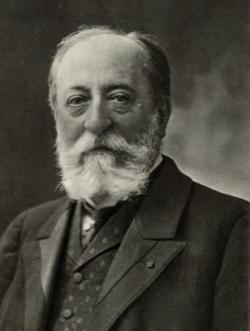
Left to right: Giacomo Puccini and Giuseppe Verdi, Italian opera legends and supreme silver foxes
Giuseppe Verdi was the most influential and successful Italian composer of the 19th century. He wrote more than 20 operas, roughly half of them masterpieces. Over a six-decade career, he kept refining his talent, exposing it to new ideas. He produced many of his greatest works when he was in his 70s, at a time when 60 was considered old.
Verdi read widely and deeply, always hunting for the next opera plot. He worked closely with his librettists to achieve minimal flab and maximal feeling. In the world according to Verdi, rage and terror rule, desire redeems and destroys, but the tenor loves bravely forever. (If that sentence doesn’t make sense, wait for the singing and you’ll understand.)
Giacomo Puccini was born 48 years after Verdi, but the two composers’ lives overlapped significantly. Puccini, the most successful opera composer of the 20th century, seemed destined to play the organ in his native Lucca. He was descended from a 200-year line of cathedral organists, and he showed early promise on the king of instruments. But in 1876, when he was seventeen, he walked 15 miles, from Lucca to Pisa, to attend a life-altering performance of Verdi’s Aida. Verdi’s darkly alluring spectacle made young Puccini forsake church music for the stage. In 1880, he enrolled at the Milan Conservatory, Verdi’s alma mater. Like Verdi, Puccini loved literature, particularly plays, a frequent source of his opera subjects.
Unlike the other two composers on this program, Ottorino Respighi is known for his orchestral works, not for his eight (rather underwhelming) operas. His bold sonic palette pays tribute to Rimsky-Korsakov, with whom he studied orchestration while playing professional viola in Russia. Aside from Puccini, Respighi was the leading Italian composer during his lifetime. He might not have mastered the dominant genre, opera, but he doled out plenty of drama in a purely symphonic language. There’s a reason that soundtrack composers have been ripping him off for the past century.
Overture to La Forza del destino
Beginning with three menacing unison brass blasts, the overture to Verdi’s La Forza del destino (The Power of Fate) compiles several of the four-act opera’s most potent earworms. Although La Forza was premiered in St. Petersburg, Russia, in 1862, Verdi revised it seven years later, giving it a somewhat less violent ending and a longer, more comprehensive overture. This version, all sensuous menace and massive hooks, is a staple of the symphonic repertory. Listen to how the fate motive—that brassy opening assault—clashes and colludes with the gentle rising melody linked to Leonora, the mandatory tragic soprano.
Prelude to Aida and “Celeste Aida”
Set in ancient Egypt, Verdi’s grand opera Aida (1871) involves a tragic love triangle, his favorite dynamic. Aida, an enslaved Ethiopian princess, and Amneris, the princess of Egypt, are both in love with Radames, an Egyptian officer. Radames loves Aida but doesn’t want to betray his country. No one can love openly; everyone suffers alone. At last, in the final scene of the fourth act, Aida and Radames get their lovers’ duet, but by that point they’re sealed in a shared tomb and running out of oxygen.
The prelude is all about establishing character. Gossamer string textures evoke the heroine, and a doomy falling motive represents the Egyptian priests. The tender “Celeste Aida,” from the first act, finds Radames dreaming of military victory and his secret love, the enslaved Aida—two irreconcilable desires. It’s one of Verdi’s most famous tenor arias, and notoriously tricky. The hardest thing about it is also the softest: its radiant close, which calls for a high B-flat to be sung very quietly and morendo (“dying”; that is, slowly fading away).
“Die quella pira,” from Il Trovatore
“Die quella pira” (“from this pyre”) is a short, thrilling aria for tenor—more specifically, a cabaletta, which was used to convey intense emotion. Here, Manrico, in the last scene of the third act of Il Trovatore (1853), vows to save Azucena, the old gypsy woman he thinks is his mother, from being burned alive. He swears that he’ll douse the flames with the blood of his enemies, even if it kills him too. Flamenco rhythms and a bell-bright final high C make “Die quella pira” the ultimate rage aria.
Triumphal March and Ballet music from Aida
Verdi’s most famous triumphal march closes Act II of Aida. The simple but powerful trumpet-voiced theme reflects Verdi’s antiquarian interests. After learning that simple valveless horns had recently been excavated in Egypt, the composer imagined the type of fanfares that these ancient instruments might sound at a victory ceremony. Soon after Aida‘s Cairo premiere, this ersatz bit of Egyptian antiquity was prominently quoted in the country’s brand new national anthem. The ballet sequence, also from the second act, is equally rich in Orientalist ear candy.
Preludio Sinfonico
Puccini wrote the Preludio Sinfonico in 1882, when he was still a student at the Milan Conservatory. Rhapsodic and vivid, his second major orchestral work mixes Impressionistic harmonies; soulful, cantabile melodies; and cutting-edge chromaticism.
“The Spectre” (“La Tregenda”) from Le Villi
“La Tregenda,” sometimes translated as “Witches’ Sabbath,” is one of two symphonic intermezzi from Puccini’s first opera, Le Villi (1883). This symphonic interlude, originally accompanied by narration, depicts the frenzied dance of witches as they work their black magic. As it picks up speed and intensity, the feverish music enacts the fate of the accursed, who is compelled by vengeful fairies to dance himself to death because he broke a good woman’s heart.
“Ch’ella mi creda” from La Fanciulla del West
Based on a play by David Belasco, The Girl of the Golden West, Puccini’s La Fanciulla del West (1910) is a supercharged Italian melodrama set in California during the Gold Rush. Whiskey drinkers, vigilantes, and outlaws abound. The heroine, Minnie, is resourceful and brave, a pistol-wielding proto-feminist. She has two rival suitors: the local sheriff, Jack Rance, and the man she secretly loves, the sexy bandit Ramerrez (who sometimes goes by Dick Johnson). Instead of succumbing to the usual fateful forces that slay Puccini sopranos, Minnie stands down a lynch mob and rescues her lover before literally riding into the sunset with him.
Right before that happens, the heroic antihero (originally played by superstar hearthrob Enrico Caruso) lets loose with the notoriously tricky tenor workout “Ch’ella mi creda” (“let her believe”). With a noose around his neck, Ramerrez asks his captors to let Minnie think he’s not dead but off somewhere atoning for his sinful past. His last words to her, before his surprise rescue, are “You’re the only flower of my life.” This nuanced aria hovers between sorrow and bliss.
“Nessun dorma” from Turandot
When Puccini died, in 1924, his magnificent final offering, Turandot, was still incomplete. Arturo Toscanini led the posthumous premiere, which concluded abruptly, with the conductor turning around and saying to the audience, “At this point the master laid down his pen.” But thanks to Puccini’s detailed sketches, Franco Alfano was able to finish the opera, in a convincing approximation of Puccini’s style. Set in ancient Peking, this savage and strange love story pits Princess Turandot against basically everyone, but particularly Calaf, who successfully answers her impossible riddles and, to her horror, wins her hand in marriage.
Before launching into “Nessun dorma,” probably the most famous tenor aria in operatic history, the hero has just heard his murderous darling declare that no one in the kingdom will sleep until she learns Calaf’s name, the answer to the riddle that will get her out of marrying him. If no one figures it out, everyone gets beheaded. Calaf, undeterred, muses over her threats, imagining how he’ll tell her his secret name while kissing her. In the electrifying final moments, he cries out, “At dawn, I will win!/I will win! I will win!” The tenor emits two gasp-worthy high notes, both sustained in performance, though not in the original score. Those last ringing syllables, a B and an A, have made and broken many a tenor’s career.
Luciano Pavarotti’s signature song, “Nessun dorma” is adored by sports fans, reality-television contestants, opera connoisseurs, and your grandmother. No one ever tires of it. It made headlines several months ago, after Pavarotti’s widow and daughters publicly demanded that Donald Trump stop using recordings of the legendary tenor’s performance of the aria during campaign events.
Respighi’s Roman Festival
Resphighi’s Feste Romane, from 1928, is the last installment of the composer’s “Roman” trilogy of symphonic poems. The first two works, Fontane de Roma (1916) and Pini de Roma (1925), pictorial tributes to the fountains and pines of Rome, respectively, were so wildly popular that Respighi could have retired and lived off the royalties. Instead, he taught composition, directed a music conservatory, and toured the world as a pianist and conductor in performances of his own works. After finishing Feste Romane, he decided to stick to smaller, more intimate forms. “It is impossible to achieve more,” he wrote, “and I do not think I shall write any more scores of this kind.”
In true program-music tradition, Respighi left a detailed written description for each of the four movements. These explanatory notes aren’t essential—you’re in for a voluptuous listen either way—but they’re fun:
- Circenses (The Circus Maximus). A threatening sky hangs over the Massimo Circus, but it is the people’s holiday: “Ave Nero!” The iron doors are unlocked; the strains of a religious song and the howling of wild beasts float on the air. The crowd rises in agitation: unperturbed, the song of the martyrs develops, conquers, and is lost in the tumult.
- Il Giubileo (The Jubilee). The pilgrims trail along the highway, praying. There finally appears from the summit of Monte Mario, to ardent eyes and gasping souls, the holy city: “Rome! Rome!” A hymn of praise bursts forth, the churches ring out their reply.
III. L’Ottobrata (The October Festival). The October festival in Roman Castelli covered with vines: hunting echoes, tinkling of bells, songs of love. Then in tender evening comes a romantic serenade.
- La Befana (The Epiphany). The night before Epiphany in the Piazza Navone: a characteristic rhythm of trumpets dominates the frantic clamor: above the swelling noise float, from time to time, rustic motives, saltarello cadenzas, the strains of a barrel-organ of a booth and the appeal of the proclaimer, the harsh song of the intoxicated and the lively stornello in which is expressed the popular feelings. “Lasstece pass! Semo Romani!” —“We are Romans! Let us pass!”
A slightly altered version of these program notes, minus all the hyperlinks, appeared in the printed program notes for a recent concert by the Dallas Symphony Orchestra, which included all these pieces.
Copyright 2016 René Spencer Saller

 (His famously red hair must be powdered or obscured by a periwig, but this is supposedly Antonio Vivaldi.)




 René Spencer Saller