Alsop Conducts the Dallas Symphony Orchestra in Ortiz, Montero, and Rimsky-Korsakov

The Venezuelan pianist and composer Gabriela Montero

On February 23 through February 25, Marin Alsop conducts the Dallas Symphony Orchestra in a fantastic program featuring two contemporary works and one beloved warhorse. The concert takes place at the Meyerson, as usual, and you can buy tickets on the website.

Rather than post a link or embed the notes in a pdf, I’m just going to cut and paste them here. They’re also published on the DSO website and in the printed program books if you’re lucky enough to visit the Meyerson this weekend.

********************************************************************************************************

“We tell ourselves stories in order to live,” Joan Didion famously observed. In Scheherazade’s case, the meaning of “live” is literal: her very survival depends on her gift for the gab. The stories she uses to captivate her murderous sultan-spouse aren’t her own inventions, but they don’t need to be. Her voice compels. It keeps her alive in the story, in every possible sense. 

Nikolay Andreyevich Rimsky-Korsakov based his 1888 symphonic suite Scheherazade on a translation of The Thousand and One Nights, a collection of tales so ancient they might as well be encoded in our DNA. But before Scheherazade, which closes the concert, Maestro Alsop presents two equally colorful and compelling, if less familiar, offerings from the 21st century. In these richly imagined works, both composed within the past five years—by two distinctive Latin American women who happen to share the first name Gabriela—the woman’s voice never falters: it’s at the forefront, no longer exoticized or filtered through a male composer’s imagination and centuries of legend. Defiantly alive, emphatically themselves, Ortiz and Montero live by their own stories.

Gabriela Ortiz (born 1964): Antrópolis

Born in Mexico City to folk-musician parents, Ortiz started playing piano at eight and knew that she wanted to be a composer before she entered her teens. She studied at the National Conservatory of Music with Mario Lavista and at the National University of Mexico with Federico Ibarra. In 1990, after receiving the British Council Fellowship, she studied in London with Robert Saxton at The Guildhall School of Music and Drama. In 1992 she received a scholarship from the University of Mexico that funded a doctorate in electroacoustic music composition with Simon Emmerson at The City University in London. She currently teaches composition at the Mexican University of Mexico City, and her music is published by Boosey & Hawkes.

The recipient of many honors and awards, including the National Prize for Arts and Literature (Mexico), as well as Guggenheim and Fulbright Fellowships, Ortiz has composed operas, orchestral works, music for chamber ensembles, and dance and film scores. Recent commissions include Clara for orchestra (The New York Philharmonic); Altar deCuerda for violin and orchestra (The Los Angeles Philharmonic); and Tzam for orchestra (Cincinnati Symphony Orchestra).

Ortiz was named a member of El Colegio Nacional (The National College) in 2022. Created in 1943 by presidential decree, this exclusive honorary academy brings together Mexico’s leading artists and scientists, who deliver lectures and seminars in their areas of expertise. Also in 2022 Ortiz was appointed curator of the Pan-American Music Initiative in conjunction with The Los Angeles Philharmonic and the conductor Gustavo Dudamel, an enthusiastic promoter of Ortiz’s career.

Ortiz’s parents cofounded Los Folkloristas in 1966, when Ortiz was a toddler. Members of this legendary ensemble continue to serve as ambassadors of traditional Latin folk music, which is also Ortiz’s goal—or one of them, anyway. Loaded with intoxicating polyrhythms and spiky syncopation, the orchestral piece Antrópolis evokes and reimagines the popular Mexican dance music of the 1940s and ’50s. Antrópolis, which might be translated as “Human City,” is scored for an unusual array of percussion instruments (bongos, maracas, cowbells, glockenspiels, and more) and opens with a spirited, lengthy—and dare I say deeply funky? —drum solo. 

Fulfilling a commission by the internationally renowned Mexican conductor Carlos Miguel Prieto, Ortiz completed Antrópolis in early 2018. Prieto led the Orquestra Sinfónica in the world premiere on April 1, 2018, at the Palacio de Bellas Artes, in Mexico City. 

The Composer Speaks

“I really enjoy dancing, for many years I went to all the clubs, visiting the Colonia Hall, the Los Angeles Hall, the Mexico Hall…. I really like the mambo; I am an admirer of Pérez Prado….

“I have always wanted to do an orchestral piece… but suddenly, why not, make it fun, sometimes everything is so intense, so why not do this side of enjoyment, pastiche, potpourri of dance clubs and lounges, especially the old ones, which are the ones that I like best.”—Gabriela Ortiz, excerpted from a 2018 interview

Gabriela Montero (born 1970): Piano Concerto No. 1, “Latin”

An improviser of breathtaking skill and ingenuity, Montero ranks among the most original pianists on the planet. Like Ortiz, she collaborates regularly with the conductor Carlos Miguel Prieto. In 2015 Montero won a Latin Grammy Award for her album Ex Patria, a meditation on her native Venezuela. She combines virtuosic technique with a prodigious imagination, capable, at a moment’s notice, sometimes at the request of an audience member, of whipping up a complex set of variations, adorned with harmony, counterpoint, and an infinite array of rhythmic patterns and procedures. Like a seasoned jazz musician, she can compose so fluently, so spontaneously, that it seems like a form of thinking out loud, or some kind of spooky prescience. She reminds us that the word “prodigy” is derived from the Latin word prodigium, which means “omen” or “monster.”  

Montero performed the world premiere of her Piano Concerto No. 1,”Latin,” in 2016, at the Leipzig Gewandhaus, and released a recorded performance of it with Prieto and the Orchestra of the Americas on Orchid Classics three years later.

The Composer Speaks
“My story is a modern one, in many ways. I was born and raised in Venezuela until the age of eight, at which point my family moved with me to the United States for a decade. I landed at the Royal Academy of Music in London in my early 20s. I am a globalized, Latin American woman raised on a diet of European classical music with multiple, circumstantial side dishes of Pan-American folklore.

“I also consider myself to be a musician whose primary role is to tell stories that reflect the wide gamut of human experience across both time and geography. Every era and continent has its story to tell, however joyful or troubling, from Renaissance Europe to the contemporary Americas, and composers are well positioned not only to tell it, but to provide a unique form of social commentary.

“The piano is my chosen instrument as a performer, but not my only narrative tool as a composer and communicator. It should come as no surprise, then, that my first concerto should be written for the piano as solo instrument, and that it should employ traditional, European musical structures to tell my contemporary story as a well-traveled Latin-American woman.

“In a process of musical osmosis—a natural consequence of the globalized, interconnected world in which we now live—my Piano Concerto No. 1, the ‘Latin’ Concerto, honors the musical traditions that have shaped me, while inviting the cultural idioms of my native continent to the concert halls of Europe and the wider world. European formalism and the informality of Latin America’s rich, rhythmical identity merge in a complementary dance of both the joyful and macabre.

“Writing my Concerto, I set out to describe the complex and often contradictory character of Latin America, from the rhythmically exuberant to the forebodingly demonic. Unlike my previous work for piano and orchestra—the specifically Venezuelan polemic Ex Patria (2011), a musical portrait of a country in collapse—the ‘Latin’ Concerto draws upon the spirit of the broader South American continent. For every suggestion of surface celebration in the first-movement Mambo, for instance, there are undercurrents of disruption. The third-movement Allegro Venezolano, which cites the well-known Venezuelan Pajarillo, is interrupted at times by the dark arts of black magic, a symbolic reminder of the malevolent forces that, too often, hold our continent hostage to tyranny in its multiple guises. —Gabriela Montero

Nikolay Andreyevich Rimsky-Korsakov (1844–1908): Scheherazade, Op. 35

The American novelist and photographer Carl Van Vechten once called the Russian composer Rimsky-Korsakov “a musical Eurasian.” To 21st-century ears, that label sounds problematic (not to mention inaccurate), but Van Vechten—a white man deeply committed to the Black-led Harlem Renaissance artistic movement—meant it as a compliment. 

Scheherazade was inspired by The Arabian Nights or A Thousand and One Nights, an ancient compendium of Arabic, Persian, and Indian tales. Rimsky-Korsakov titled his symphonic suite for the heroine whose dilemma frames the tales: Scheherazade, who keeps her homicidal freak of a husband from killing her by hooking him on her fiction. After each new cliffhanger, the story-loving sultan postpones her execution, night after night, until finally he decides to spare her.

Although Rimsky-Korsakov acknowledged that Scheherazade consisted of “separate, unconnected episodes and pictures from The Arabian Nights,” with a unifying theme representing Scheherazade herself, he tried not to get bogged down in too much extramusical detail. In his memoir he described his artistic goals: “All I had desired was that the listener, if he liked my piece as symphonic music, should carry away the impression that it is beyond doubt an Oriental narrative of some numerous and varied fairy-tale marvels and not merely four pieces played one after another and composed on the basis of themes common to all four movements.”

Seascapes and Soundtracks

Rimsky-Korsakov’s descriptive titles refer to iconic scenes in the collection, not to specific stories. The first, “The Sea and Sinbad’s Ship,” juxtaposes a harsh, articulated theme, which may represent the Sultan or possibly Sinbad, and a sinuous legato motif, sung by solo violin, that suggests the beguiling voice of Scheherazade herself. The concerto-like second movement, “The Story of the Kalender Prince,” highlights various solo instruments and instrumental groupings as it enacts the many transformations of a masquerading prince. The most overtly Romantic movement, “The Prince and the Princess” is a rapturous romp that wouldn’t sound out of place on the soundtrack of a late-1940s Hollywood melodrama. 

Shipwrecks, Seductions, and Salvation

The finale contains three parts: “Festival at Baghdad,” “The Sea,” and “The Ship Is Dashed Against a Rock Surmounted by a Bronze Warrior.” Like the first movement, it opens with dramatic elaborations of the contrasting Sultan and Scheherazade themes. The mood is lively, almost nerve-wracking in its profuse variations. Strings scurry, brass stutters, and as the hysteria mounts, in come the lordly trombones intoning their grim message against a maelstrom of strings, winds, and percussion. A more ominous passage ensues, pierced by the doomy clash of a gong. Then, accompanied by gentle winds and delicate harp, Scheherazade sashays back with an acutely seductive take on her by now familiar violin theme. She has saved her own life and maybe the soul of a despot, too. As the suite closes, the violin holds one long, impossibly sweet and sustaining high note.

Copyright 2023 René Spencer Saller.

Please email me at rene.saller@att.net if you would like to reprint these notes.
Mendelssohn’s Lobgesang Symphony with the Dallas Symphony Orchestra (March 2-5)

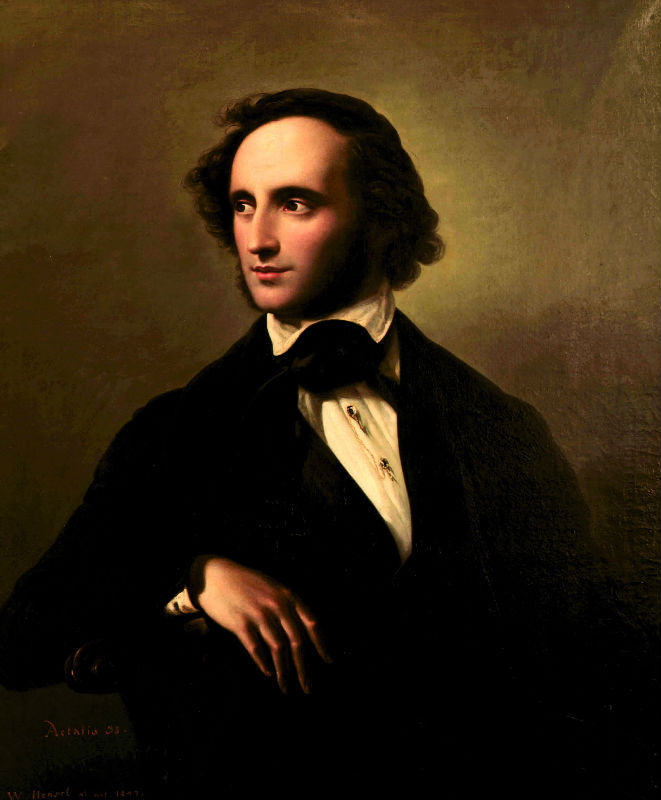
Portrait of Felix Mendelssohn by Wilhelm Hensel. Public domain, via Wikimedia Commons.

The Dallas Symphony Orchestra, for which I am the longtime annotator, is putting my program notes online again, on their elegant and well-appointed website, which means I no longer need to download pdfs (although I might end up doing this eventually, if the links wind up as broken as the ones on some of my other pages, a deficiency of which I am regrettably aware and that I have resolved to correct eventually). But in the meantime, yay! Even though I have a backlog of program notes (hundreds of batches by now, I’m thinking), I prefer talking about concerts before they happen, if at all possible, because that means a few more people who might not have known about the concert otherwise will benefit from the advance notice and buy tickets for what promises to be a transcendent experience.

I wrote about Mendelssohn’s Lobgesang Symphony, sometimes referred to as his Symphony No. 2, for the upcoming performance on March 2-5, at the glorious and acoustically superb Meyerson. Conducted by Paul McCreesh, it should be a fantastic concert: also on the program is Charles Hubert Hastings Parry’s Blest Pair of Sirens, a setting of a Milton poem. Along with the DSO and the DSO Chorus, the roster includes sopranos Susanna Phillips and Sari Gruber and tenor Nicholas Phan.

You can read my program notes here (just scan down a bit, and be sure to click on the little plus-sign icon on the right to read the full essay for each composer/work). I do retain the copyright, so if you have any interest in reprinting them, please email me at rene.saller@att.net

Mahler’s “Resurrection” Symphony

Gustav-Mahler

(Gustav and Alma Mahler)

Tonight Xian and I are going to Powell Hall to hear the SLSO and SLSO Chorus, conducted by new music director and all-around swell fellow Stéphane Denève, perform Mahler’s Symphony No. 2 (“Resurrection”). Although I didn’t write the notes for that concert—or any notes for the SLSO since the beginning of last season—I did feel inspired to post my program notes (dsopn121317 ) for Mahler’s “Resurrection” Symphony, originally published for a 2018 concert by the Dallas Symphony Orchestra at the Meyerson in Dallas.

I’m  going to be thinking about resurrections and rebirths (René means reborn, not that I chose my own name or anything), and possibly updating this site more regularly than every several months. I do have a lot of new chamber music writing that I could add, for a Tippet Rise concert season that just ended. Tonight, at Powell Hall, I’m going to be enjoying the dulcet tones of my friend Patty Kofron and her peerless colleagues in the SLSO Chorus. Patty also helped me purchase my tickets, with the usual stipulation that I’d much rather hear well than see well. She’s a gem, and I love talking with her about music as much as I enjoy dishing the musical dirt with her.

Since this is my personal blog I should probably take the opportunity to muse more about Mahler and bring up all the Mahlerian matters that I can’t discuss in the genre of Professional Notes I Get Paid For. If I were more of a Lester Bangsian annotator, I might bring up a decades-past experience involving an illicit psychedelic substance and a recording of Dietrich Fischer-Dieskau’s staggering interpretation of Mahler’s Kindertotenlieder. I might mention, or even reproduce, a minutely handwritten letter to a friend that I was writing while listening to this Children Death Songs cycle, over and over again, in the company of the aspiring composer I was living with, co-captain of our extremely boring-to-recount-and-yet-harrowing-to-experience trip). For several consecutive hours, neither of us wanted to listen to anything else except this song cycle about dead children, and I must thank the unnamed aspiring composer (and indirectly his professor) for hooking us up with the good stuff, that Dietrich Fischer-Dieskau recording, still my favorite, which was that night branded into my brain forever and ever amen. This is my favorite song in the cycle, the one I couldn’t quit hitting repeat on: “Nun will die Sonn so hell aufgehn.” If the link doesn’t work (I won’t seem to spring for the premium plan, all you profiteering WordPress executive scoundrels), just search Youtube or your favorite streaming service for Dietrich Fischer-Dieskau singing it, and you won’t regret it.

My mind was already primed for the over-the-top intensity verging on kitsch sentimentality of the dead-child concept, thanks partly to the great Dolly Parton and her vast canon of ballads about victimized children. Listen to a lot of classic country music (Dolly and the Louvin Brothers and Leadbelly and the Carter Family and George and Tammy), as I was doing at the time of my primal, hallucinogen-enhanced Mahler encounter, and the theme of dead kids is going to come up again and again, the same way it does in Renaissance poetry and my daily newspaper (St. Louis City, my heartbreaker of a hometown, maintains a high tally of murdered children, among them my husband’s recently murdered coworker’s recently murdered 10-year-old daughter). The details change, but the acute and particular grief of surviving a child is eternal. The pain of that loss barely seems endurable, and yet millions and millions have endured it or are enduring it right now. They can’t go on, they go on.  Mahler and Dolly and the Louvin Brothers and Shakespeare and Dickens and Beckett and Morrison, so many unsung others, turn our constant sorrow into a tribute, a consolation, a promise. A grief-stained joy almost seems possible.

Bernstein’s Symphony No. 3 (Kaddish)

C1tO0s+Z51S._CR0,0,3840,2880_._SL1000_.png

God on Trial

 by René Spencer Saller

 According to Jewish tradition, mourners recite the Kaddish to prove that they still praise God, even in their grief. Although the title for his third symphony explicitly refers to the Jewish prayer for the dead, Bernstein’s Kaddish focuses on the living. More specifically, it deals with our need to find meaning in an absurd and indifferent universe. In the emotionally fraught original text that shapes this dramatic narrative, Bernstein’s speaker and stand-in hectors God, who remains maddeningly silent; after much pleading and recrimination, the speaker eventually finds, if not peace, at least a way to go on.

In Judaism, arguing with God is a time-honored tradition. From the Old Testament’s Job to the American poet Allen Ginsberg (whose Beat epic Kaddish, dedicated to his late mother, had appeared a few years earlier), Jews had been taking the Creator to task for thousands of years. Although Bernstein expected that his Kaddish would be controversial, this challenging and underrated symphony left audience members and critics more perplexed than outraged. The score presented various difficulties, mostly owing to its outsize ambition. It juxtaposed a crisis of faith with an underlying faith in humanity; it dramatized the dream of peace in a world of strife as a struggle between harmony and dissonance. As the music shifts from sublime melodies to unsettling 12-tone excursions, the narrator accuses, negotiates, and consoles.

Written for a large orchestra, a full mixed choir, a boys’ choir, a soprano soloist, and a narrator, Kaddish asks tough existential questions and doesn’t settle for pat or reductive answers. Even though it is nominally a prayer for the dead, it never mentions death at all. Instead, it grapples with the human drive toward self-destruction, the elusiveness of faith, the infinite ways we betray and redeem one another. In English, Hebrew, Aramaic, and an even greater number of musical languages, the symphony builds a Babel, a welter of voices. Our civilization remakes itself in crisis; out of the welter of voices comes a fragile, tentative hope. The final movement ends with a resolution, but it’s an uneasy one. Whereas a conventional Christian Requiem would end on a note of triumph, Bernstein’s Kaddish closes with a dissonant, suspense-laden chord.

Bernstein was finishing up the scoring of Kaddish on November 22, 1963, when the U.S. President, whom he not only supported but considered a friend, was assassinated in downtown Dallas. Stunned and grief-stricken, he dedicated the symphony “to the beloved memory of John F. Kennedy.” A few weeks later, in Tel Aviv, Bernstein led the Israel Philharmonic Orchestra in the world premiere. A month after that, he conducted the Boston Symphony Orchestra in the U.S. premiere, with his spoken text recited by his wife, Felicia Montealegre. Dissatisfied with the recitation’s excessive length, he revised the work in 1977 and recorded it for the Deutsche Grammophon label. In 1981, he conducted a performance of Kaddish in Rome, where the Pope, who had recently survived an assassination attempt, was in attendance. In 1985, Bernstein led the European Community Youth Orchestra in a performance to commemorate the 40th anniversary of the bombing of Hiroshima. Do yourself a favor and track down the Youtube video. By the final movement, the Maestro’s face is wet with tears.

Copyright 2015 by René Spencer Saller

Fabio Luisi conducts the DSO

wm_grant_still-980x520

American composer and conductor William Grant Still

On April 18, 2019, Music Director Designate Fabio Luisi led the Dallas Symphony Orchestra in a concert featuring William Grant Still’s Poem for Orchestra (1944), Frank Martin’s Concerto for Wind Instruments, Percussion, and String Orchestra (1949), and Beethoven’s Symphony No. 7 (1813).

If you weren’t lucky enough to be present at the Meyerson, you can still check out the concert thanks to the wonders of Vimeo. The video is available to stream until May 23, 2019. It’s an exciting program, and the first two works aren’t programmed nearly often enough.

Here is a link to the concert. Remember to watch it before it disappears on May 23:

https://tinyurl.com/y2bvn482

Here are my program notes:

stillmartinbeethoven

And just for the hell of it, here is another photo of Still, because he’s a brown-eyed handsome man:

William-Grant-Still-010

Copland, Rachmaninoff, Hanson

howard-hanson-1

The time is nigh for a Howard Hanson revival.

This weekend (April 14 and 15), Music Director David Robertson leads the SLSO in works by Aaron Copland’s Fanfare for the Common Man, Serge Rachmaninoff’s Piano Concerto No. 2, and Howard Hanson’s Symphony No. 2, “Romantic” (the source of the most memorable tune from the Alien soundtrack). The soloist for the Rachmaninoff piano concerto is Simon Trpceski.

My program notes can be read here:

https://tinyurl.com/yb2w3wsn

If you can’t make it to Powell Hall in person, tune in Saturday night at 8 PM CST to St. Louis Public Radio. That’s FM 90.7 for those of you in the broadcast range, or you can click on the livestream here:

http://news.stlpublicradio.org/#stream/0

Tüür, Rautavaara, Rimsky-Korsakov, and Respighi

erkki-sven_tueuer_foto_muusikaelu.ee

(Estonian composer Erkki-Sven Tüür, whose Solastalgia receives its U.S. premiere in these concerts.)

On Saturday evening and Sunday afternoon (March 24 and 25), St. Louis Symphony Orchestra Resident Conductor Gemma New leads the SLSO in Rimsky-Korsakov’s Capriccio espagnol, Rautavaara’s Cantus Articus, Tüür’s Solastalgia (a U.S. premiere, featuring SLSO principal piccolo Ann Choomack), and Respighi’s Pines of Rome.

As usual, my program notes can be read on the SLSO website, in the Plan Your Visit section, but here is a somewhat longer version, minus the fancy formatting and cool photos:

TuurRespRaut

If you can’t make it to Powell Hall tonight or Sunday afternoon (good tickets are still available!), be sure to tune in to the live stream on St. Louis Public Radio at 8:00 PM Central Time:

http://news.stlpublicradio.org/#stream/0

Britten, Saint-Saëns, Vaughan Williams

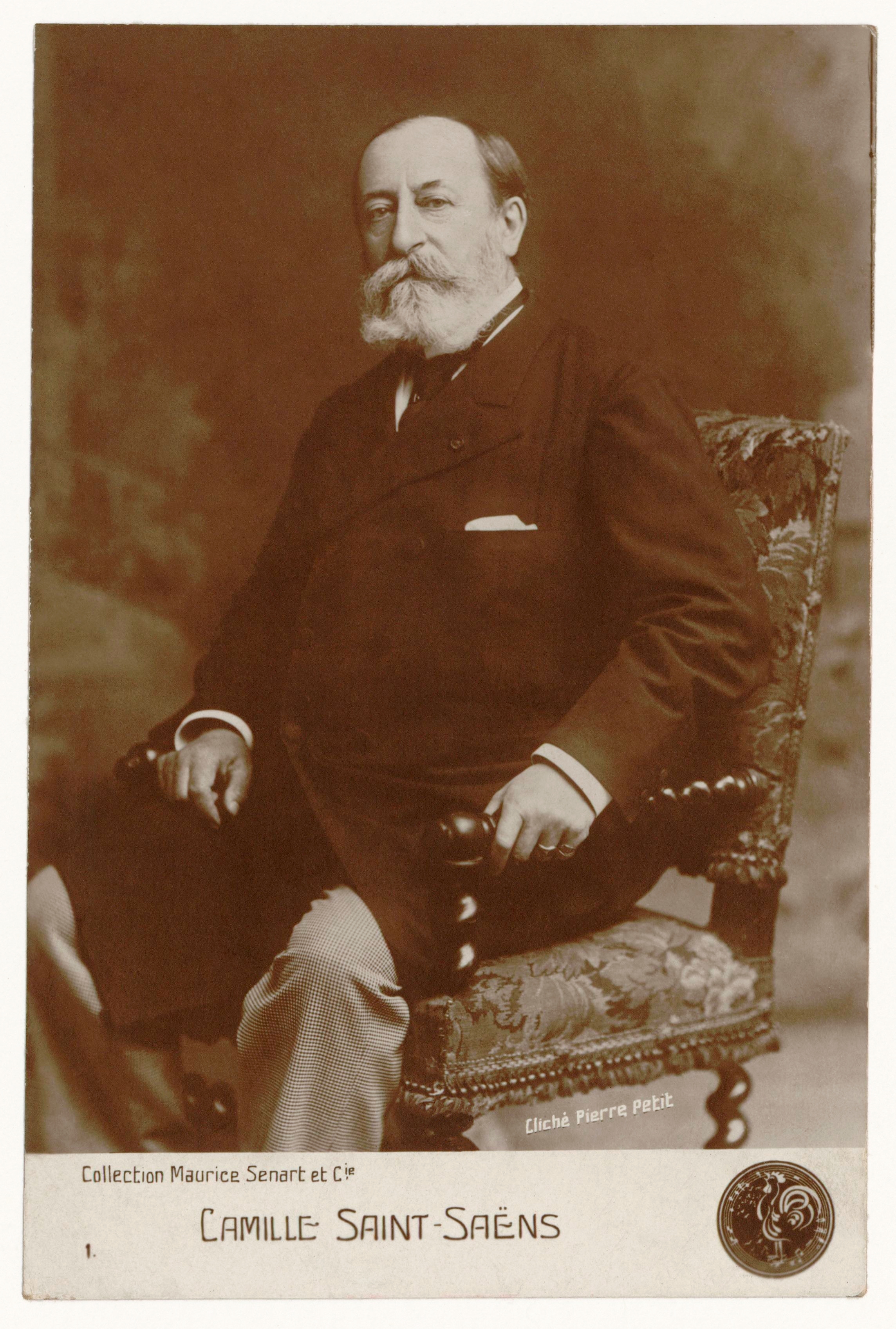
Camille_Saint-Saëns_in_1900_by_Pierre_Petit

This weekend (March 10 and 11), guest conductor Cristian Macelaru leads the St. Louis Symphony Orchestra in works by Britten, Saint-Saëns, and Vaughan Williams. Special guest soloist James Ehnes performs Saint-Saëns’s Third (and final) Violin Concerto.

My program notes begin on p. 26 and can be read here:

https://tinyurl.com/yc3ahfvv

Tune in at 8 PM CST to St. Louis Public Radio on Saturday, March 10. That’s FM 90.7 for those of you in the broadcast range, or you can click on the livestream here:

http://news.stlpublicradio.org/#stream/0

Smetana, Schumann, Tchaikovsky

USE-Schumann-Pic

This weekend (March 2 and 3), guest conductor Christian Arming leads the St. Louis Symphony Orchestra in works by Smetana, Schumann (pictured), and Tchaikovsky. Special guest soloist Rémi Geniet performs Tchaikovsky’s Piano Concerto No. 1.

Tune in at 8 PM CST to St. Louis Public Radio. That’s FM 90.7 for those of you in the broadcast range, or you can follow the livestream here:

http://news.stlpublicradio.org/#stream/0

My program notes can be read here:

https://tinyurl.com/yclz9c96


Bernstein and Orff

Berstein-90efb66b

This weekend guest conductor Bramwell Tovey leads the St. Louis Symphony Orchestra and St. Louis Symphony Chorus in Leonard Bernstein’s Chichester Psalms and Carl Orff’s Carmina Burana.

If you can’t make it to the live concert at Powell Hall tonight, tune in at 8 PM CST to St. Louis Public Radio. That’s FM 90.7 for those of you in the broadcast range, or you can follow the livestream here:

http://news.stlpublicradio.org/#stream/0

My program notes can be read on the SLSO website, in the Plan Your Visit section, but here’s a somewhat longer version for those who enjoy extraneous details.

BernsteinOrff